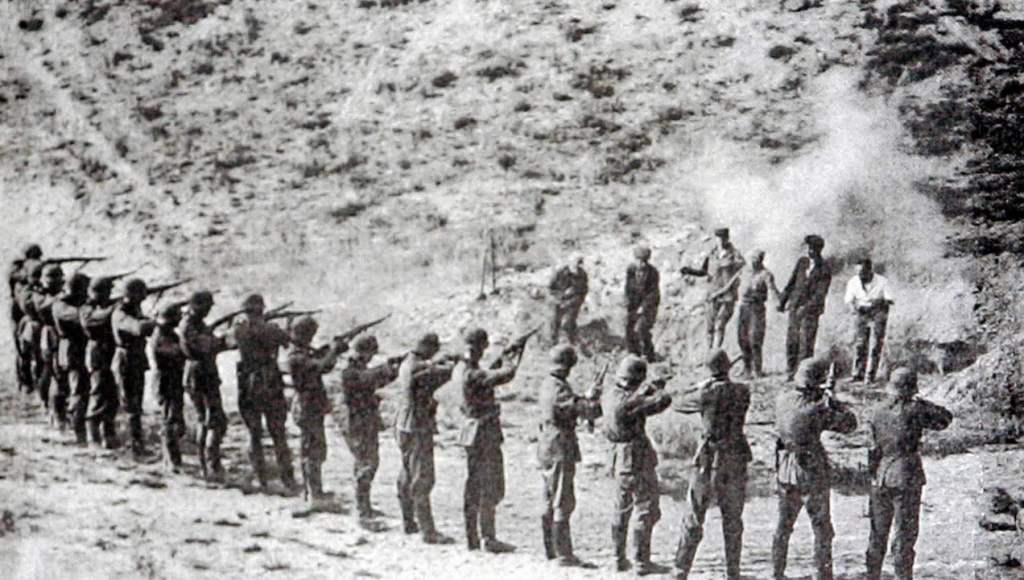
Image: German soldiers are shown during the execution of villagers and refugees near Sant’Anna di Stazzema on May 12, 1944. (italtimes.it)
On this day in history, the Sant’Anna di Stazzema massacre occurred in the village of Sant’Anna di Stazzema in Tuscany, Italy, during World War II. On August 12, 1944, the Waffen-SS, with the aid of the Brigate Nere, a Fascist paramilitary group organized and run by the Italian Republican Fascist Party in Northern Italy, murdered about 560 local villagers and refugees, including over a hundred children and subsequently burned their bodies. These crimes have been categorized as acts of terrorism by the Military Tribunal of La Spezia and the Italian courts.
On the morning of August 12, 1944, German troops of the 2nd Battalion of SS Panzergrenadier Regiment 35 of 16th SS Panzergrenadier Division Reichsführer-SS, commanded by SS-Hauptsturmführer Anton Galler, entered the mountain village of Sant’Anna di Stazzema. With them came some fascists of the 36th Brigata Nera Benito Mussolini based in Lucca, dressed in German uniforms.
The soldiers immediately gathered up the villagers and refugees, securing hundreds of them in a number of barns and outbuildings before methodically executing them. The killings were committed mainly by shooting groups of people with machine guns or by gathering them into basements and other enclosed spaces and throwing in hand grenades. At the 16th-century local Catholic church, Father Fiore Menguzzo (awarded the Medal for Civil Valor posthumously in 1999) was murdered, after which the soldiers shot and killed the 100 people assembled there. In all, the victims included over 100 children (the youngest of whom, Anna Pardini, was only 20 days old), as well as eight pregnant women (one of whom, Evelina Berretti, had her womb cut with a bayonet and her baby pulled out and killed independently).
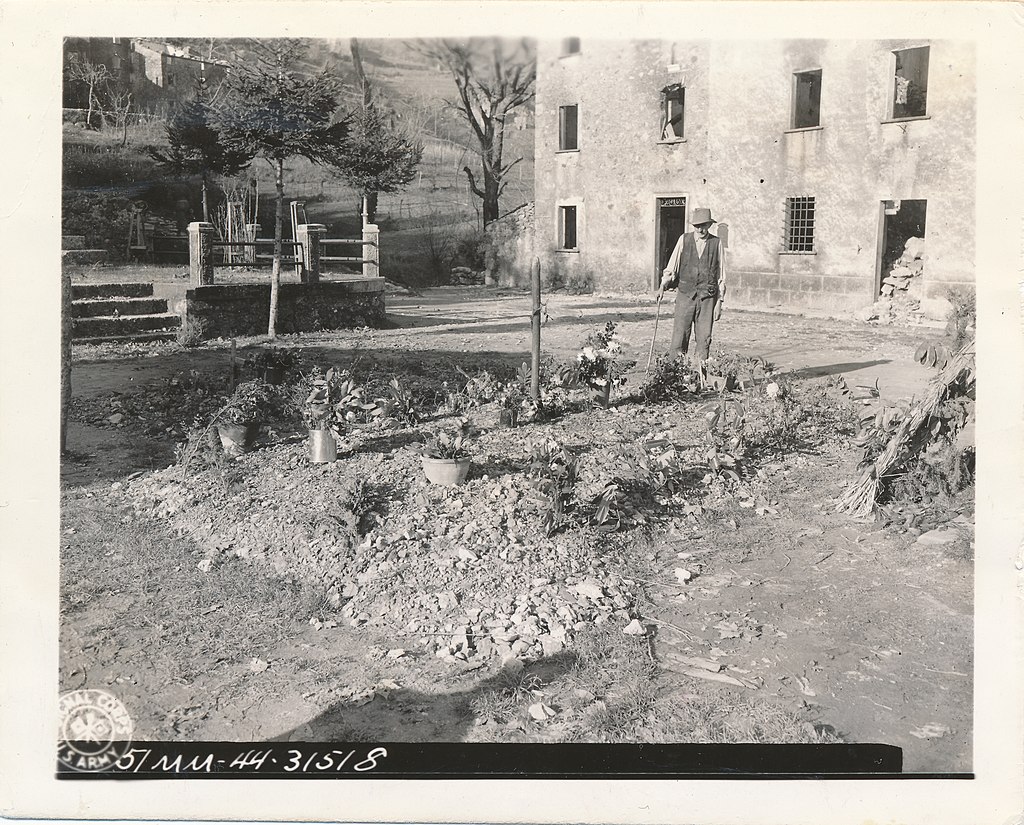
Image: An elderly survivor at the village on 14 December 1944 (Wikimedia Commons.)
After other people were killed in the village, their corpses were set on fire (at the church, the soldiers used their pews for a large fire to dispose of the bodies). The livestock were also eradicated, and the whole village was burned to the ground. This entire event occurred over three hours. The SS men then assembled outside the burning Sant’Anna and ate lunch.
After the war, the church was reconstructed. The Charnel House Monument and the Historical Museum of Resistance were erected nearby. Stations of the Cross show scenes from the massacre along the trail from the church to the central memorial site—the National Park of Peace- created in 2000. The massacre inspired the novel Miracle at St. Anna by James McBride and Spike Lee’s film of the same title that was based on it.
Only Max Simon, the divisional commander, was prosecuted for this massacre before July 2004, when a trial of ten former Waffen-SS officers and NCOs living in Germany was held before a military court in La Spezia, Italy. On June 22, 2005, the court found the accused guilty of participating in the murders and sentenced them in absentia to life in prison.
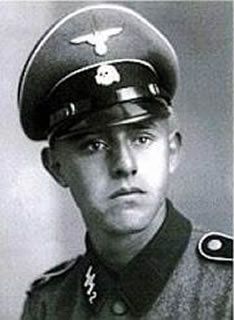
Image: Gerhard Sommer, at the time of the events, SS company commander of the 35th Grenadier regiment, one of the officers responsible for the massacre of Sant’Anna di Stazzema. (Wikimedia Commons.)
However, extradition requests from Italy were refused by Germany. In 2012, German prosecutors stopped their inquiry into the actions of 17 unidentified former SS soldiers (eight still alive) assigned to the unit that took part in the massacre because there was no proof. The statement said: “Belonging to a Waffen-SS unit deployed to Sant’Anna di Stazzema cannot replace the need to prove individual guilt. Rather, for every defendant it must be proven that he took part in the massacre, and in which form.” The mayor of Sant’Anna di Stazzema, Michele Silicani (a survivor who was 10 when the massacre happened), called the verdict “a scandal” and said he would ask Italy’s justice minister to petition Germany to reopen the case. German deputy foreign minister Michael Georg Link stated that “while respecting the independence of the German justice system,” it was not possible “to ignore that such a decision causes deep dismay and renewed suffering to Italians, not just survivors, and relatives of the victims.”
ON SALE NOW!!!
History Daily: 365 Fascinating Happenings Volume 1
In the United States:
In Canada:
 History Daily With Francis Chappell Black
Leave a comment