“HOUND DOG” IS RECORDED FOR THE FIRST TIME BY BIG MAMA THORNTON. AUGUST 13, 1952
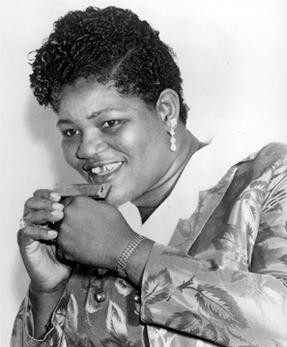
Image: Big Mama Thornton (Wikimedia Commons)
Elvis Presley’s “Hound Dog” (1956) is one of Rock and Roll’s most identifiable songs. It’s a song so closely associated with Presley that many have incorrectly accepted that Presley recorded it first. The story of the tune that gave Elvis his longest running #1 hit (11 weeks) in 1956 commenced four years before, when “Hound Dog” was recorded for the very first time by R&B singer Ellie Mae “Big Mama” Thornton in Los Angeles, California.
Big Mama Thornton, a native of Montgomery, Alabama, gained most of her experience on the R&B circuit in the 1940s after beginning her professional career in 1941 at 14. In 1951, she signed her first record deal with Peacock Records and was soon matched with bandleader Johnny Otis, who had Thornton meet up with his band in California. It was there, in late 1952, that Otis requested that two young songwriters write something specifically for Thornton. The songwriters were Jerry Lieber and Mike Stoller, who would have substantial music careers, especially in R&B and early rock and roll, through their writing for bands like the Drifters and the Coasters. Hits like “Jailhouse Rock,” “Yakkity Yak,” “Love Potion No. 9″, “Charlie Brown,” and “Stand by Me” were still to come from Lieber and Stoller when they produced for Otis a country blues song called “Hound Dog.”
On August 13, 1952, Big Mama Thornton and the Johnny Otis Band recorded “Hound Dog,” it became a massive hit on the R&B charts, staying at #1 for seven weeks. Presley’s inspiration to record “Hound Dog” did not emanate from Thornton, though; it came from a new arrangement by a singer called Freddie Bell, who rewrote the original lyrics to include the lines “Cryin’ all the time” and “You ain’t never caught a rabbit.” During his first Las Vegas concert in early 1956, Elvis Presley heard Freddie Bell perform the reworked “Hound Dog.” He added it to his set list without delay. The song is viewed as an influential beginning of rock-and-roll, mainly because of its use of the guitar as the main instrument.
BATTLE OF BLENHEIM
On August 13, 1704, Battle of Blenheim (Second Battle of Höchstädt): A combined British, German and Dutch army led by John Churchill, 1st Duke of Marlborough, decisively beats the French and Bavarians.
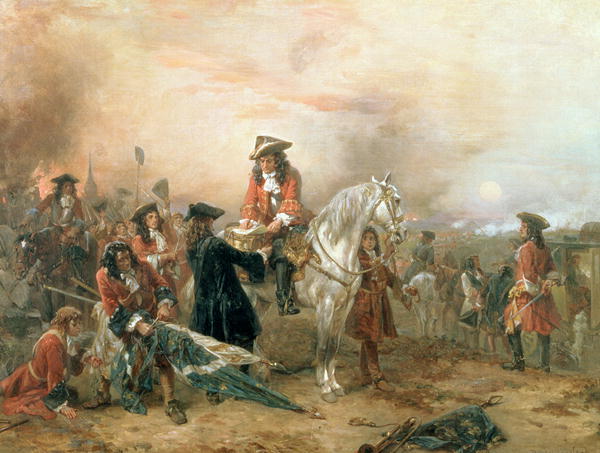
Image: Duke of Marlborough signing the Despatch at Blenheim (Wikimedia Commons)
The Battle of Blenheim was fought on August 13, 1704, and was a pivotal battle of the War of the Spanish Succession. The devastating Allied victory guaranteed the protection of Vienna from the Franco-Bavarian army, thus foiling the downfall of the reorganized Grand Alliance.
Louis XIV of France wanted to defeat the Holy Roman Emperor, Leopold, and push him out of the war by capturing Vienna, the Habsburg capital, and gaining a favorable peace agreement. The threat to Vienna was immense: Maximilian II Emanuel, Elector of Bavaria, and Marshal Ferdinand de Marsin’s forces in Bavaria threatened from the west, and Marshal Louis Joseph de Bourbon, duc de Vendôme’s large army in northern Italy, was seen as a danger with a possible assault through the Brenner Pass. Vienna was also under pressure from Rákóczi’s Hungarian revolt from its eastern approaches. Understanding the threat, the Duke of Marlborough decided to relieve the peril to Vienna by marching his army south from Bedburg to help uphold Emperor Leopold within the Grand Alliance.
A mixture of deceit and skilled organization – meant to hide his real destination from everybody – allowed Marlborough to travel 400 km (250 mi) unopposed from the Low Countries to the River Danube in five weeks. After capturing Donauwörth on the Danube, Marlborough tried to engage Maximilian’s and Marsin’s army before Marshal Camille d’Hostun, Duc de Tallard, could move reinforcements through the Black Forest. The Franco-Bavarian commanders were unwilling to fight until they had sufficient forces, and Marlborough was unsuccessful in attempting to force a fight. When Tallard arrived to help Maximilian’s army, and Prince Eugene of Savoy also arrived with reinforcements for the Allies, the two armies finally clashed at the small village of Blindheim, where the English “Blenheim” originated.
The Battle of Blenheim altered the course of the war, favoring the French and Spanish Bourbons up to that point. Although the battle did not win the war, it prevented a dreadful loss for the Grand Alliance and changed the war’s momentum, ending French plans of pushing Emperor Leopold out of the war. The French suffered devastating casualties in the battle, including their commander-in-chief, Tallard, who was taken prisoner to England. Before the 1704 campaign finally ended, the Allies had taken several towns in preparation for the following year’s campaign into France itself. This offensive never happened because the Grand Alliance had to divert its army to defend Liège from a French counter-offensive. The war would continue for another decade before finally ending in 1714.
CAPTURE OF MANILA
On August 13, 1898, American forces under Admiral George Dewey captures Manila during Spanish–American War.
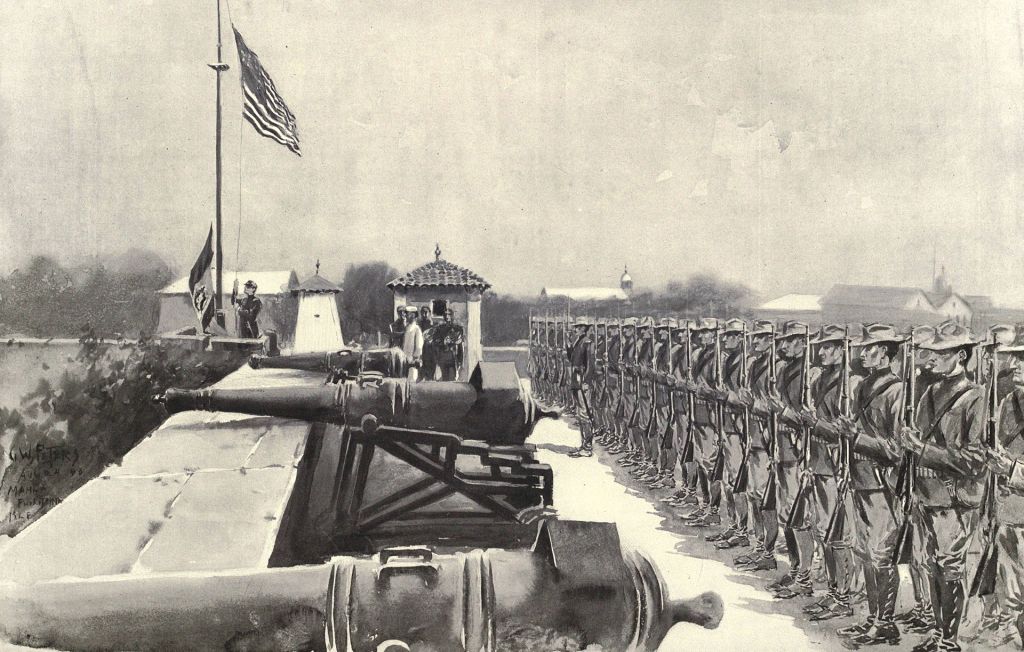
Image: Raising the American flag over Fort Santiago, Manila, on the evening of August 13, 1898. From Harper’s Pictorial History of the War with Spain, Vol. II, published by Harper and Brothers in 1899. (Wikimedia Commons).
The Battle of Manila, sometimes called the Mock Battle of Manila, took place in Manila on August 13, 1898, at the end of the Spanish–American War, four months after the decisive victory by Commodore Dewey’s Asiatic Squadron at the Battle of Manila Bay. The combatants were Spanish forces led by Governor-General of the Philippines Fermín Jáudenes and American forces led by United States Army Major General Wesley Merritt and United States Navy Commodore George Dewey. The American military was supported by units of the Philippine Revolutionary Army, led by Emilio Aguinaldo.
The battle is sometimes called the “Mock Battle of Manila” because the commanders of the Spanish and American forces, who were technically at war, secretly and jointly planned the fake battle to transfer control of the city center from the Spanish to the Americans while keeping the Philippine Revolutionary Army away from the city center, and to prevent Filipino forces from defeating Spain at the final stretch of the Philippine-Spanish War. By doing so, Spain, a white country, would not be humiliated internationally for losing to Filipino forces who have brown skin. The battle left American forces in control of the center of Manila, surrounded by Philippine revolutionary forces, creating the conditions for the Battle of Manila of 1899 and the beginning of the Philippine–American War.
 History Daily With Francis Chappell Black
Leave a comment