On this day in history, Francis Blandy, the father of eighteenth-century murderer Mary Blandy, falls into a coma and dies outside London, England. Later that night, Blandy’s daughter Mary offered one of the family’s servants a large sum of money to help her get to France immediately. Mary was forced to flee when he refused, but she was chased down and caught by neighbors who had heard that Blandy had been poisoned.
History Daily: 365 Fascinating Happenings Volume 1 & Volume 2 – August 14, 1751
Mary Blandy was unusual in the annals of female criminal history at the time – she was middle-class and educated. Her father had been a prosperous lawyer and the Town Clerk of Henley on the Thames in Oxfordshire at the time of his murder. So, Mary lived a comfortable lifestyle at the family home on Hart Street. Francis had unwisely advertised a dowry of ten thousand pounds – a considerable sum for those days for the man who married Mary. This attracted many suitors, all promptly rejected except the Honorable Captain William Henry Cranstoun, who was initially deemed acceptable. Cranstoun was born the son of a Scottish nobleman and was therefore seen as a suitable match for Mary. By all accounts, he was not a physically attractive person but seems to have been able to fool Mary completely. All went well, to begin with, but then problems arose when it was discovered that Cranstoun was, in fact, still married, having wed one Anne Murray in 1744 in Scotland, although he had been living in the Blandy household for a year. Mary’s father became very unhappy about Cranstoun and began to see him for what he was. To get over Francis’ hostility, Cranstoun persuaded Mary to give her father powders which he described as an ancient “love philtre,” and he assured her it would make Francis like him.
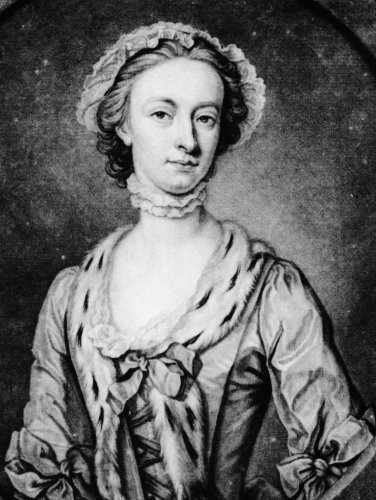
Image: Mary Blandy 1751 (Wikimedia Commons)
He knew what the powders contained but presumably didn’t mind letting his girlfriend murder her father to get the large dowry. Ironically, Francis Blandy’s estate was only worth a mere 4,000 pounds. Under the law, this would have automatically passed to him if they married.
Mary seemed to be taken in by Cranstoun and administered these powders, which were, in fact, arsenic, in her father’s tea and gruel. He became progressively more ill. The servants had also become sick from eating some of the leftovers, although they all recovered. None of this seemed to register with Mary – that the powders might be the cause of the problem.
When her father was seriously ill and near death, Mary sent for the local doctor, who advised her that she could be held responsible for poisoning him, so she quickly burned Cranstoun’s love letters and disposed of the remaining powders. Susannah Gunnell, the housemaid, had the presence of mind to rescue some of the powder from the fire when Mary tried to destroy the evidence and take it to a chemist for analysis, who found that it was arsenic. Arsenic is a cumulative poison and only kills when the levels have built up in the body.
Francis finally died on August 14, 1751, and Mary was arrested and kept under house arrest, under the care of the parish clerk, Edward Herne. Cranstoun deserted Mary at the first sign of trouble and headed for France before he could be apprehended. The coroner issued a warrant for Mary’s arrest on August 16, and she was committed to the county jail in Oxford.
She came to trial at Oxford Assizes on March 3, 1752. The trial was fascinating because it was the first time medical evidence had been given in a court of law on a charge of murder by poisoning. Although Dr. Anthony Addington had not been able to analyze Francis’ organs for arsenic as the technology did not yet exist, he convinced the court, based on observed comparison, that the powder Mary had put in her father was indeed arsenic. Mary maintained that she did not poison her father but had given him a powder – she claimed: “which had been given me with another intent.” The servants gave evidence against her.
Not surprisingly, at the end of the one-day, 13-hour trial, the jury swiftly convicted her of murder, and she received the mandatory death sentence. There was a lapse of six weeks between conviction and execution.
Mary was the main story in the press in the early part of 1752. She corresponded with various people, including another woman under sentence of death, Elizabeth Jeffries (convicted with her lover John Swan and hanged at Epping Forest in Essex on March 28, 1752, for the murder of her master and his uncle).
Mary’s execution took place in the Castle Yard at Oxford on April 6, 1752, from a gallows consisting of a wooden beam placed between two trees. For her execution, she chose “a black crepe sack, with her arms and hands ty’d with black paduasoy ribbons.” She behaved with bravery and penitence to the end and was attended by Reverend Swinton. She suffered in front of a relatively small crowd to whom she protested her innocence before being turned off.
Her last request to the officials was, “for the sake of decency, gentlemen, don’t hang me high.” She was naturally modest and concerned that the young men would look up her skirt if she were too high. She was then made to climb a ladder draped in black cloth while the hangman climbed a ladder beside her. Mary was noosed, and her hands were tied in front to allow her to hold her prayer book. She covered her face with a large handkerchief. Her legs were not tied together.
It had been agreed that she would drop the book when she had finished her prayers, signaling the hangman to turn the ladder over and “turn her off,” as the saying went. She died without a struggle. She was taken down after half an hour and taken back to the castle by six men. She was buried in the early hours of the following day between her mother’s and father’s graves at Henley Parish Church. There is now little trace of her grave, and it is said that her ghost haunts the Westgate and the Little Angel Inn.
Not long after Mary was executed, Cranstoun is said to have died in poverty in France.
ON SALE NOW!!!
History Daily: 365 Fascinating Happenings Volume 1
In the United States:
In Canada:
Subscribe to History Daily with Francis Chappell Black for daily updates:
 History Daily With Francis Chappell Black
Leave a comment