BABE RUTH DIES
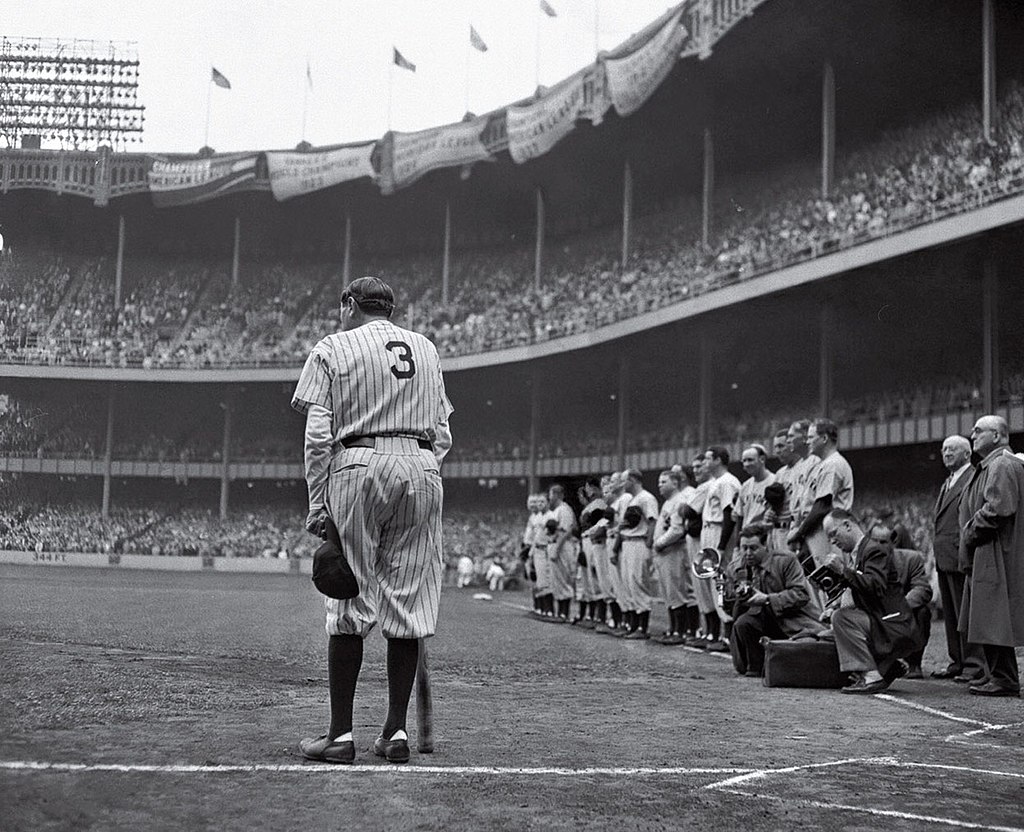
Image: Ruth at Yankee Stadium prior to the Yankees’ retirement of his jersey number. (Wikimedia Commons.)
On August 16, 1948, baseball icon George Herman “Babe” Ruth died from cancer in New York City. Following his death, his body lay in state at Yankee Stadium, and thousands of people paid their last respects. He was buried in Hawthorne, New York.
Ruth began his major league career in Baltimore in 1914. That same year, he was traded to the Boston Red Sox and proved himself to be an impressive left-handed pitcher and batter during the next five years. In 1919, he was sold to the New York Yankees, where he played outfield to better utilize his unique hitting talents. At a time when baseball was undergoing the shame of the Black Sox scandal, Ruth almost single-handedly reclaimed the sport’s popularity, hitting an astounding 60 home runs during the 1927 season and leading the Yankees to seven pennants. Yankee Stadium opened in 1923 and came to be called “the House that Ruth Built.”
However, the Babe also made headlines for his charitable work, such as visiting sick children in hospitals. In 1935, he retired from baseball, having hit a record 714 home runs. In 1946, Ruth was diagnosed with throat cancer, but doctors could do nothing to save him. Early the following year, his treatment ended. On June 13, 1948, a uniformed Ruth appeared at Yankee Stadium one last time to retire his number. On August 16, he died of cancer at the age of 53.
THE BATTLE OF BENNINGTON
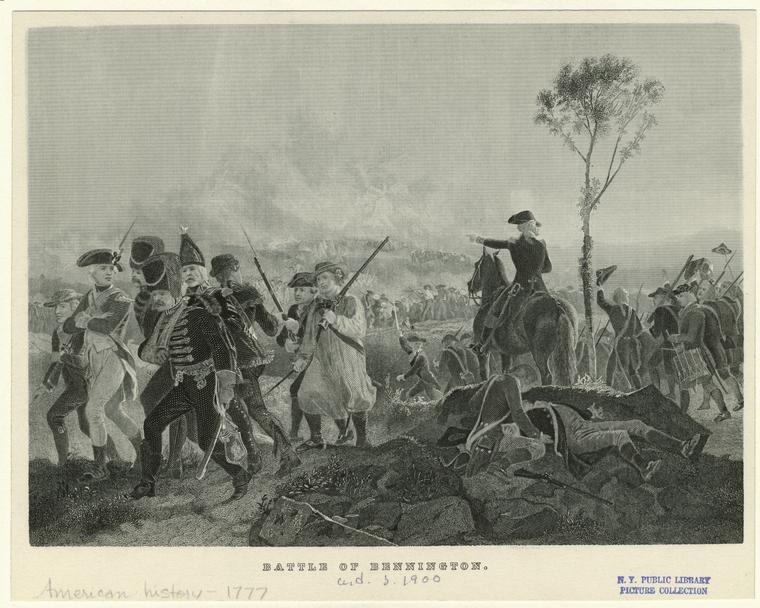
Image: The Battle of Bennington, August 16, 1777. Wikimedia Commons
On August 16, 1777, American militiamen defeated the British at the Battle of Bennington near Vermont during the American Revolutionary War.
The Battle of Bennington occurred during the American Revolutionary War. It was part of the Saratoga campaign, which took place on August 16, 1777, on a farm in Walloomsac, New York, about 10 miles (16 km) from Bennington, Vermont. An American force of 2,000 men, mostly New Hampshire and Massachusetts militiamen, led by General John Stark, and reinforced by Vermont militiamen led by Colonel Seth Warner and members of the Green Mountain Boys, firmly defeated a unit of General John Burgoyne’s army led by Lieutenant Colonel Friedrich Baum and supported by additional forces under Lieutenant Colonel Heinrich von Breymann.
Baum’s detachment comprised 700 men from the Brunswick dragoons, Canadians, Loyalists, and Native Americans. Burgoyne sent him to raid Bennington for horses, draft animals, provisions, and other supplies. They believed the town was only lightly protected; Burgoyne and Baum were unaware that a force of 1,500 militiamen was positioned there. After a rain-induced standoff, Stark’s men encircled Baum’s position, taking many prisoners and killing Baum. Reinforcements from both sides arrived as Stark and his men were cleaning up, and the battle restarted, with the Americans driving away the British reinforcements, causing massive casualties.
The battle was a major strategic success for the revolutionary cause and is considered part of the turning point of the Revolutionary War; it reduced Burgoyne’s army in size by nearly 1,000 men, led his Native American supporters to abandon him, and deprived him of much-needed supplies, such as horses for his cavalry regiments, draft animals and provisions, all factors that contributed to Burgoyne’s eventual defeat at Saratoga. The victory galvanized colonial support for the independence movement and performed a crucial role in bringing France into the war on the American side.
RINGO STARR BECOMES THE BEATLES’ NEW DRUMMER

Image: Ringo Starr (Wikimedia Commons)
On August 16, 1962, Ringo Starr replaced Pete Best as the Beatles’ drummer following the band’s first recording session. The Beatles had invited Best to join the band on August 12, 1960, on the eve of the group’s first Hamburg season of club dates. Best was fired at the request of John Lennon, Paul McCartney, and George Harrison, and Starr replaced him two days later.
ON SALE NOW!!!
History Daily: 365 Fascinating Happenings Volume 1
In the United States:
In Canada:
 History Daily With Francis Chappell Black
Leave a comment