On this day in history, American spy pilot Francis Gary Powers is put on trial in Moscow for espionage against the Soviet Union after his ultra-sophisticated Lockheed U-2 high-altitude reconnaissance aircraft was shot down over Sverdlovsk in the Ural Mountains on May 1, 1960. Powers pleaded guilty to the charges and was sentenced to 10 years imprisonment – three in prison and seven in a prison colony. After less than 24 months of incarceration, Powers was exchanged for a captured Soviet agent in the first-ever U.S. – USSR “spy swap.”
History Daily: 365 Fascinating Happenings Volume 1 & Volume 2 – August 17, 1960
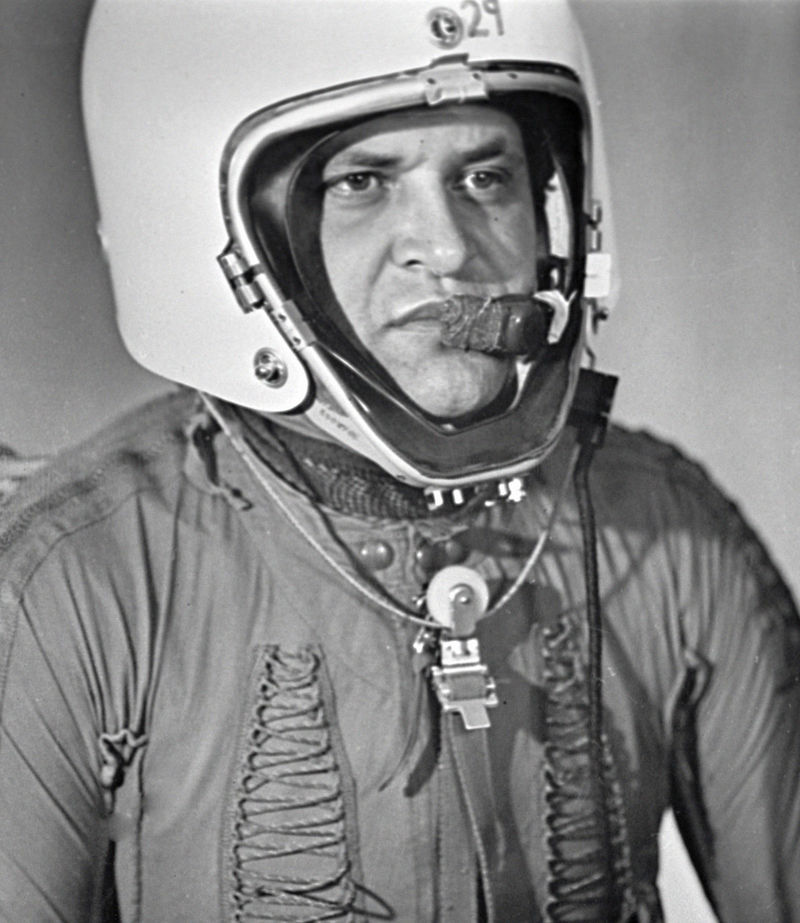
Image: Francis Gary Powers wearing special pressure suit for stratospheric flying was an American spy whose Lockheed U-2 reconnaissance plane was shot down by a Soviet surface-to-air missile outside Sverdlovsk. (Wikimedia Commons.)
An international diplomatic crisis began in May 1960 when the USSR shot down an American U-2 spy plane in Soviet air space and captured its pilot, Francis Gary Powers. Faced with the evidence of his nation’s espionage, President Dwight D. Eisenhower was forced to acknowledge to the Soviets that the U.S. Central Intelligence Agency (CIA) had been conducting spy missions over the USSR for several years. The U-2 spy plane incident increased tensions between America and the Soviets during the Cold War. The primary political clash between the superpowers and their allies started after World War II.
Fearful over the rapid developments in military technology by his Communist rivals in the USSR, President Dwight D. Eisenhower, president from 1953 to 1961, sanctioned a plan to gather information about Soviet military capabilities and intentions. High-altitude U-2 spy planes began reconnaissance flights over the USSR in 1956, giving the U.S. its first comprehensive look at Soviet military facilities.
Eisenhower was pleased with the information gathered from the flights. Photographs from the spy planes showed Soviet nuclear capabilities were notably less advanced than had been claimed by Soviet leader Nikita Khrushchev. Eisenhower learned that the U.S., rather than enduring a shortage of weapons or a: missile gap,” as many politicians claimed, had nuclear forces far superior to those of the Soviet Union.
The Soviets knew the reconnaissance flights because they could spot the spy planes on radar. For nearly four years, however, the USSR was powerless to stop them. Flying more than 13 miles above the ground, the U-2 aircraft were initially unreachable by Soviet jets and missiles. Nevertheless, by the spring of 1960, the USSR had created a new Zenith surface-to-air missile with a more extended range. On May 1, that new weapon locked onto a U-2 piloted by a 30-year-old CIA pilot Francis Gary Powers.
Flying through the thin atmosphere at the edge of space, Powers carried out top-secret missions, flying a U-2 spy plane over the USSR to photograph military installations. Powers’ nine-hour flight would have taken him from Peshawar, Pakistan, to a landing zone at the Boda military airfield in Norway if all had gone according to plan. This mission went highly awry.
As Powers flew over Sverdlovsk (present-day Yekaterinburg, Russia), a Soviet surface-to-air missile detonated near his plane, causing it to drop precipitously. Another missile scored a direct hit, and Powers and his aircraft began to fall. The pilot bailed out, but when his parachute landed, he was surrounded by Soviet forces. Powers touched down in the middle of a major diplomatic crisis.
On May 5, Khrushchev announced that the Soviet military had shot down an American spy plane, but he never mentioned capturing Powers. Officials in the Eisenhower administration believed the aircraft had been destroyed in the crash, so they responded that only a weather plane had inadvertently flown off course. The Soviet leader quickly refuted that story by showing a photograph of the imprisoned Powers and evidence recovered from the wreckage that proved it was a surveillance plane.
The U-2 spy plane incident happened at a critical point in U.S. – Soviet relations. Eisenhower and Khrushchev were slated to meet with the leaders of France and Great Britain at a conference in Paris on May 14. The American president had hoped the Paris Summit would produce new agreements on nuclear arms production and testing. Still, he recognized that the embarrassing U-2 crisis posed a potential obstacle to that goal.
Before the Paris meeting began, the Eisenhower administration took responsibility for the spy flights and conceded that the weather plane explanation was invalid. But the president’s confession did little to save the summit. The U-2 incident had persuaded Khrushchev that he could no longer trust or work with Eisenhower, and the Soviet leader left the Paris conference only hours after it started. The Soviets abandoned talks on nuclear disarmament the following month as well. During Eisenhower’s last year in the White House, these events brought relations between America and the USSR to a new low. They set the stage for added confrontations during the administration of Eisenhower’s successor, John F. Kennedy.
While world leaders argued about the spy flights, Powers remained in a Soviet prison. On August 17, 1960, legal proceedings began, and he was charged with espionage, convicted, and sentenced to 10 years in prison. In the end, he spent less than two years behind bars. Powers received his freedom in February 1962, when he and Soviet agent Rudolf Abel became the subjects of the first “spy swap” between America and the Soviet Union.
Powers received a cold reception when he returned to the United States. Initially, he was criticized for failing to activate his aircraft’s self-destruct charge to destroy classified parts of his plane before his capture. He was criticized for not using his CIA-issued “suicide pill” to kill himself. Powers appeared before a Senate Armed Services Select Committee hearing, where it was found that Powers had conformed to orders, had not disclosed any critical intelligence to the Russians, and had acquitted himself “as a fine young man under dangerous circumstances.” Powers was killed in a helicopter crash while covering brush fires for a T.V. station in Los Angeles in 1977. He was 47 years of age.
ON SALE NOW!!!
History Daily: 365 Fascinating Happenings Volume 1
In the United States:
In Canada:
Subscribe to History Daily with Francis Chappell Black to receive daily updates:
 History Daily With Francis Chappell Black
Leave a comment