ROANOKE COLONY ABANDONED

Image: 19th-century illustration depicting the discovery of the abandoned colony, 1590. (Wikimedia Commons.)
On August 18, 1590, John White, the governor of the Roanoke Island colony in present-day North Carolina, returns from a trip to England to find the settlement abandoned. White found no evidence of the whereabouts of the 100 colonists he left behind and no indication of violence. Among the missing were Ellinor Dare, White’s daughter, and Virginia Dare, White’s granddaughter and the first English child born in America. August 18 was to have been Virginia’s third birthday. The only clue to their strange disappearance was the word “CROATOAN” carved into the palisade wall encircling the settlement. White assumed the colonists had moved to Croatoan Island, about 50 miles away, but a later search found nothing.
The Roanoke Island colony, the first English settlement in the New World, was founded by English explorer Sir Walter Raleigh in August 1585. The first Roanoke colonists did not do well, suffering from a lack of food and Indian attacks, and in 1586 they returned to England aboard a ship captained by Sir Francis Drake. In 1587, Raleigh dispatched another group of 100 colonists under John White. White returned to England to gather more supplies, but the war with Spain delayed his return to Roanoke. By the time he finally returned in August 1590, everyone had disappeared.
In 1998, archaeologists studying tree-ring data from Virginia found that extreme drought conditions existed between 1587 and 1589. These conditions would have added to the reasons for the failure of the “Lost Colony,” but where the settlers went after they left, Roanoke remains a mystery to this day. Some believe they had become assimilated into a local Native American tribe known as the Croatans.
AARON MONTGOMERY WARD ISSUES HIS FIRST “CATALOG” FOR HIS MAIL-ORDER BUSINESS

Image: Aaron Montgomery Ward. (Wikimedia Commons.)
On August 18, 1872, Aaron Montgomery Ward issued the first “catalog” for his mail-order business, a one-sheet document listing 163 available items.
Aaron Montgomery Ward (February 17, 1843 – December 7, 1913) was an American businessman based in Chicago who made his fortune through mail order for retail sales of general merchandise to rural customers. In 1872 he founded Montgomery Ward & Company, which became nationally recognized.
Ward, a traveling salesman, was troubled over the difficulty of many rural Midwest Americans who were, he felt, being overcharged and under-served by many of the small-town stores on whom they had grown to rely for their general merchandise. He opened his first mail-order house in 1872. By heavily using the railroads centered on Chicago and associating his business with the non-profit Patrons of Husbandry (the Grangers), Ward offered rural customers a far more extensive selection than generally available in small towns and at a lower price. Unlike local merchants, Ward did not haggle and offered no credit. His free catalog, printed by the most modern methods, was widely distributed to customers, allowing them to view images of consumer goods and imagine how they might be used. Later, Ward used the Post Office’s Rural Free Delivery service; he lobbied for a parcel post system in 1906. The early 20th century was the glory days of mail orders, and Ward’s had become an American tradition, along with its rival Sears Roebuck.
AMERICAN WOMEN DEMAND THEIR RIGHTS

Image: Febb Burn, Harry Burn’s mother. (Wikimedia Commons.)
On August 18, 1920, State Representative Harry Burn (age 24) cast the deciding vote in Tennessee’s and thus America’s ratification of the 19th Amendment to the constitution allowing women’s Suffrage after reading a letter from his mother.
The Nineteenth Amendment, regarding women’s Suffrage, was proposed by Congress on June 4, 1919. The Amendment could only become law with the ratification of at least thirty-six of the forty-eight states. By the summer of 1920, thirty-five of the forty-eight states had ratified the Amendment, with four more called upon to hold legislative voting sessions on the issue. Three of those states refused to call special sessions, but Tennessee agreed to do so. This session was called to meet in August 1920. Joe Hanover led the effort to pass the legislation in the House. Banks Turner and Burn were two critical votes that ultimately tilted the balance to ratification.
Burn had initially intended to vote for the Amendment. After being pressured by party leaders and receiving misleading telegrams from his constituents telling him his district was overwhelmingly opposed to woman suffrage, he decided to align with the anti-suffragists. However, a letter from his mother asking him to vote in favor of the Amendment helped change his mind: Febb Ensminger Burn of Niota had written a long letter to her son, which he held in his coat pocket during the August 18, 1920 voting session. The letter contained the following:
Dear Son:
…
Hurrah and vote for Suffrage, and don’t keep them in doubt. I noticed Chandlers’ speech; it was very bitter. I’ve been watching to see how you stood but have not seen anything yet … Don’t forget to be a good boy and help Mrs. ‘Thomas Catt’ with her “Rats.” Is she the one that put rat in ratification? Ha! No more from Mama this time.
…
With lots of love, Mama.
After much debating and discussion, the vote was 48-48. After Burn voted twice to “table” the Amendment, the house speaker called for a vote on the “merits.” Burn followed his mother’s advice and voted “Aye.” His vote broke the tie in favor of ratifying the Amendment. He responded to attacks on his integrity and honor by inserting a personal statement into the House Journal, explaining his decision to cast the vote in part because “I knew that a mother’s advice is always safest for a boy to follow, and my mother wanted me to vote for ratification.”
As antisuffragists had been fighting and preparing for this moment for months, they became furious when they discovered the news of Burn’s decision. Contrary to popular belief, Burn was not chased out of the capitol by an angry mob of antisuffragists. But the anti-suffrage forces accused him of bribery, and a grand jury was called to investigate the accusations. Burn narrowly won re-election to a second term in the House after a grueling campaign back home in McMinn County.
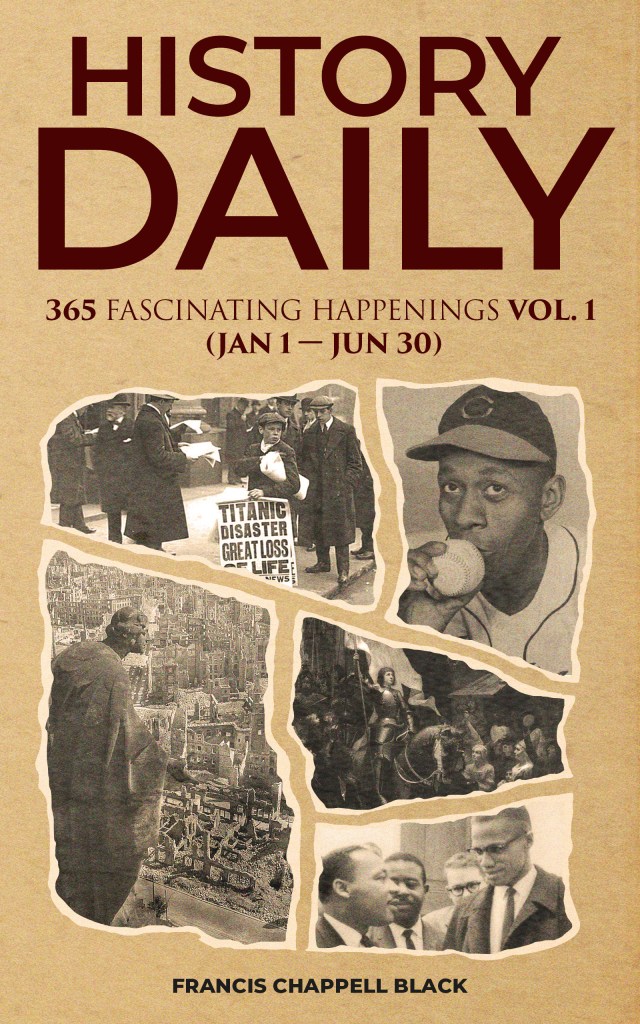
ON SALE NOW!!!
History Daily: 365 Fascinating Happenings Volume 1
In the United States:
In Canada:
Subscribe to History Daily with Francis Chappell Black to receive daily updates:
 History Daily With Francis Chappell Black
Leave a comment