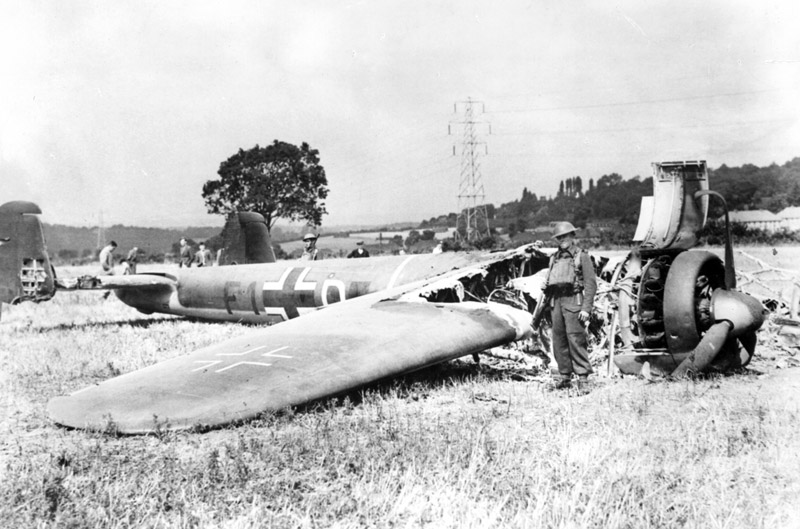
Image: A Dornier DO 17Z of 9 Staffel (Squadron), Kampfgeschwader 76 (Bomber Wing 76). The bomber was shot down by Hawker Hurricane fighter aircraft of No. 111 Squadron RAF. It crash landed near RAF Biggin Hill, 18 August 1940. (Wikimedia Commons.)
On August 18, 1940, the air battle dubbed “The Hardest Day” occurred during World War II during the Battle of Britain between the German Luftwaffe and the British Royal Air Force (RAF). On that day, the Luftwaffe made an all-out effort to demolish RAF Fighter Command. The air battles occurring on that day were amongst the most extensive aerial engagements in history to that point in time. Both sides suffered heavy losses. In the air, the British shot down twice as many Luftwaffe aircraft as they lost. Nevertheless, many RAF aircraft were destroyed on the ground, equalizing the total losses of both sides.
History Daily: 365 Fascinating Happenings Volume 1 & Volume 2 – August 18, 1940
Further significant and costly aerial battles took place after August 18. Still, both sides lost more planes combined on this day than at any other point during the campaign, including September 15, the Battle of Britain Day, generally deemed the climax of the fighting. For this reason, Sunday, August 18, 1940, became known as “the Hardest Day” in Britain.
By June 1940, the Allies had been conquered in Western Europe and Scandinavia. After Britain rejected peace proposals, Adolf Hitler issued Directive No. 16, ordering the conquering of the United Kingdom – codenamed Operation Sea Lion (Unternehmen Seelowe). However, before this could happen, air supremacy was required to prevent the RAF from attacking the invasion fleet or providing protection for any attempt by the Royal Navy’s Home Fleet to intercept a landing by sea. Hitler ordered the Luftwaffe’s commander-in-chief, Reichsmarschall Hermann Goring, and the Oberkommando der Luftwaffe (High Command of the Air Force) to prepare for this assignment.
The primary target was RAF Fighter Command. In July 1940, the Luftwaffe began operations to destroy the RAF. Throughout July and early August, the Germans targeted shipping convoys in the English Channel and occasionally RAF airfields. On August 13, a major German effort, known as Adlertag (Eagle Day), was made against RAF airfields but was unsuccessful. The failure did not stop the Germans from continuing with air raids against the RAF or its infrastructure. Five days later came the Hardest Day.
The Germans expected a weaker opposition than Britain had. On August 17, German intelligence received information that the British were down to 300 available air fighters. In reality, there were 855, with another 289 in storage and another 84 in training units.
The Luftwaffe’s plan of attack was simple. German bombers were to strike at RAF airfields in southeast England. The most critical airfields in this region, under the command of AOC (Air Officer Commanding) Keith Park and his No. 11 Group RAF, were the sector stations at RAF Hornchurch, Kenley, Tangmere, Biggin Hill, North Weald, Northolt, and Debden. At least five were on the periphery of Greater London. Each airfield housed two to three squadrons and had its own sector operations room. From there, its fighters were directed from its satellite airfields into combat.
Despite the failure of Adlertag and considerable loss rates on August 15, 16, and 17, Kesselring convinced Goring that the only sound strategy was to continue to send heavily escorted bombers to destroy British airfields. Kesselring also advocated using Jagdgeschwader (fighter wings) in free-chase tactics. Messerschmitt Bf 109 single-engine fighters were to be sent out before the main raids to force the British fighters into large-scale air battles, which, in theory, would destroy RAF aircraft in combat and deplete British defenses. However, this time, Kesselring changed his operational methods; he chose not to scatter his effort against many targets. Instead, he narrowed the targets to a short list to centralize his strength and striking power. Sector stations RAF Hornchurch, Kenley, North Weald, and Biggin Hill were selected as the prime targets.
The formation that the RAF was using was a tactical failure. AOC Fighter Command Hugh Dowding and his planners developed an incredibly tight formation for the pilots. Pilots were trained to open fire at an extended range of 300-400 yards and then break away without closing to short range. The tactics had been practiced over the years but were to be impractical and purposeless in the battle Britain was on the cusp of in 1940.
The tight formation meant RAF pilots were more worried about keeping in their position and not crashing into one another than looking out for the enemy for bombardment. This made them at risk of surprise attacks by the Germans, and the rushed training meant pilots could barely use the old tactical methods or cope with any changes made.
The long-range attacks were broken off too early and did minor damage to the German fighters.
The famous V-formation was developed in June but was still inferior to the Germans’ much more flexible formation.
The attack was part of a coordinated pincer movement against the airfields. Planes were to dive-bomb buildings and hangers in the airfields from a higher altitude first before other aircraft would swoop in five minutes later and bomb the runways and landing grounds while also attacking the defenses. After this, a low-level strike unit would destroy other buildings. If the plan were successful, it would wreck the airfield, but the attack was postponed due to heavy mist reducing the visibility.
Altogether the German forces had 108 bombers and 150 fighter aircraft. They finally set off at 11 am, two hours later than scheduled. They found Calais was covered in clouds, and as the planes ascended, the formations lost their solidarity and had to reform, losing more time. Some of the aircraft had overtaken the bombers that were supposed to be ahead of them, meaning the plan of attack was now the wrong way around. The Dorniers that were supposed to attack first ended up 15 miles behind the other bombers.
The British were aware of the approaching enemy aircraft but estimated the strength of the German planes as approximately 350 aircraft, which was one-third more than the actual size of the force. They prepared for that size and had 12 Hawker Hurricanes in the air above Canterbury, and eight more squadrons were sent to meet them. There were a further three Reserve Squadrons held at RAF Tangmere as reinforcements.
The British expected more Luftwaffe forces than there actually were, so their reaction was much stronger than the Germans expected. Both sides took heavy losses, the most in one day during the Battle of Britain. Although the loss rates favored the British side, the high number of casualties could not be sustained on either side for the remainder of the Battle of Britain.
ON SALE NOW!!!
History Daily: 365 Fascinating Happenings Volume 1
In the United States:
In Canada:
Subscribe to History Today with Francis Chappell Black to receive daily updates:
 History Daily With Francis Chappell Black
Leave a comment