RUSSIAN REVOLUTIONARY LEON TROTSKY IS MORTALLY INJURED IN MEXICO CITY ATTACK
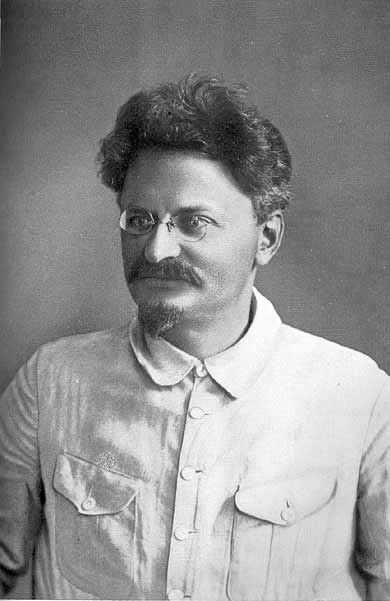
Image: Leon Trotsky (Wikimedia Commons.)
Born in Ukraine to Russian-Jewish parents in 1879, Trotsky became a Marxist as a teenager and later left the University of Odessa to help organize the subversive South Russian Workers Union. In 1898, he was arrested for radical activities and imprisoned. In 1900, he was sentenced to exile in Siberia.
In 1902, he fled to England using a forged passport under the assumed name of Leon Trotsky (his real name was Lev Davidovich Bronstein). In London, he worked with Bolshevik revolutionary Vladimir Lenin but later sided with the Menshevik factions that called for a democratic approach to socialism. With the beginning of the Russian Revolution of 1905, Trotsky returned to Russia and was again sent into exile in Siberia when the revolution collapsed. In 1907, he once again escaped.
During the next decade, he was expelled from several countries because of his revolutionary views, living in Switzerland, Paris, Spain, and New York City. He even spent a month in an internment camp in Amherst, Nova Scotia, Canada, while on his return trip to Russia. It should be noted that Russia and Canada were allies in World War I.
Trotsky played a leading role in the Bolsheviks’ seizure of power, conquering most of Petrograd before Lenin’s triumphant return in November. Appointed Lenin’s secretary of foreign affairs, he negotiated with the Germans to end Russia’s participation in World War I. In 1918, he became war commissar and began building up the Red Army, which succeeded in defeating anti-communist opposition in the Russian Civil War. In the early 1920s, Trotsky seemed the heir apparent of Lenin, but he lost out in the struggle for succession to Stalin after Lenin fell ill in 1922.
In 1924, Lenin died, and Joseph Stalin became the leader of the USSR. Against Stalin’s stated policies, Trotsky called for a continuing world revolution that would inevitably dismantle the increasingly bureaucratic Soviet state. He also criticized the new regime for suppressing democracy in the Communist Party and for failing to develop adequate economic planning. In response, Stalin and his supporters launched a propaganda counterattack against Trotsky. In 1925, he was removed from his post in the war commissariat. One year later, he was expelled from the Politburo and, in 1927, from the Communist Party. In January 1928, Trotsky was deported by Soviet leader Joseph Stalin to Alma-Ata in remote Soviet Central Asia. He lived there in internal exile for a year before being banished from the USSR forever by Stalin.
He was given refuge by the government of Turkey and settled on the island of Prinkipo, where he worked on finishing his autobiography and history of the Russian Revolution. After four years in Turkey, Trotsky lived in France and then Norway and, in 1936, was granted asylum in Mexico. Settling with his family in Mexico City, he was found guilty of treason in absentia during Stalin’s purges of his political foes.
On August 20, 1940, exiled Russian revolutionary Leon Trotsky is mortally injured by an ice-ax-wielding assassin at his home on the outskirts of Mexico City. The killer—Ramón Mercader—was a Spanish communist and an agent of Soviet leader Joseph Stalin. Trotsky died from his wounds the following day.
After a failed attempt to have Trotsky murdered in March 1939, Stalin assigned the overall organization of implementing the task to the NKVD officer Pavel Sudoplatov, who, in turn, co-opted Nahum Eitingon. According to Sudoplatov’s Special Tasks, the NKVD proceeded to set up three NKVD agent networks to carry out the murder; these three networks were designed to operate entirely autonomously from the NKVD’s hitherto-established spy networks in the U.S. and Mexico.
On 24 May 1940, Trotsky survived a raid on his villa by armed assassins led by the NKVD agent Iosif Grigulevich and Mexican painter David Alfaro Siqueiros. Trotsky’s 14-year-old grandson, Vsevolod Platonovich “Esteban” Volkov (7 March 1926 – 16 June 2023), was shot in the foot. A young assistant and bodyguard of Trotsky, Robert Sheldon Harte, disappeared with the attackers and was later found murdered; it is probable that he was an accomplice who granted them access to the villa. Trotsky’s other guards fended off the attackers. Following the failed assassination attempt, Trotsky wrote an article titled “Stalin Seeks My Death” on 8 June 1940, in which he stated that another assassination attempt was certain.
On 20 August 1940, Trotsky was attacked in his study by Spanish-born NKVD agent Ramón Mercader, who used an ice axe as a weapon. The blow to his head was bungled and failed to kill Trotsky instantly. Witnesses stated that Trotsky spat on Mercader and began struggling fiercely with him, which resulted in Mercader’s hand being broken. Hearing the commotion, Trotsky’s bodyguards burst into the room and nearly beat Mercader to death, but Trotsky stopped them, laboriously stating that the assassin should be made to answer questions. Trotsky was then taken to a hospital and operated on, surviving for more than a day, but dying, at the age of 60, on 21 August 1940 from exsanguination and shock.
CRUSADER KING RICHARD I KILLS 2700 MUSLIM PRISONERS AFTER THE FALL OF ACRE
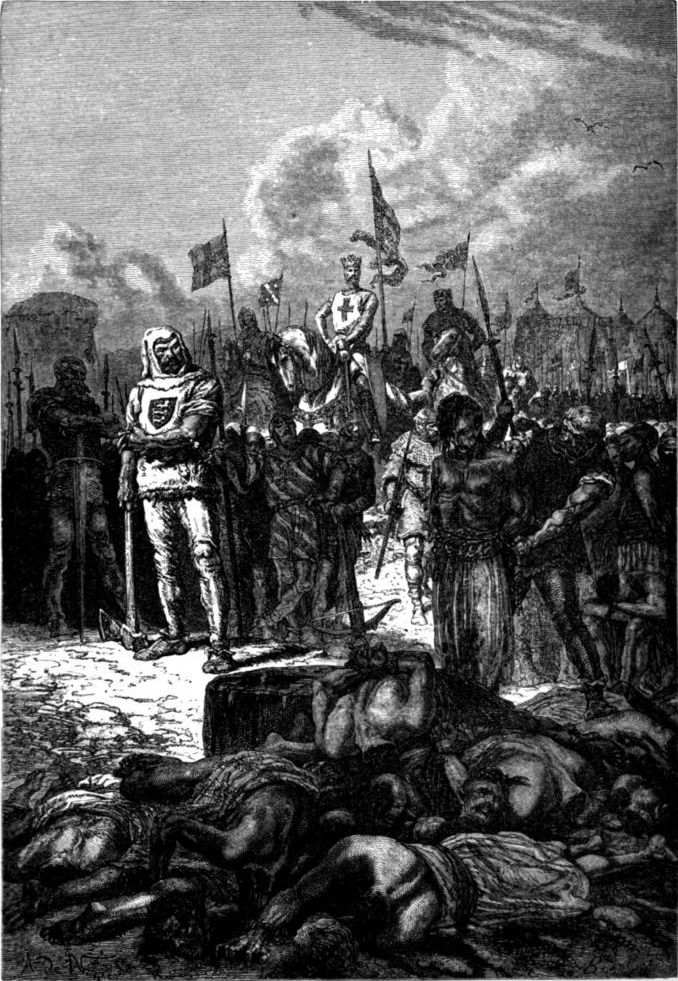
Image: Massacre of the Saracen prisoners, ordered by King Richard the Lionheart by artist Alphonse de Neuville. (Wikimedia Commons.)
On August 20, 1191, the Massacre of Ayyadieh occurred during the Third Crusade after the fall of Acre when King Richard I had more than two thousand seven hundred Muslim Prisoners of war from the captured city beheaded in front of the Ayyubid armies of Sultan Saladin. Despite attacks by Muslim forces during the killings, the Christian Crusaders were able to retire in good order. Saladin subsequently ordered one thousand six hundred Crusader prisoners of war to be executed in retaliation.
AMERICA’S GREAT WHITE FLEET ARRIVES IN SYDNEY, AUSTRALIA, TO A RAPTUROUS WELCOME; 221 AMERICAN SAILORS DESERT TO REMAIN IN AUSTRALIA.
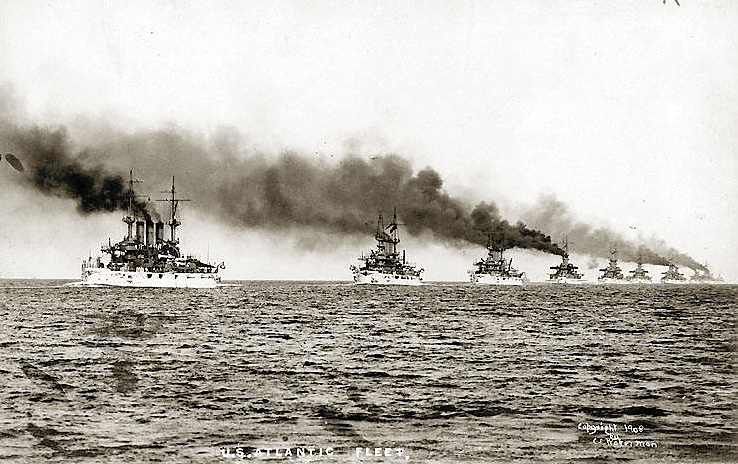
Image: USS Kansas sails ahead of USS Vermont as the fleet leaves Hampton Roads, Virginia, on 16 December 1907. (Wikimedia Commons.)
The Great White Fleet was the name given for the group of United States Navy battleships that journeyed around the globe from December 16, 1907, to February 22, 1909, by order of President Theodore Roosevelt. It consisted of 16 battleships divided into two squadrons, along with various small escorts, and earned its moniker for the stark white paint on its hulls.
The fleet’s primary mission was to make friendly courtesy visits to numerous countries while displaying new U.S. naval power to the world; Roosevelt sought to demonstrate growing American military prowess and blue-water naval capabilities. Another goal was to deter a threatened war with Japan amid growing tensions around 1907. The voyage helped familiarize the 14,500 officers and sailors with the logistical and planning needs for extended fleet action far from home.
After long neglecting the Navy, Congress started generous appropriations in the late 1880s. Beginning with just 90 small ships, over one-third of them wooden and obsolete, the Navy quickly added new steel fighting vessels. The fleet’s capital ships were already obsolete compared to the British dreadnoughts in 1907. Nevertheless, it was by far the largest and most powerful fleet that had ever circled the globe; the mission was a success at home and in every country that was visited, including in Europe (which was visited only briefly).
 History Daily With Francis Chappell Black
Leave a comment