Image:
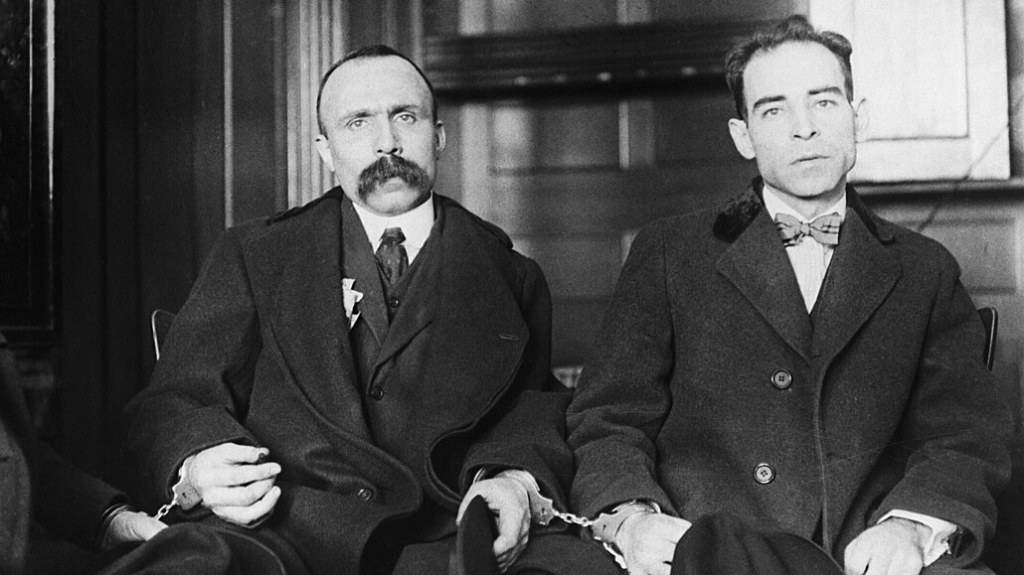
Bartolomeo Vanzetti (left), handcuffed to Nicola Sacco (right). Dedham, Massachusetts Superior Court, 1923.This photo was taken in 1923 when Sacco was on the 23rd day of a hunger strike. (Wikimedia Commons.)
On this day in history, despite worldwide protests in support of their innocence, Italian-born anarchists Nicola Sacco and Bartolomeo Vanzetti are executed for murder in Boston, Massachusetts.
History Daily: 365 Fascinating Happenings Volume 1 & Volume 2 – August 23, 1927
Both Fred Parmenter and Alessandro Berardelli – one the paymaster and the other a guard – were shot several times and killed as they attempted to move the payroll boxes of their New England shoe company in South Braintree, Massachusetts, a suburb of Boston. The two armed thieves, identified by witnesses as “Italian-looking,” fled in a Buick. The car was found abandoned in the woods several days later. Through evidence found in the vehicle, police suspected a man named Mike Boda was involved. However, Boda was one step ahead of the police and fled to Italy.
Police did manage to catch Boda’s colleagues, Nicola Sacco and Bartolomeo Vanzetti, who were each carrying loaded weapons at the time of their arrest. Sacco had a .32 caliber handgun – the same type used to kill the two employees of the shoe company – and bullets from the same manufacturer as those recovered from the shooting. Vanzetti was identified as a participant in a previous robbery attempt by a different shoe company.
Sacco and Vanzetti were anarchists, believing that social justice would come only through the destruction of governments. In the early 1920s, mainstream America developed a fear of communism and radical politics that resulted in an anti-communist, anti-immigrant hysteria. Sacco and Vanzetti, recognizing the uphill battle ahead, tried to put this fear to their advantage by drumming up support from the left wing with claims that the prosecution was politically motivated. Millions of dollars were raised for the costs of their defense by the radical left worldwide. The American embassy in Paris was even bombed in response to the Sacco-Vanzetti case; a second bomb was intercepted for the embassy in Lisbon.
The well-funded defense put up a good fight, bringing forth nearly 100 witnesses to testify on the defendant’s behalf. Ultimately, eyewitness identification was not a crucial issue; instead, it was the ballistics tests on the murder weapon. Prosecution experts with primitive instruments testified that Sacco’s gun was the murder weapon. Defense experts claimed just the opposite. Ultimately, on July 14, 1921, Sacco and Vanzetti were found guilty and sentenced to death.
However, the ballistics issue remained a burning issue as Sacco and Vanzetti waited on death row. In addition, a jailhouse confession by another criminal fueled the controversy. In 1927, Massachusetts Governor A.T. Fuller ordered another inquiry to advise him on the clemency request of the two anarchists. In the meantime, there have been many scientific advances in forensics. The comparison microscope was now available for new ballistics tests and proved beyond a doubt that Sacco’s gun was indeed the murder weapon.
The executions were slated for midnight between August 22 and 23, 1927. On August 15, a bomb went off at the home of one of the jurors from the original trial. On Sunday, August 21, more than 20,000 protesters assembled on Boston Common.
Sacco and Vanzetti awaited execution in their cells at Charlestown State Prison, and both men refused a priest several times on their last day, as they were atheists. Their attorney, William Thompson, requested that Vanzetti make a declaration opposing violent retaliation for his death, and they talked about forgiving one’s enemies. Thompson also asked Vanzetti to affirm his and Sacco’s innocence one more time, and Vanzetti complied. Celestino Medeiros, whose execution had been delayed in case his testimony was needed at another trial of Sacco and Vanzetti, was put to death first. Sacco was next, and he walked quietly to the electric chair, then shouted, “Farewell, Mother.” In his final moments, Vanzetti shook hands with guards, acknowledged them for their kind conduct, read a statement declaring his innocence, and finally stated, “I wish to forgive some people for what they are now doing to me.” Following the executions, death masks were made of the men.
Violent rallies swept through many cities the following day, including Geneva, Tokyo, London, Paris, and Amsterdam. In South America, strikes closed factories and workplaces. Three were killed in Germany, and protesters in Johannesburg, South Africa, burned an American flag outside the American embassy. It has been alleged that the Communist Party organized some of these activities.
At Langone Funeral Home in Boston’s North End, more than 10,000 mourners viewed Sacco and Vanzetti in open caskets over two days. A wreath over the coffins at the funeral parlor announces In attesa l’ora della vendetta (Awaiting the hour of vengeance). On Sunday, August 28, a two-hour funeral procession bearing huge floral tributes moved through the city. Thousands of marchers participated in the procession, and over 200,000 came out to watch. Police blocked the route, which passed the State House, and at one point, mourners and police came to blows. The hearses reached Forest Hills Cemetery, where, after a brief eulogy, the bodies were then cremated. The Boston Globe called it “one of the most tremendous funerals of modern times.” Hollywood officials were told to destroy all recordings of the funeral procession.
Sacco’s ashes were sent to his hometown in Italy, Torremaggoire, where he is interred at the base of a monument built in 1998. Vanzetti’s ashes were buried beside his mother in Villafalletto, Italy.
In 1961, a test of Sacco’s gun using modern forensic techniques proved it was his gun that killed the two employees, though little evidence has been found to substantiate Vanzetti’s guilt. But serious doubts remain about negligence by the police and prosecutors and if the two men received a fair trial. In 1977, Massachusetts Governor Michael Dukakis issued a proclamation pardoning Sacco and Vanzetti, remarking that they had been mistreated and that no stigma should be associated with their names.
ON SALE NOW!!!
History Daily: 365 Fascinating Happenings Volume 1
In the United States:
In Canada:
 History Daily With Francis Chappell Black
Leave a comment