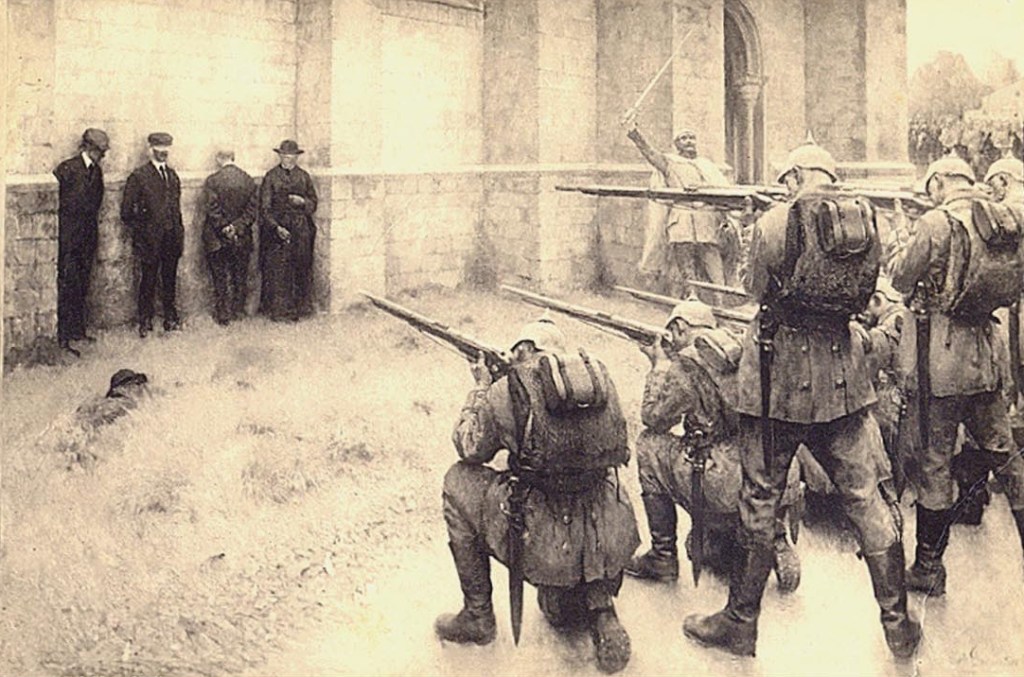
Image: Depiction of the mass murder of civilians in Blégny by Évariste Carpentier. (Wikimedia Commons.)
On this day in history, and over the next five days, German soldiers stationed in the Belgian village of Louvain during the opening month of World War I burn and loot much of the town, executing hundreds of civilians.
Located between Liege, the fortress town that had experienced heavy fighting during the first weeks of the German conquering, and the Belgian capital of Brussels, Louvain became the symbol, in the eyes of world public opinion, of the brutal nature of the German war machine. From the first days they moved into Belgium, they violated that country’s neutrality to invade France. The German army looted and destroyed a large part of the countryside and villages in their path, killing untold numbers of civilians, not to mention women and children. These vicious deeds, the Germans maintained, were allowed because of the illegal civilian opposition to the German occupation, organized and advanced by the Belgian government and other community leaders – especially the Catholic Church – and carried out by irregular fighters or franc-tireurs (snipers, or free shooters) of the kind that had taken part in the Franco-Prussian War in 1870-1871.
In reality, this type of civilian resistance – despite being allowed by the Hague Conventions of 1899 and 1907, which the Germans hated – did not exist in Belgium during the German invasion but was used as an excuse to explain the German stalking of a theory of terror previously written about by the very influential 19th-century Prussian military philosopher Karl von Clausewitz. As claimed by Clausewitz, the civilian population of an enemy country should not be spared from war. Still, it should be made to feel its effects and be forced to pressure their authorities to surrender.
The burning of Louvain came after a slaughter in the village of Dinant, near Liege, on August 23, in which German soldiers had killed 674 civilians. Two days later, the small but hardy Belgian army made a sudden sharp attack on the rear lines of the German 1st Army, forcing the Germans to retreat to Louvain. In the confusion that followed, civilians fired on the German soldiers. The Belgians would claim the Germans had mistakenly fired on each other in the dark. Whatever happened did not matter: the Germans burned Louvain to illustrate what happens to those who resist mighty Germany.
Over the next five days, as Louvain – including its renowned university and library, founded in 1426 – burned, a protest grew in the international community, with refugees pouring out of the town and eyewitness accounts filling the foreign press. The Allied press went wild, with British editorials proclaiming “Treason to Civilization” and insisting the Germans had proved themselves descendants not of the great author Goethe but of the bloodthirsty Attila the Hun.
On August 25, although they had encountered no resistance from the population, German troops began a massacre. The massacre likely started when some German soldiers, frantic because of a false report of a major Allied offensive in the area, took part in some friendly fire and shot at fellow German troops. Civilians were shot and bayoneted, homes were burned, and some people were tortured. Many of those killed were arbitrarily dumped in ditches and construction trenches. The city’s mayor and the university’s rector were summarily executed.
At around 11:30 p.m., German soldiers broke into the university’s library, which held significant special collections, including medieval manuscripts and books, and set it on fire. Within a dozen hours, the library and its collection were virtually destroyed. The fire continued to burn for several days. The rector of the American College of Louvain was rescued by Brand Whitlock, the U.S. ambassador, who recorded the rector’s account of “the murder, the lust, the loot, the fires, the pillage, the evacuation and the destruction of the city” as well as the deliberate burning of the library’s incunabula. The incineration of the University of Louvain’s library destroyed more than 230,000 books, including 750 medieval manuscripts.
The killings and other acts of brutality occurred the next night and day. The day after, the German army bombarded the town with five shells. The town was utterly ravaged, with many German officers and men taking part in stealing of money, silver, wine, and other things of value and killing those who resisted.
In the town, over 1,100 buildings were destroyed, variously estimated to constitute one-sixth or more than one-fifth of the town’s structures. The town hall was saved only because it was the site of the German headquarters. About 248 civilians were killed, and most of the city’s 42,000 residents were exiled by force into the countryside, with some being taken from their homes at gunpoint. Approximately 1,500 town citizens, including women, children, and four hostages, were deported to Germany in railway cattle wagons.
By the war’s end, the Germans would kill 5,521 civilians in Belgium (and 896 in France). Above all, German activity in Belgium was intended to show the Allies that the German empire was a great power that should be submitted to and that those resisting that power – whether soldier or civilian, belligerent or neutral – would be met with a force of ruination. Ironically, for many in the Allied countries and in the remainder of the world, a much different ending came out from the flames of Louvain: Germany must be defeated no matter what, without compromise, because a German victory would mean the defeat of civilization.
Subscribe to History Daily with Francis Chappell Black to receive daily updates:
ON SALE NOW!!!
History Daily: 365 Fascinating Happenings Volume 1 – VOLUME 2 NOW AVAILABLE
In the United States:
In Canada:
 History Daily With Francis Chappell Black
Leave a comment