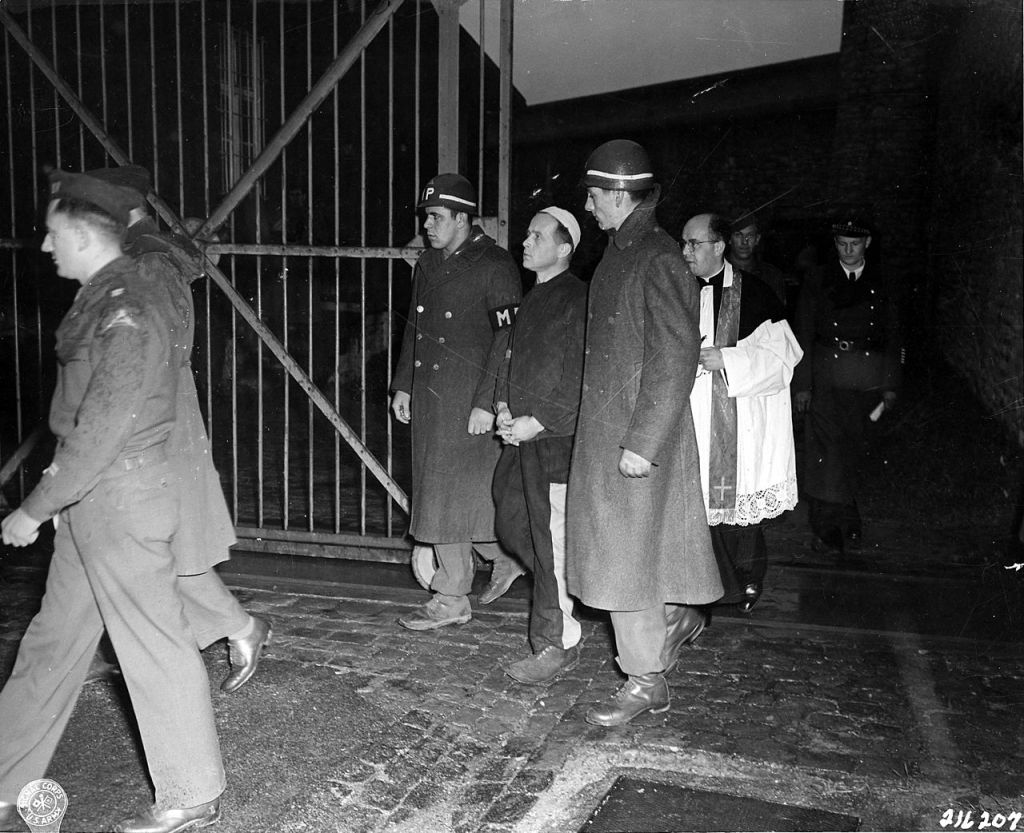
Image: Five Germans were condemned to death for the killing of six American flyers, who were seized from their German military captors. Joseph Harzgen is led to execution by hanging at Bruchsal, Germany. (Wikimedia Commons.)
On this day in history, six American airmen were murdered by the townspeople of Russelsheim, Germany, during World War II. The war crime happened two days after nine USAAF crew members of a B-24 Liberator were shot down over Hanover. They parachuted to the ground and were captured and held by German Luftwaffe personnel. Unable to transfer the downed airmen to a POW facility due to the train tracks being heavily damaged by RAF bombing the night before, the crew was forced to march through the already devastated town of Russelsheim to catch another train. The townspeople, already angered by the previous night’s raid, started attacking the unarmed airmen with rocks, hammers, sticks, and shovels, resulting in six airmen dying.
History Daily: 365 Fascinating Happenings Volume 1 & Volume 2 – August 26, 1944
During World War II, the RAF bombed Russelsheim, an industrial town that housed many vital targets, including the Opel plant. The RAF carried out a policy of “area bombing” of cities at night, while the USAAF relied on “precision bombing” by day. On August 24, 1944, an American B-24 bomber named Wham! Bam! Thank you, Ma’am was shot down while taking part in an attack over Hanover, and the crew parachuted down near Hutterup. The airfield’s local fire brigade and military detachment were alerted and dispatched to find the downed airmen. One of the nine airmen had serious flak injuries to his abdomen. After landing on a farm, the airman found was given medical assistance by an elderly couple, and in return, the airman gave the couple his silk parachute as a gift. Within a few hours, most of the crew had been captured and taken to an interrogation room in the town hall in Greven. After that, most crewmembers were taken to an airbase near the town, where they slept for the night. The injured crewman was taken to a medical clinic where his wounds were looked after and then shipped to a hospital in Munster to undergo an operation. The following day, the rest of the airmen were loaded on a train for a trip south to the Dulag Luft in Oberursel, north of Frankfurt. After German civilians noticed the Americans on the train at every stop, crowds would form at the windows, yelling angrily at the “terror fliers” and shaking their fists while spitting on the windows. On the evening of August 25, the RAF sent 116 Lancaster bombers to Russelsheim to attack the Opel plant, dropping 674 2,000-lb bombs and more than 400,000 incendiaries on the city, destroying the plant and damaging the rail tracks.
On the morning of August 26, most crewmembers were still proceeding to their original destination. However, the RAF heavily damaged the train line from the previous night’s bombing, so the airmen were forced off the train and made to walk to Russelsheim to catch another train. Two German soldiers escorted them. As the crew marched towards the devastated town of Russelsheim, the townspeople, assuming that the fliers were Canadians from the previous night bombing raid, quickly formed and immediately became an unruly, angry mob. Two women shouted out, “There are the terror flyers. Tear them to pieces! Beat them to death! They have destroyed our houses!” One of the crewmembers replied in German, “It wasn’t us! We didn’t bomb Russelsheim!”
Nevertheless, one woman hurled a brick at the crew, precipitating a riot during which the townsfolk attacked the crew with rocks, hammers, sticks, and shovels. Three Opel workers arrived with iron bars and started beating the men to death to the cries of the crowd. The mob was joined by a German air raid warden, Joseph Hartgen, armed with a pistol. He would prove to be the crew’s worst nightmare. The German soldiers who guarded the airmen made no attempts to prevent the beatings; Hartgen lined them up and shot six in the head, then ran out of ammunition, leaving two of the airmen, William Adams and Sidney Brown, alive. The mob then put the airmen on a cart and took them to the cemetery. Those who moaned were beaten further. An air raid siren went off during the attack, and the mob ran for cover. The two surviving crewmembers managed to crawl from the bloody cart, fled toward the Rhine, and avoided capture for four days. However, they were found by a policeman and brought to their original destination, the camp in Oberursel, where they remained until the war’s end.
After the war in Europe ended in 1945 when Russelsheim came under occupation by the American Army, the killings came to light, and the bodies were located on June 28, 1945. In the first war trials in Germany before the Nuremberg trials, eleven residents of Russelsheim, including Joseph Hartgen, were put on trial in late July 1945 in Darmstadt, a town devastated by a British night attack the previous September that had killed 8,500 residents and left 70,000 homeless. The defense argued that they had been incited to commit the crimes by Joseph Goebbels’s propaganda, which encouraged the German people to take reprisals against the downed Allied pilots, and that they were not guilty of their actions. Lt. Colonel Leon Jaworski, who would achieve national fame three decades later as the special prosecutor in the Watergate scandal, argued that the townsfolk were responsible for their actions.
The trial lasted six days. The court heard eyewitness testimony to the cold-blooded assassinations and chilling accounts of the bludgeoning and shooting of the airmen. On August 2, Joseph Hartgen and six other townspeople were found guilty and sentenced to death. The remainder of the defendants were given varying prison terms, while the Commission acquitted one. The judge, however, commuted two of the death penalties to 30 years in prison. On November 10, 1945, Hartgen and four others were hanged at the prison in Bruchsal. A sixth, a German soldier, was convicted and executed in 1946.
ON SALE NOW!!!
History Daily: 365 Fascinating Happenings Volume 1 – VOLUME 2 NOW AVAILABLE
In the United States:
In Canada:
Join my mailing list for updates:
 History Daily With Francis Chappell Black
Leave a comment