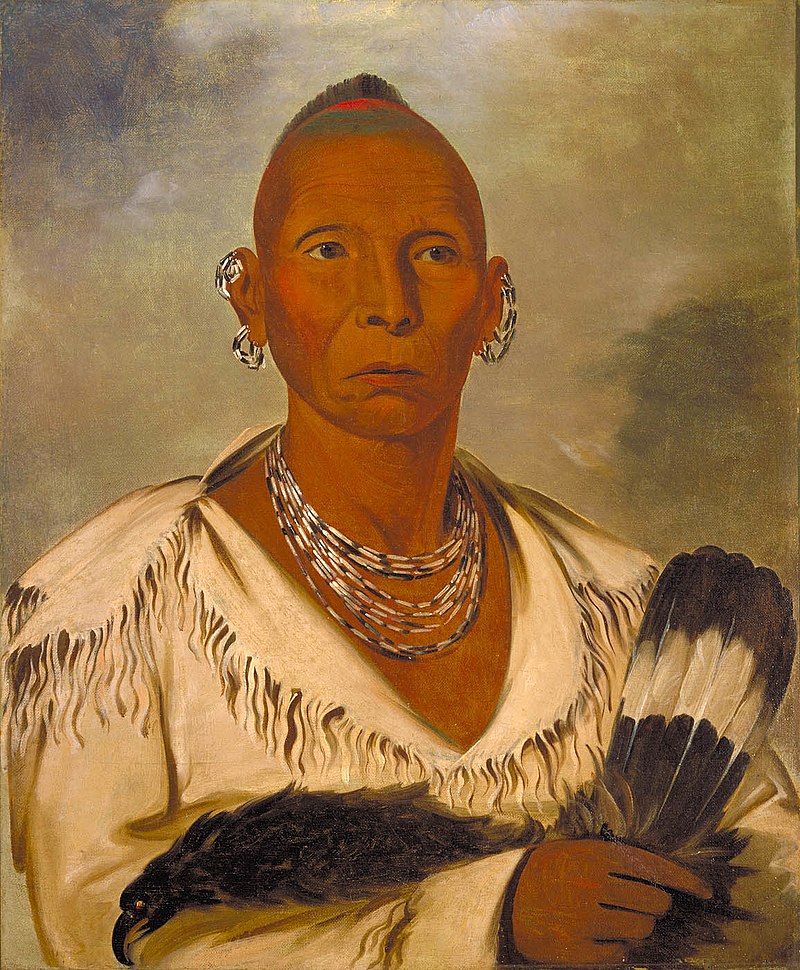
Image: Black Hawk, the Sauk war chief and namesake of the Black Hawk War in 1832. (Wikimedia Commons.)
On this day in history, after capitulating to the Americans at the end of the Black Hawk War, an exhausted and demoralized Sauk leader, Black Hawk, surrendered to Indian agent Joseph Street at Fort Crawford (present-day Prairie du Chien), Wisconsin. Colonel Zachary Taylor took custody of Black Hawk and sent him by steamboat to Jefferson Barracks in Missouri, escorted by Lieutenants Jefferson Davis and Robert Anderson. In his surrender speech, Black Hawk stated, “I fought hard, but your guns were well aimed. The bullets flew…. My warriors fell around me; it began to look dismal. I saw my evil day at hand. The sun rose dimly on us in the morning, and at night it sank in a dark cloud and looked like a ball of fire. That was the last sun that shone on Black Hawk. His heart is dead and no longer beats in his bosom. He is now a prisoner to the white men.”
Called Ma-ka-tai-me-she-kia-kiak by his people, Black Hawk was born in 1767 in the village of Saukenuk in the present-day state of Illinois. He became known as a courageous and fierce fighter in the many skirmishes between the Sauk and their main rival, the Osage. By the early 1800s, however, Black Hawk realized that the real threat to his people was the large numbers of white people heading into the territory.
In 1804, the Sauk and Fox (Mesquakie) Indians signed a treaty that gave all of their territory east of the Mississippi River to the government of the United States. Black Hawk, however, stated that the treaty was invalid and had been signed by inebriated Indian representatives. In 1816, he reluctantly confirmed the treaty with his signature, but he later confirmed that he did not understand that this meant he would have to give up his home village of Saukenuk on the Rock River.
Black Hawk grew increasingly angry as the U.S. Army built more forts and brought more settlers moved into the territory during the next 15 years. Finally, in 1831, settlers began to inhabit the village of Saukenuk, which would become Rock Island, Illinois. Regardless of the 1804 treaty details, Black Hawk declined to leave his home. He began to prepare for war.
In 1832, General Edmund Gaines arrived in the area with a large force of U.S. troops and Illinois militiamen. In the beginning, Black Hawk removed his huge band of warriors, women, and children to the western side of the Mississippi. On April 5, though, he brought them back to the disputed territory, believing that other Indian forces and the British to the north would support him in a confrontation. Many soldiers caught up to Black Hawk and his followers the following day near the Rock River of northern Illinois. When neither the British nor his Indian allies came to his support, Black Hawk tried to surrender. As luck would have it, one of his truce bearers was killed in the melee, and the Black Hawk War began.
In May, Black Hawk’s warriors won a significant victory that demoralized the Americans. As subsequent generations of Indian fighters would learn, however, the mighty force of the American government was persistent. On August 2, U.S. soldiers almost destroyed Black Hawk’s band as it tried to escape west across the Mississippi, and Black Hawk finally surrendered.
Casualties in the 15-week war were very one-sided. An estimated 70 settlers or soldiers lost their lives; the number of Indians killed is between 442 and 592.
Imprisoned for a time in St. Louis, Black Hawk and a few of his men were sent to Washington, D.C., in April of 1833 to meet with President Andrew Jackson. Black Hawk expected that he would be treated with respect, but Jackson berated Black Hack for his attacks and sent him and his men to another Fort Monroe, Virginia prison. In 1833, Black Hawk was allowed to return to his people, but not before he was taken on a tour of eastern cities meant to show him how powerful America had become.
Shortly after his return to Iowa in 1833, Black Hawk dictated a moving account of his life story to interpreter Antoine LeClaire. Published as Life of Ma-ka-tai-me-she-kia-kiak, or Black Hawk, the book offered Black Hawk’s version of the wrongs done to him and his people. He lived the remaining six years under the supervision of a Sauk chief who had once been his enemy. Unlike Black Hawk, the Sauk chief had cooperated with the United States government.
On October 3, 1838, Black Hawk died at seventy-one. Not long after his death, Black Hawk’s corpse was stolen from his burial ground by a man who wanted to exhibit them in museums and traveling shows. The governor of the Iowa Territory protested and eventually secured the remains at the Iowa Historical Society. When the society’s building burned, Black Hawk was finally free of the white man’s grasp.
After Black Hawk’s death, the United States took the remaining six million acres of Sauk and Fox lands. By 1842, the tribes were forced to give away all their land in Iowa and move to a smaller reservation in Kansas. Finally, in 1867, the Sauk and Fox were moved to their final destination in Indian Territory in Oklahoma.
Several American men with political ambitions fought in the Black Hawk War. At least seven future U.S. Senators took part, as did four future Illinois governors; future governors of Michigan, Nebraska, and the Wisconsin Territory; and two future U.S. presidents, Taylor and Lincoln. The Black Hawk War showed American officials the need for mounted troops to fight a mounted adversary. During the war, the U.S. Army did not have cavalry; the only mounted soldiers were part-time soldiers. After the war, Congress designed the Mounted Ranger Battalion commanded by Henry Dodge, which became the 1st Cavalry Regiment in 1833.
ON SALE NOW!!!
History Daily: 365 Fascinating Happenings Volume 1 – VOLUME 2 NOW AVAILABLE
In the United States:
In Canada:
 History Daily With Francis Chappell Black
Leave a comment