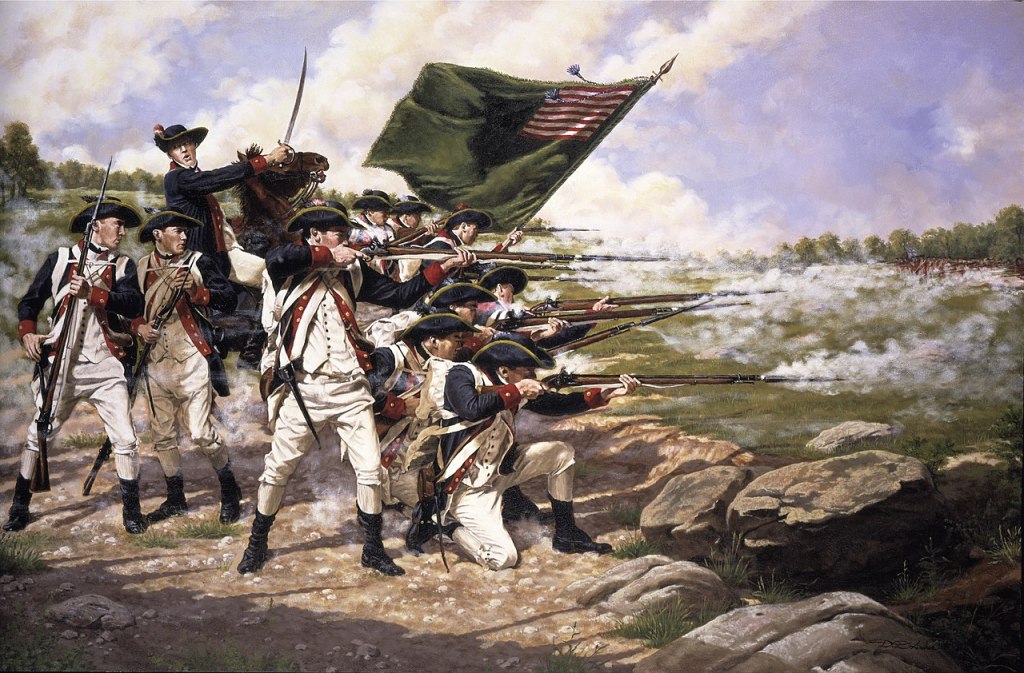
Image: The painting depicts the Delaware Regiment at the Battle of Long Island. (Wikimedia Commons.)
Colonel Henry “Light-Horse Harry” Lee, a hero of the Revolutionary War and father of Robert E. Lee, once commented that during the war “the state of Delaware furnished one regiment only; and certainly no regiment in the army surpassed it in soldiership.” At the Battle of Long Island, the actions of the Delaware Regiment kept the American defeat from becoming a disaster. Fighting alongside the 1st Maryland Regiment, the soldiers from Delaware may well have prevented the capture of the majority of Washington’s army – an event that might have ended the colonial rebellion. Organized in January 1776 by Colonel John Haslet, the Delaware Regiment was noted as the best uniformed and equipped regiment of the Continental Army. Delaware’s blue jackets with red facings and white waistcoats and breeches would later become the uniform for all the Continental troops. During the Battle of Long Island, the Delaware and Maryland troops were positioned on the right of Washington’s line. They defended the most direct route from the British landing site in south Brooklyn to the American fortifications in Brooklyn Heights. Though the troops faced the fiercest fighting of the day, they held their ground long enough to allow the remainder of Washington’s army to safely retreat to the fortifications. However, the Delaware regiment was outflanked and forced to retreat, taking 23 prisoners with them, through marshland and across the Gowanus creek. Two nights later, Washington entrusted his Delaware and Maryland soldiers to be the rear guard as he secretly withdrew his army from Brooklyn to Manhattan. Today, the 175th Infantry Regiment, Maryland Army National Guard, preserves the legacy of the 1st Maryland Regiment. The 198th Signal Battalion, Delaware Army National Guard, perpetuates the proud lineage of the Delaware Regiment.
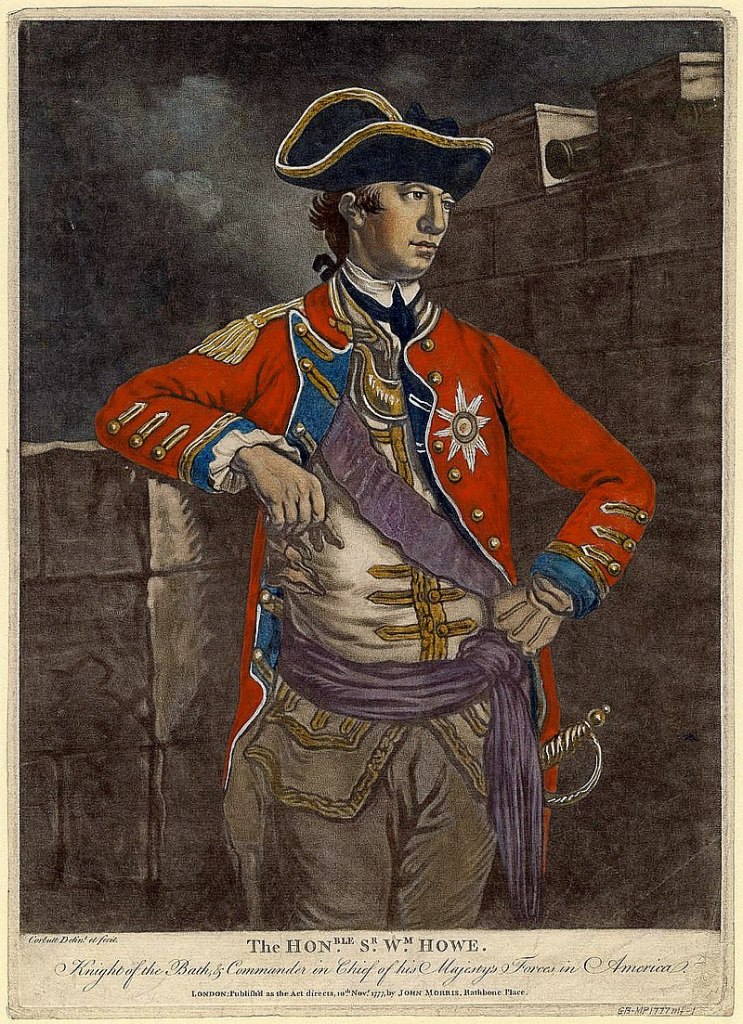
Image: British General Sir William Howe (Wikimedia Commons.)
BRITISH DEFEAT AMERICAN ARMY AT THE BATTLE OF LONG ISLAND
During the American Revolution, the British army under General William Howe defeated American forces under General George Washington at the Battle of Long Island in New York.
On August 22, Howe’s massive army arrived on Long Island, hoping to capture New York City and extend control over the Hudson River. This victory would divide the revolutionary colonies in half. On August 27, the British marched against the American position at Brooklyn Heights, overpowering the Patriots at Gowanus Pass and then outflanking the whole Continental Army. Howe neglected to follow the suggestions of his subordinates and capture the redoubts at Brooklyn Heights. On August 29, General Washington wisely ordered a retreat to Manhattan by boat, thus sparing the Continental Army from the indignity of capture.
At the Battle of Long Island, the Americans suffered 1,000 casualties to the British, losing just 400 men. On September 15, the British seized New York City.
THE ANGLO-ZANZIBAR WAR: THE SHORTEST WAR IN HISTORY. AUGUST 27, 1896
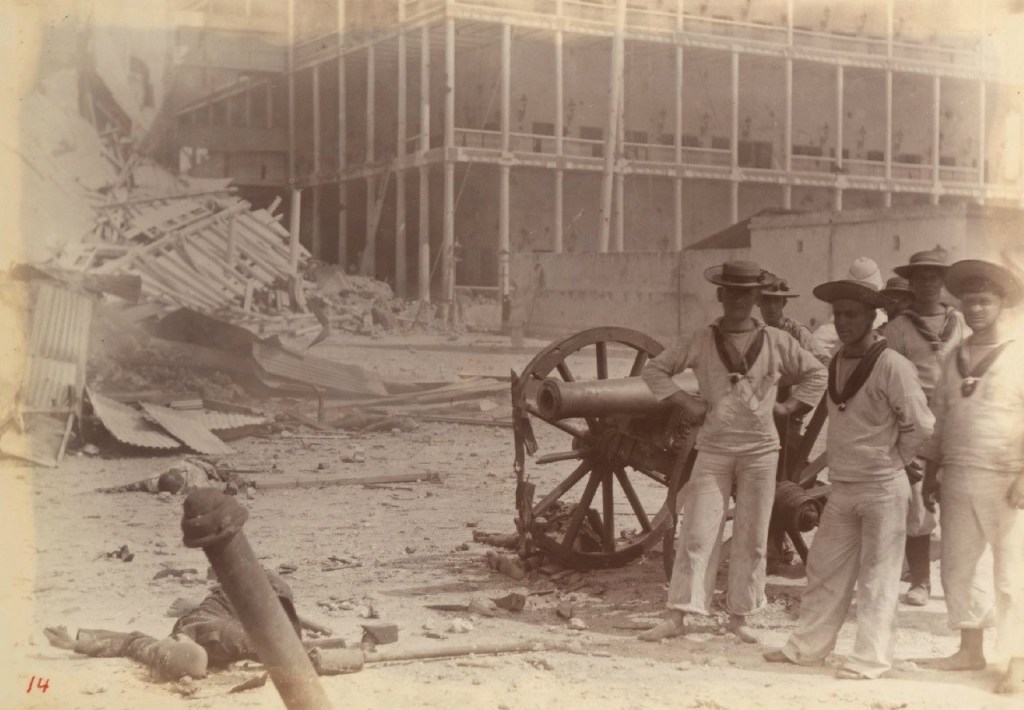
Image: British marines pose with a captured Zanzibari gun following the capture of the Sultan’s palace in Zanzibar Town. (Wikimedia Commons.)
The Anglo-Zanzibar War was fought between the United Kingdom and the Zanzibar Sultanate on August 27, 1896. The conflict lasted 46 minutes, making it the shortest war in history. The immediate cause of the war was the death of the pro-British Sultan Hamad bin Thuwaini on August 25, 1896, and the subsequent succession of Sultan Khalid bin Barghash. The British authorities preferred Hamoud bin Mohammed, who was more satisfactory to British interests, as sultan. In the June 14, 1890 agreement instituting a British protectorate over Zanzibar, a candidate for accession to the sultanate needed to gain the permission of the British consul, and Khalid had yet to do this. The British considered this a casus belli and sent a request to Khalid demanding that his forces stand down and leave the palace. In reply, Khalid called up his palace guard and barricaded himself inside the palace.
The ultimatum expired at 09:00 on August 27, by which time the British had gathered two cruisers, three gunboats, 150 marines and sailors, and 900 Zanzibaris in the harbor area. The Royal Navy contingent was under the command of Rear-Admiral Harry Rawson, and the pro-Anglo Zanzibaris were commanded by Brigadier-General Lloyd Mathews of the Zanzibar army (who was also the First Minister of Zanzibar). Around 2,800 Zanzibaris defended the palace; most were recruited from the civilian population, including the sultan’s palace guard, several hundred servants, and enslaved people. The defenders had several artillery pieces and machine guns set in front of the palace, sighted at the British ships. A bombardment opened at 09:02, set the palace on fire, and disabled the defending artillery. A small naval action occurred, with the British sinking the Zanzibari royal yacht HHS Glasgow and two smaller vessels. As they approached the palace, some shots were also fired ineffectually at the pro-British Zanzibari troops. The flag at the palace was shot down, and gunfire ceased at 09:46.
The sultan’s forces endured roughly 500 casualties, while only one British sailor was injured. Sultan Khalid received asylum in the German consulate before escaping to German East Africa (in the mainland section of present Tanzania). The British quickly placed Sultan Hamoud in power at the head of a puppet government. The war marked the end of the Zanzibar Sultanate as a sovereign state and the start of a period of heavy British influence.
BRITISH ROYAL NAVY CAPTURES U-570 ON AUGUST 27, 1941
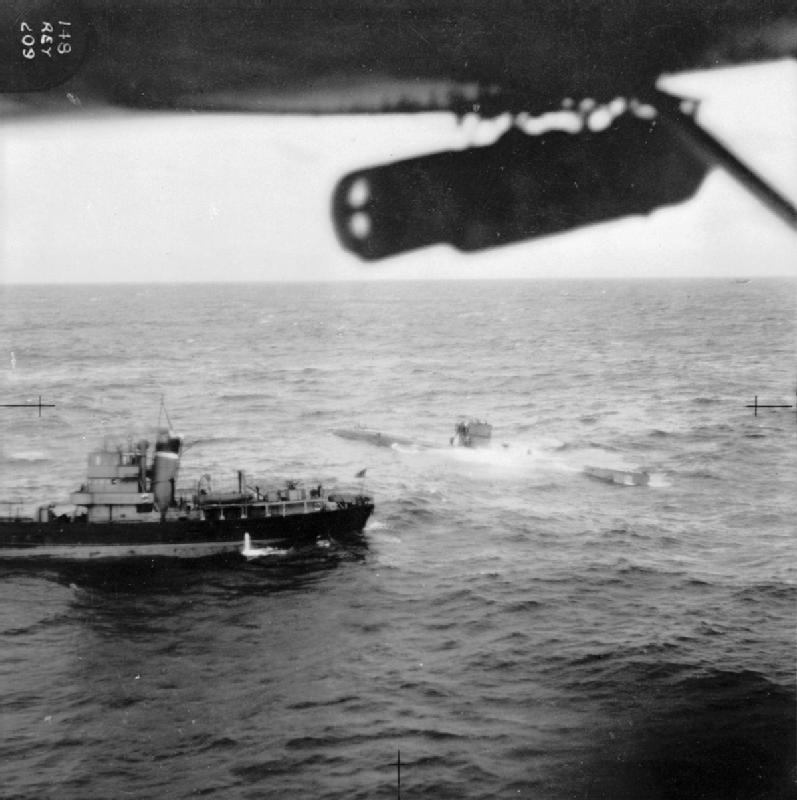
Image: Capture of the German submarine U570. The surfaced submarine is alongside a Royal Navy ship. Taken from RAF Catalina aircraft of 209 Squadron. (Wikimedia Commons.)
On August 27, 1941, the British Royal Navy captured the German U-boat U-570 on its maiden voyage; it was re-flagged as HMS Graph and used by the British for nearly two years.
On August 27, 1941, U-570 spent much of the morning submerged. She had been four days at sea on her maiden voyage to give respite to her inexperienced crew suffering severely from seasickness (several had been incapacitated). Earlier that day, a Lockheed Hudson bomber of 269 Squadron, RAF, operating from Kaldaðarnes, Iceland, had attacked her. The attack failed when the Hudson’s bomb racks could not release its depth charges. U-570 surfaced at position 62°15′N 18°35′W at around 10:50 a.m., immediately below a second Hudson, flown by Squadron Leader James Thompson. Thompson was patrolling the area after the other Hudson aircraft had summoned him by radio. The captain of U-570, who had clambered out onto the bridge, heard the oncoming Hudson’s engines and ordered the submarine to crash-dive. Thompson’s aircraft reached U-570 before she was entirely submerged and dropped its four 250-pound (110 kg) depth charges—one detonated just 10 yards (10 m) from the sub.
U-570 quickly resurfaced, and ten of the crew emerged. The Hudson shot at them with machine guns but stopped when the U-boat crew displayed a white flag. The captured crew members later told British naval intelligence interrogators what had transpired—the depth charge explosions had nearly caused the sub to roll over, eliminated all electrical power, smashed instruments, caused water leaks, and contaminated the air on the ship. The inexperienced crew felt the contamination was chlorine, caused by acid leaking from battery cells mixing with seawater, and the engine-compartment team panicked and moved forward to escape the gas. Fixing electrical power—for the underwater electric motors and lighting—would have been straightforward, yet nobody was remaining in the engine compartment to do this. The submarine was dead in the water and in darkness. The captain believed the chlorine would render it fatal to stay submerged, so he resurfaced. The sea was too rough for the crew to use their anti-aircraft gun, so they displayed a white flag to prevent another, possibly deadly, depth charge attack from the Hudson—they were unaware that the aircraft had dropped all its depth charges.
Most of the crew remained on the submarine’s deck as Thompson circled above them, his aircraft now joined by a second Hudson en route from Scotland to Iceland and been ordered to divert to help the effort. A Consolidated Catalina flying boat from 209 Squadron was scrambled at Reykjavík; it reached the scene three hours later. The German crew radioed their predicament to the German naval high command, destroyed their radio, smashed their Enigma machine, and threw its parts overboard along with the boat’s secret papers. After receiving this report, Admiral Dönitz ordered U-boats in the area to go to U-570’s aid; U-82 responded, but Allied air patrols prevented U-82 from reaching U-570.
U-570’s transmission was in plain language, and the British intercepted it. Admiral Percy Noble, commander of Western Approaches Command, immediately ordered several ships to hurry to the scene. By the afternoon, low fuel levels had forced the Hudsons to return to base in Iceland. The Catalina, a long-range aircraft, was ordered to watch the submarine until Allied ships arrived. If none came before sunset, the plane was to order U-570’s crew to take to the water, then sink her. The first Allied vessel to reach U-570 was the anti-submarine trawler HMT Northern Chief, who arrived at 10 p.m. and was guided to the scene by flares the Catalina had dropped. The Catalina then returned to Iceland after circling U-570 for over 13 hours.
The German crew stayed on board U-570 overnight; they did not attempt to scuttle their boat as Northern Chief had signaled; she would open fire and not rescue any survivors from the water if they did this. (Northern Chief’s captain, N.L. Knight had been ordered to prevent the submarine from being scuttled by any means necessary.) During the night, five more Allied ships reached the scene:
- The armed trawler Kingston Agate
- Two anti-submarine whalers
- The Royal Navy destroyer HMS Burwell
- The Royal Canadian Naval destroyer HMCS Niagara
At daybreak, the Allies and Germans exchanged signal lamp messages, with the German crew constantly requesting they be taken off as they could not stay afloat. The British refused to evacuate them until the Germans secured the submarine and prevented it from sinking—the British were worried that the Germans would deliberately leave behind a sinking U-boat if they were evacuated. The situation became more confusing when a small floatplane (a Northrop N-3PB of 330 (Norwegian) Squadron) appeared. Unaware of the surrender, it attacked U-570 with small bombs and fired on the Northern Chief, which fired back. No damage was inflicted, and the aircraft was ordered away by radio.
The weather worsened; several attempts to attach a tow line to U-570 were unsuccessful. Believing the Germans were being obstructive, Burwell’s captain, S.R.J. Woods, ordered a machine gunner to fire warning shots that accidentally hit and slightly wounded five of the German crew. With much difficulty, an officer and sailors from Kingston Agate reached the submarine using a life raft. After a search could not locate the U-570’s Enigma machine, they secured a tow line and transferred the five wounded men and the submarine’s officers to Kingston Agate. The remaining crew were placed on board HMCS Niagara, which had come alongside U-570.
The ships began sailing towards Iceland with U-570 under tow and with a relay of Hudsons and Catalinas constantly patrolling overhead. They arrived on August 29 at Þorlákshöfn. There, they beached U-570 because she had begun taking on water, and it was thought she might sink.
Renamed HMS Graph, she provided the Royal Navy and United States Navy with much information about German submarines. She would carry out three combat patrols with a Royal Navy crew, becoming the only U-boat to see active service with the Allies and the Nazis during the war. She was taken out of service in 1944 because of the difficulty maintaining her. While being towed to be scrapped, she ran aground on the Isle of Islay, off the west coast of Scotland. A part of the wreckage was discarded as scrap, but some wreckage remains there to this day.
ON SALE NOW!!!
History Daily: 365 Fascinating Happenings Volume 1 – VOLUME 2 NOW AVAILABLE
In the United States:
In Canada:
 History Daily With Francis Chappell Black
Leave a comment