WOMEN JOIN BRITISH WAR EFFORT
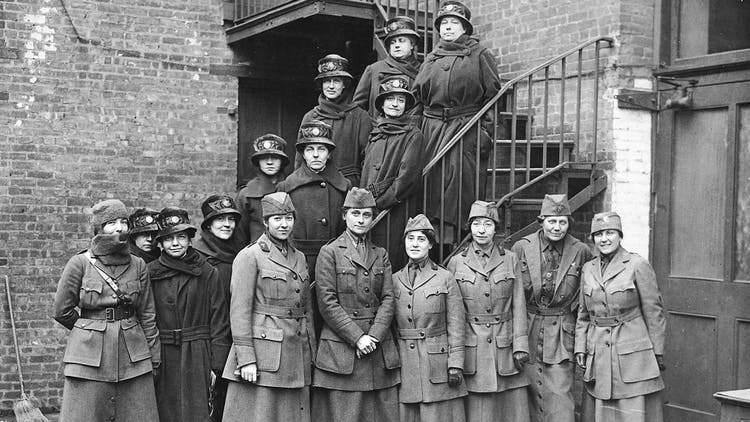
On August 29, 1914, with World War I approaching the end of its first month, the Women’s Defense Relief Corps was formed in Britain.
Though women’s rights organizations in Britain had initially opposed the country’s entry into World War I, they soon reversed their position, recognizing the potential of the war effort to gain advancement for British women on the home front.
In addition to the two nursing organizations that existed in 1914—the First Aid Nursing Yeomanry (FANY) and the Voluntary Aid Detachments (VADs)—several new women’s organizations were created throughout the war. Established with the support of the British Secretary of State for War, Lord Horatio Herbert Kitchener, the Women’s Defense Relief Corps came into being in late August 1914. The corps was made up of two divisions: a civil section, the goal of which was to substitute women for men in factories and other places of employment to free those men for military service, and a “semi-military” or “good citizen” section, where women were actively recruited for the armed forces. This latter group was trained in drilling, marching, and using arms; its members were encouraged to protect themselves and their loved ones on the home front in case of possible invasion by the enemy.
Another organization founded during World War I was the Women’s Army Auxiliary Corps (WAAC), created in July 1917. Members of the WAAC supported the war effort more directly, enlisting in the army to perform labors such as cooking, mechanical and clerical work, and other various tasks. For the first time, British women were sent to the battlefields of the Western Front to serve their country, thus freeing more male soldiers to battle in the trenches against the German enemy. By the war’s end, over 80,000 women had served Britain as non-combatants, both at home and on the front lines in France and Belgium.
HOW 200 CONQUISTADORS CONQUERED AN EMPIRE OF 10 MILLION
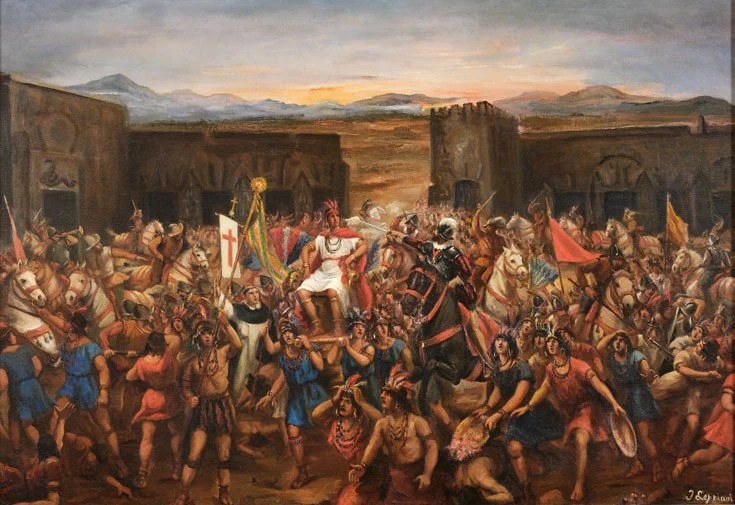
Image: Battle of Cajamarca and the capture of Atahualpa, 1533.
On August 29, 1533, Atahualpa, the last Sapa Inca Emperor, is suspected of having been buried in Northern Peru or Ecuador.
The Inca people named their empire “Land of the Four Quarters” or Tahuantinsuyu, and in 1533, it was the largest in the world. It covered 2,500 miles and stretched from southern Colombia in the north to central Chile in the south. It rose between 1200 and 1300 AD in the valley of Cusco, an increase in temperatures allowing the Inca to inhabit ever higher altitudes and produce agricultural surpluses. The astonishing site of Machu Picchu is evidence of this. The empire successfully built a road network of 14,000 miles, and 10 million people lived within its borders. So how did a mere 200 Spanish conquistadors capture its Emperor-god Atahualpa, and conquer an entire empire?
In reality, several factors brought down this mighty empire, so wealthy contemporaries remarked that its people walked on sandals lined with silver. Since the arrival of the Spanish conquistadors in the Americas, western diseases have steadily weakened native populations. The Inca empire had been especially struck by smallpox, which had reduced the population by an estimated two-thirds and claimed the life of Atahualpa’s father, Emperor Huayna Capac.
After his father’s death, Atahualpa waged a civil war against his half-brother Huascar that lasted six years. A war he had only just won when he encountered Francisco Pizarro in 1532.
The success of Hernán Cortés in Mexico inspired Pizarro and his small force of mercenaries. In a daring ambush on November 16, 1532, Pizarro and his men surprised Atahualpa and his lightly armed followers in the town square of Cajamarca. They shot and killed 5,000 of his men in one hour, sparing only Atahualpa himself. Pizarro had realized Atahualpa was more valuable to him alive than dead. With Atahualpa captive, his generals did not dare to attack, and the Emperor then convinced his captors to ransom him for a room filled with gold and silver.
Once the treasure was gathered, the Spanish refused to release Atahualpa. They gave him the choice of being burnt alive, a pagan’s death, or converting to Christianity and having the kinder end by strangulation. Atahualpa chose the latter, was garroted on July 26, 1533, and given a Christian burial. Various accounts have his remains later dug up, mummified, and reburied. With Atahualpa’s death, the empire collapsed, and the Spanish consolidated their power over the Inca by marching on the capitol, Cusco, and installing their own puppet emperor.
A famous hoard of treasure that never made it in time for Atahualpa’s ransom is supposedly hidden in the Andes. The city of Machu Picchu remained undiscovered by the Spanish and was eventually abandoned by the Inca. Its existence became widely known only when it was discovered by the American explorer Hiram Bingham in 1911.
BRITAIN’S FIRST FACTORY ACT BECOMES LAW ON AUGUST 29, 1833
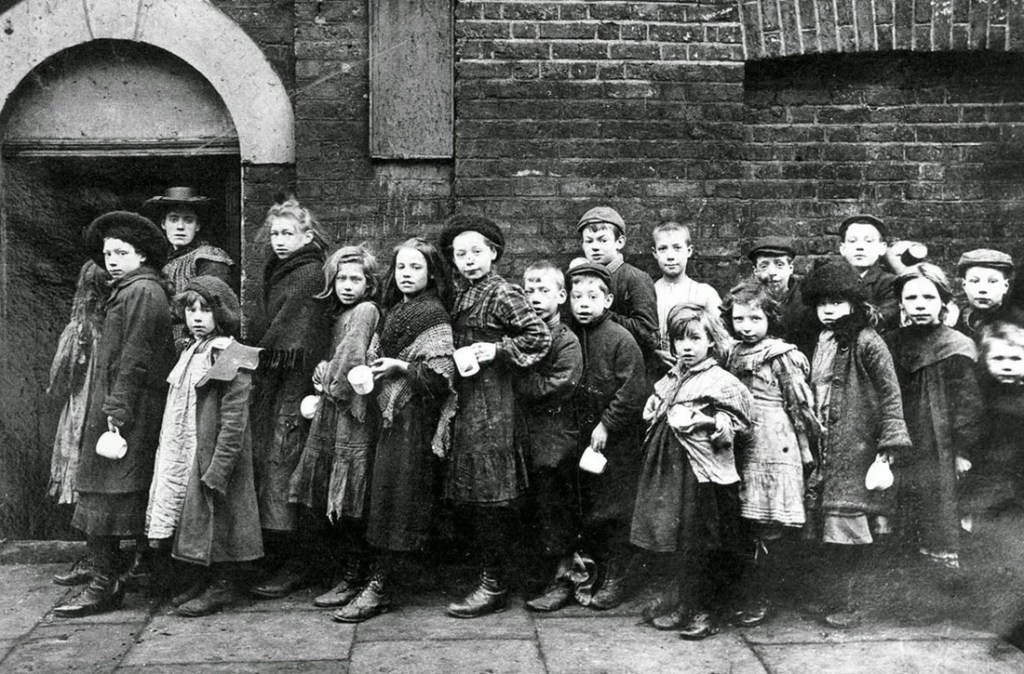
Image: Children lining up for work outside a factory in the late nineteenth century
August 29, 1833 — The United Kingdom’s historic first Factory Act became law today and was much needed.
Women and children faced a grueling workload and positively inhuman conditions, especially in the textile industry, as thousands of factories were built across the country to meet the burgeoning demands of the Industrial Revolution.
Apart from working incredibly long hours – often through the night – workers had to use dangerous machinery that could, and frequently did, cause serious injuries. And if an injured person caused production delays, they would be severely punished.
That applied in some cases even after the tired victim had been heavily fined or even, in the case of a child, beaten for arriving late for work.
Without any regulations to protect them, young children would be forced to work extremely long and dangerous hours, often because their impoverished parents needed money to feed the family.
Word began to spread about the appalling conditions in Britain’s factories, and campaigns for improvement sprung up, leading to the 1833 legislation. It was opposed by Tory Members of Parliament and, of course, by the factory owners, who feared that any change might slow production and cut profits.
By today’s standards, the reforms were modest and, in any case, applied only to the textile industry. The principal provisions of the Act declared that:
* Children under nine must not be employed in textile factories.
* Children between the ages of nine and thirteen must work at most eight hours and be provided an hour lunch break.
* Children between the ages of nine and thirteen could only be employed provided they also had two hours of education daily.
* Children under eighteen must not work after 8:30 p.m. and before 5:30 a.m.
* Children between the ages of fourteen and eighteen must work twelve hours a day or be given an hour’s lunch break.
No rules were established to protect adult male workers, and only four factory inspectors were appointed to enforce the law nationwide!
A Factory Inspector’s report around this time sheds light on some conditions. He wrote:
“I took the evidence from the mouths of the boys themselves. They stated to me that they commenced working on Friday morning, May 27, at 6 am and that, except for meal breaks and one hour at midnight extra, they continued working on Saturday evening, having been two days and a night thus engaged.
“Believing the case scarcely possible, I asked every boy the same questions, and from each received the same answers.”
Examples of subsequent court records show that in 1862, John Jones, who ran a factory in Wales, faced a fine of £1 for “employing three young persons and one female after 6 pm.”
Another Welsh factory owner, Samuel Harris, was accused in the same year of “employing two young persons and two children after 2 pm on a Saturday.” The charges were dropped when he paid £1.14 shillings costs.
A new Factory Act in 1844 decreed that children aged eight to 13 could work six hours a day. Night work for women was banned.
In 1847, it was ruled that women and children under 18 could not work more than ten hours daily.
Then, the 1901 Factory Act raised the minimum age for workers to 12 and ruled that this would apply everywhere, not just the textile industry.
Despite the limitations of the 1833 Act, it did at least create the beginnings of a much-needed system of government control and offered, as one historian put it, “the first recognition that the common laborer needed state protection from the full might of unbridled capitalism.”
Join my mailing list.
 History Daily With Francis Chappell Black
Leave a comment