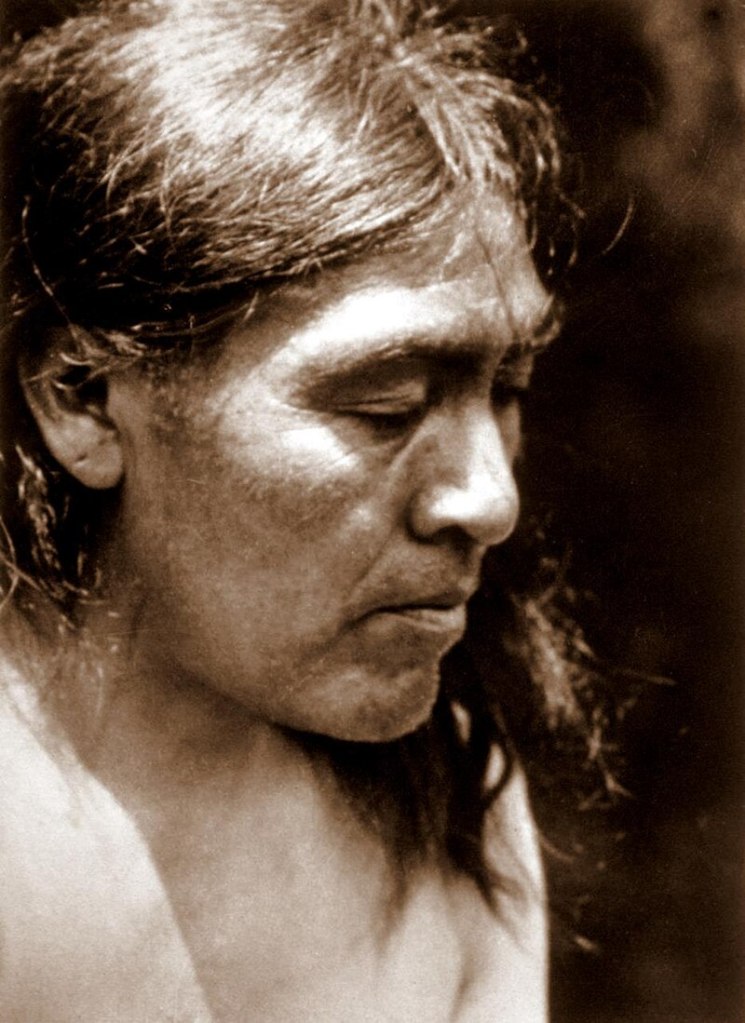
Image: Ishi portrait. (Wikimedia Commons.)
On this day in history, Ishi, who was described as the last surviving member of the Native American Yahi tribe, is discovered near Oroville, California.
History Daily: 365 Fascinating Happenings Volume 1 & Volume 2 – August 29, 1911
By the early 20th century, Anglo-Americans had overwhelmed the North American continent, and barely any Native Americans remained who had not been acculturated into Anglo society to some degree. Ishi was an exception to that rule. Found lost and starving near an Oroville, California, slaughterhouse, he was unfamiliar with white American ways and spoke no English.
Authorities took the Native American man into custody for his protection. News of the so-called “Stone Age Indian” attracted the attention of a young Berkeley anthropologist, Thomas Waterman. Gathering what partial vocabularies existed of Northern California Native dialects, the speakers of which mainly had vanished, Waterman went to Oroville to meet Ishi. After unsuccessfully attempting words from several native dialects, Waterman attempted a few words from the language of the Yana Indians. Some were intelligible to Ishi, and the two men could finally partake in a rough dialogue. The following month, Waterman took Ishi to live at the Berkeley University Museum, where their communication ability gradually improved.
Waterman eventually learned Ishi was a Yahi people member, an outlying branch of the northern California Yana tribe. He was about 50 years old and was the last of his people. Ishi said he had meandered the mountains of northern California for some time with a small number of the Yahi people. Gradually, an accident or disease killed his companions. A white man murdered his final male companion, and Ishi wandered alone until he reached Oroville.
Following custom, Ishi declined to speak his name to outsiders without introduction by a person from his tribe. Instead, he was called by the word that means “man” in the language of his people, the Yahi. The southernmost group of Yana speakers, the Yahi, lived in the valleys east of the upper Sacramento River. Born probably around 1860, Ishi spent much of his life in hiding with his family, trying to avoid the influences of predominantly white settlers moving into Yahi territory.
White settler militias systematically eliminated the Yahi people during the nineteenth and early twentieth centuries, part of a more extensive campaign of genocide against Native Californians. On August 29, 1911, after the demise of his family and other remaining Yahi, Ishi was trapped by dogs outside Oroville, CA. Having secured Ishi in the local jail, town officials contacted the Hearst Museum, then known as the University of California, Berkeley Museum of Anthropology.
Museum Director Alfred Kroeber proposed Ishi live at the Museum instead of officials’ proposal that he be sent to a Native reservation in Oklahoma. Ishi was brought to the Museum in San Francisco, where he lived for the last four and a half years of his life.
Advertised as “the last wild Indian in California,” Ishi was employed by the Museum to demonstrate Yahi culture. He spent much time on display for white museum audiences, creating obsidian and colored glass projectile points and recording Yahi songs and stories. The Museum collected and still maintains the objects and recordings that Ishi made.
Ishi was also a live-in custodian and research assistant at the Museum. In 1914, at Kroeber’s insistence, Ishi reluctantly went with anthropologists back to his home and the location of his family’s massacre, the Deer Creek Valley area of Tehama County, to record Yahi culture.
Ishi was well-known in San Francisco and could be found hunting on Mount Parnassus and walking in Golden Gate Park. First-hand accounts recall him making tools and sharing information with Museum visitors. Many described Ishi as very friendly and anxious to share his knowledge. Nonetheless, we must now acknowledge that Ishi’s position at the Museum resembled indentured servitude and that he was objectified as a living exhibit. Kroeber counted Ishi as his friend and used their unequal relationship to advance his career and the Museum’s popularity.
Lacking acquired immunity to common diseases, Ishi was often ill. Saxton Pope, a professor of medicine at UCSF, treated him. Pope became close friends with Ishi and learned how to make bows and arrows from him in the Yahi way. He and Ishi often hunted together. Ishi died of tuberculosis on March 25, 1916. It is said that his last words were, “You stay. I go.” It is now disgraceful to think about the actions taken by employees of the Museum and University after Ishi’s death. While at the Museum, Ishi was very distressed to live among excavated human remains; Native American ancestors exhumed for research and curation. He requested that his own body be cremated according to Yahi tradition. While traveling at the time of Ishi’s death, Kroeber advised against an autopsy. His friends at the University tried to stop an autopsy on Ishi’s body since Yahi tradition called for the body to remain intact. However, the University of California medical school doctors performed an autopsy before Waterman and Kroeber could prevent it.
Ishi’s brain was preserved, and his body was cremated. His friends placed grave goods with his remains before cremation: “one of his bows, five arrows, a basket of acorn meal, a boxful of shell bead money, a purse full of tobacco, three rings, and some obsidian flakes.” Ishi’s remains were interred at Mount Olivet Cemetery in Colma, California, near San Francisco. Kroeber put Ishi’s preserved brain in a deerskin-wrapped Pueblo Indian pottery jar and presented it to the Smithsonian Institution in 1917. On August 10, 2000, the Smithsonian repatriated the preserved brain to the descendants of the Redding Rancheria and Pit River tribes. Ishi’s ashes and brain were repatriated and reunited. Ishi is now buried in a confidential location near Deer Creek, California, his homeland.

ON SALE NOW!!!
History Daily: 365 Fascinating Happenings Volume 1 – VOLUME 2 NOW AVAILABLE
In the United States:
In Canada:
Join my mailing list.
 History Daily With Francis Chappell Black
Leave a comment