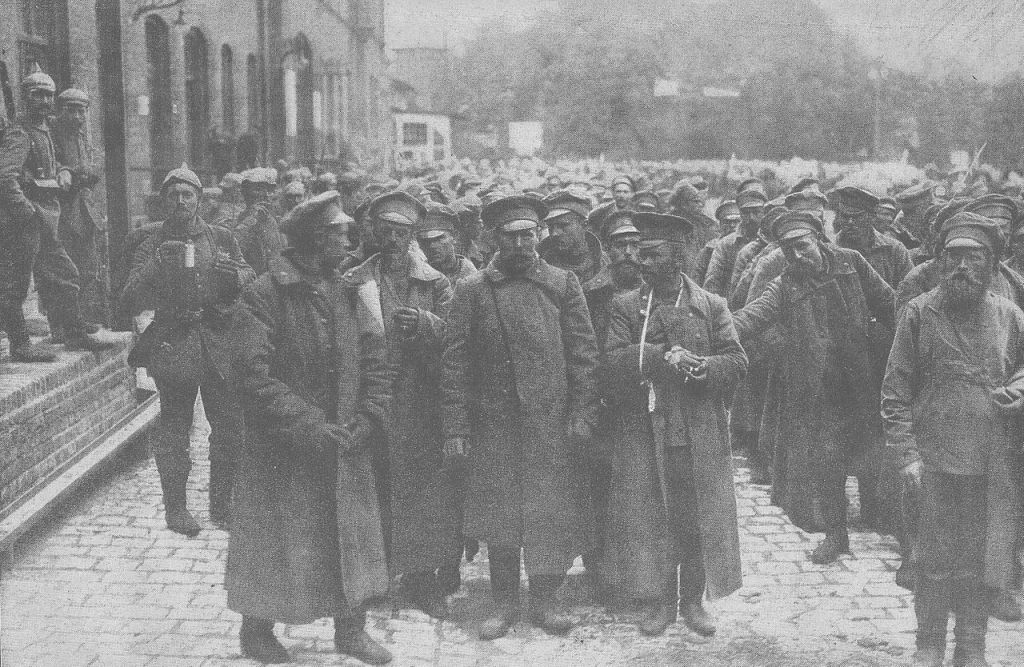
Image: Russian prisoners of war after the Battle of Tannenberg (Wikimedia Commons.)
On this day in history, August 30, 1914, the Battle of Tannenberg ended with the destruction of the Russian Second Army, with 140,000 killed, injured, or captured by the German 8th Army led by Paul von Hindenburg and Erich Ludendorff.
History Daily: 365 Fascinating Happenings Volume 1 & Volume 2 – August 30, 1914
There have been two epic battles at the place known as Tannenberg. The first, in 1410, saw the defeat of a German religious order called the Teutonic Knights at the hands of Poles and Lithuanians.
Five hundred years later, Germany got its revenge in one of the earliest battles of World War I when a single German army destroyed two much larger Russian invading forces in August of 1914. Even though the German World War I victory took place miles from the 1410 battle, the Kaiser, unable to resist the historical significance, named it Tannenberg.
The Battle of Tannenberg was fought August 23 -30, 1914. One of the few battles of maneuver from a conflict best known for static trench warfare, Tannenberg saw German forces in the east effectively destroy General Alexander Samsonov’s Russian Second Army. The Germans could concentrate their forces before overwhelming and surrounding Samsonov’s men by employing a mix of signals intelligence, knowledge of the enemy commander’s personalities, and effective rail transportation. The battle also marked the debut of General Paul von Hindenburg and his chief of staff, General Erich Ludendorff, as a highly effective duo on the battlefield.
When World War I broke out in 1914, Russia and Great Britain allied with France against the Central Powers of Germany, Austria-Hungary, and the Ottoman Empire. Germany’s attack strategy, known as the Schlieffen Plan, was to amass its superior forces in the West and invade France through the neutral state of Belgium. Then the triumphant German armies would ride the rails East to repel the Russians. At least, that was the plan.
But the German military machine miscalculated how easy it would be to waltz through Belgium. The neutral nation fought valiantly against an all-out German assault at the 10-day Battle of Liege, the first official battle of World War I, which bought time for British and French soldiers to shore up their line of defense.
Meanwhile, Germany had committed seven of its eight armies to the West, believing it would take at least six weeks for the sluggish Russian army to mobilize its forces and attack in the East. The lone German army dispatched to the Russian border region, known as East Prussia, was the 8th Army led by General Maximilian von Prittwitz.
What happened was the Russians mobilized a lot quicker than the Germans expected. Also, the 8th Army was the weakest of the German armies. It had a lot of reservists and garrison troops, people commonly assigned to defend fixed positions.
When the Germans learned that the Russians were invading East Prussia with two armies, one in the North and another in the South, they ordered Prittwitz to attack the northern Russian 1st Army at what became known as the Battle of Gumbinnen on August 20, 1914. Both sides suffered heavy losses, and Prittwitz, envisioning a second Russian army on its way, lost his nerve. Prittwitz was a capable commander, but he had suffered defeat at the Battle of Gumbinnen and decided that retreat was the only option in the face of these two armies coming at him out of Russia.
The German High Command pulled Prittwitz from command and replaced him with the legendary Paul von Hindenburg (brought out of retirement) and a military mastermind named Erich Ludendorff, fresh from a German victory at the Battle of Liege. Retreat was not an option.
The Russian army was less experienced and well-trained than its German foe, which led to some critical mistakes. The most significant Russian error was broadcasting their orders over open radio frequencies, confusing encoded messages. By intercepting these messages, the Germans learned that the Russian 1st Army wasn’t chasing down the German 8th Army as expected but rather turning North toward the Prussian city of Konigsberg.
Ludendorff, the brilliant German strategist, saw an opportunity. The two Russian armies were separated by challenging terrain known as the Masurian Lakes, which slowed their progress. Knowing that the Russian 1st Army was on its way North to Konigsberg, Ludendorff and Hindenburg decided to commit most of the 8th Army to strike the Russian 2nd Army south of the lakes.
The Russian commanders were not amateurs but needed to improve on better communications, slow supply routes, and the frustrations of moving a large army (plus heavy artillery) on foot and horseback through rugged terrain. General Alexander Samsonov, in charge of the Russian 2nd Army in the South, walked right into Ludendorff’s trap and allowed his men to be completely encircled.
Then the Germans launched two flank attacks. Because of communication problems, the Russian commanders didn’t know that a significant attack on their flank was underway until half a day too late.
Samsonov commanded 150,000 men in the Russian 2nd Army, and less than 10,000 returned to Russia. An estimated 50,000 soldiers were killed in panicked fighting, and 92,000 more were taken prisoner by Germany.
Unable to face the Czar and explain the lopsided defeat at Tannenberg, Samsonov walked alone into the woods and killed himself with his officer’s pistol/
But the troubles for Russia weren’t over yet. Fresh from the victory at Tannenberg, the German 8th Army marched north and routed the Russian 1st Army at the Battle of Masurian Lakes. The Russian army retreated in disarray, losing tens of thousands as POW’s.
The Russian 1st and 2nd Armies effectively ceased to exist after those two battles. It was a devastating defeat. The Russians faced off against the Germans with superior numbers and got nothing – worse than nothing.
Hindenburg and Ludendorff, now national heroes in Germany, petitioned the Kaiser to name the initial victory the Battle of Tannenberg simply for the “mythical benefit” of German retribution for the 1410 defeat. After Germany ultimately lost World War I, Tannenberg took on even greater symbolic significance.

ON SALE NOW!!!
History Daily: 365 Fascinating Happenings Volume 1 – VOLUME 2 NOW AVAILABLE
In the United States:
In Canada:
Join my mailing list for regular updates on new content and publications:
 History Daily With Francis Chappell Black
Leave a comment