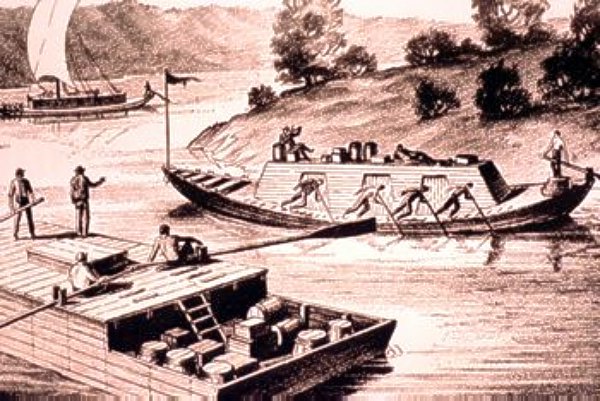
Image: While on the Ohio River and later the Mississippi, Samuel Mason and his gang of river pirates chose flatboats, keelboats, and rafts as profitable targets to attack because of the valuable and plentiful cargo on board. (Wikimedia Commons.)
On this day in history, August 31, 1777, Samuel Mason, a Patriot captain in command of Fort Henry on the Ohio frontier, survives a devastating Native American attack on the fort.
Samuel Mason was born in Norfolk, Virginia, on November 8, 1739, and was raised in Charles Town, West Virginia. He married Rosanna Dorsey in 1767, and the couple would have eight children. In 1773, he moved his family to Ohio County, West Virginia, during the Revolutionary War. He was a captain of the Ohio County Militia, Virginia State Forces, in January 1777. He was given control of Fort Henry on the Ohio frontier in present-day West Virginia.
During the summer of 1777, while soldiers to the east were fighting the war of independence, Mason was apprehensive about attacks by the Indian allies of the British. On August 31, 1777, a band of Native Americans from several eastern tribes attacked the fort. Initially, the Indians fired on several men outside the fort, rounding up horses. When Mason heard the shots, he gathered 14 men and rode to their rescue. However, this was precisely what the warriors had hoped for, and they quickly ambushed the rescue party, killing every last man except Captain Samuel Mason. The captain, however, was severely wounded and escaped death by hiding behind a log. He was soon rescued and recovered from his wounds to command Fort Henry for two more years.
By the early 1790s, Mason had settled at Red Banks, now known as Henderson, Kentucky. Later, he moved downriver to Diamond Island, where he began participating in criminal activity. By 1797, he moved his headquarters to Cave-in-Rock on the Illinois shore. By this time, he had several followers who openly based themselves at Cave-in-Rock. Here, Mason and his men warmly welcomed riverboat travelers to rest and eat. However, while these visitors enjoyed the hospitality, Mason’s men scoured their supplies and goods for anything valuable. If they found something, they would wait until the next day and rob them as they made their way around the river’s bend when the visitors went on their way.
While at Cave-in-Rock, Mason and his men briefly harbored the infamous Harpe brothers, who were wanted by the law. The Harpes were a couple of the most vicious outlaws at the time and were America’s first serial killers. Though the Mason Gang could be ruthless, even they were taken aback at the activity of the Harpes. After the murderous pair began to take travelers to the top of a cliff, strip them naked, and throw them off, they were told they had to leave.
In 1799, the Mason Gang was coerced to leave Cave-in-Rock when a group of bounty attacked them hunters called the “Exterminators.” Mason moved his operation downriver, settled in Spanish Louisiana, and became a highwayman on the Natchez Trace in Mississippi, robbing and killing unsuspecting travelers.
In April 1802, Mississippi Governor William Claiborne was informed that Samuel Mason and Wiley Harpe had tried to board the boat of Colonel Joshua Baker between Yazoo and Walnut Hills, now Vicksburg, Mississippi. The governor responded by ordering Colonel Daniel Burnet, with 15-20 volunteers to track down Mason and his men. A reward of $2000 was offered for their capture.
Though dozens of men searched for the Mason Gang, the outlaws continued their evil deeds along the Natchez Trace, striking one caravan with horrific brutality. Another posse and a few bounty hunters were raised to go after them. The posse quickly pursued, learning that Mason and his men hid near the Trace near Rocky Springs, Mississippi. When they found the camp, it had been abandoned. Though the outlaws’ trail was fresh, most of the posse chose not to follow instead of remaining at the camp, searching for any hidden loot that the outlaws may have left. However, a few men continued the pursuit but stopped the search when they lost the scent.
Months later, Spanish officials had more success. In January 1803, Mason, four of his sons, and several other individuals at the Little Prairie settlement in southeastern Missouri were arrested. Mason and the rest of the group were ferried to the colonial government in New Madrid, Missouri, where a three-day hearing took place to determine if Mason was indeed a pirate. Although Mason claimed he was a farmer accused by his enemies, the presence of $7000 in cash and 20 human scalps in his baggage did little to think that Mason was anything else but guilty. Mason, his family, and the other men then boarded a boat to New Orleans. They were to be handed over to the American governor in the Mississippi Territory. However, using the alias John Sutton, Mason and Wiley Harpe overpowered their guards while being transported and ran. Even though Mason was shot in the leg, he made good his escape.
Governor William Claiborne immediately added an additional $500 reward for their recapture, making the total reward $2500. This staggering amount prompted Wiley Harpe and another man to bring Mason’s head to claim the reward in September 1803. Whether they killed Mason or he died from his leg wound is unknown. However, the two gang members were arrested, tried in federal court, and found guilty of piracy rather than recovering any reward for the head of Mason. They were hanged in Greenville, Mississippi, in early 1804.
Help us with our endeavors to keep History alive. With our daily Blog posts and our publishing program we hope to inform people in a comfortable and easy-going manner. This is my full-time job so any support you can give would be greatly appreciated.
 History Daily With Francis Chappell Black
Leave a comment