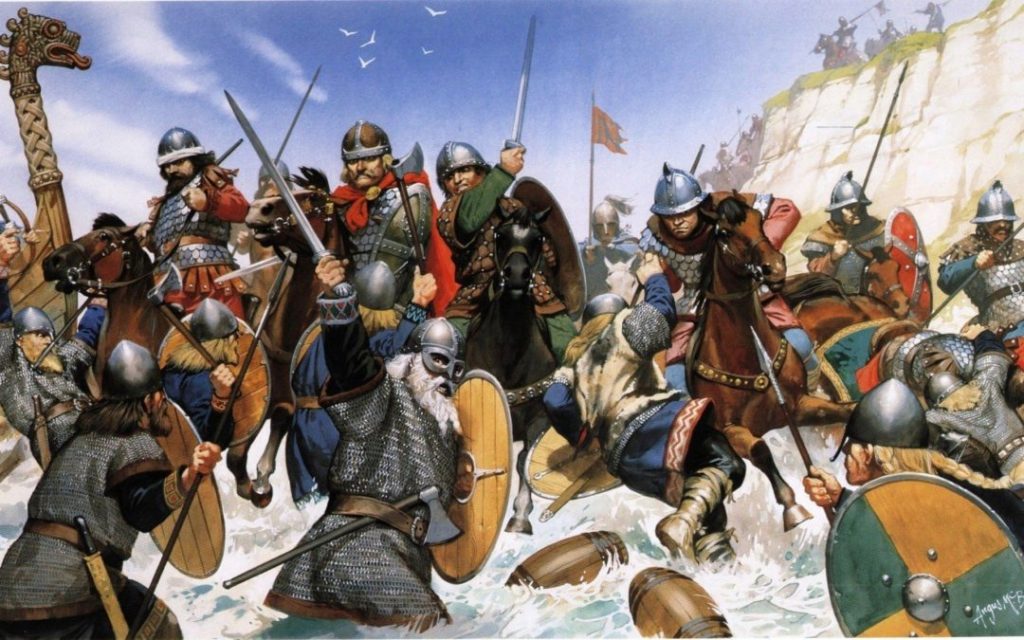
Image: Vikings in battle by artist Marii Armate Pagane.
On this day in history, September 1, 891, a Viking force gathered on the River Dyle was defeated by the forces of East Francia at the Battle of Leuven.
The existence of this battle is known through several chronicles, including the Annales Fuldenses and the Anglo-Saxon Chronicle. The Battle of Leuven occurred near the present-day location of Leuven in Belgium. In the 880s, the Vikings established a camp that they used as a base of operations to launch raids into the ruptured Frankish kingdom. Attempts to verify the report of the battle, specifically the considerable loss of life on the Viking side, have been hampered by the lack of archaeological excavations in Belgium.
Little is known about what prompted the renewed Viking assault on the continent and East Francia, specifically at the end of the 9th century. The Chronicon of Regino of Prum stated that the Vikings were compelled to give up their attacks on Britain, which they had been attacking at least since the 8th century. Here the Vikings mainly focused their attention on Ireland, and once they established their presence there, they began launching raids into neighboring England and Europe. The Viking raids continued throughout much of Europe for most of the next two centuries. In 866, the Danish ‘great army’ began a significant attack on England, whose fractured kingdoms were considered easy targets. They quickly took over East Anglia, Mercia, and Northumbria, but the king of the West Saxons, Alfred the Great, held things up. At the Battle of Edington in 878, Alfred defeated a leading Danish Viking leader, and the main campaign force of Vikings went from England to Europe, where they continued raiding throughout. They even besieged Paris in 885-886. Charlemagne’s great-grandson, Charles the Fat, offered them a ransom of silver and shuffled them off to Burgundy, where they continued to raid and plunder.
Regino’s Chronicon reinforces this image, stating that after two decisive defeats in Britain, the Vikings moved their forces across the channel and began raiding and plundering the continent with renewed vigor. The defeat in England and the unique circumstances in Francia in the mid to late 9th century made that section of Europe a primary objective for the Vikings. Louis the Stammerer died in April 879, leaving to his two sons a kingdom that quickly erupted in upheaval. Frankish nobles supported differing candidates for the throne, and their internal divisions left them open to attacks across the channel from the opportunistic Danes, who took advantage of the situation. Whatever the reasons, it is clear that the battle occurred during a revitalized and concentrated raiding by the Vikings on the European continent, centered on the fractured Carolingian Empire.
The lead-up to the battle happened during the summer of 891. While King Arnulf was off on the Bavarian frontier dealing with the Slavs, the Vikings met a Frankish force in battle on June 26. The Franks were still determining their opponents’ aims: would the Vikings make next for Cologne, head for Trier, or flee when faced with a Frankish army? The Franks would march out and draw up battle lines after crossing a stream called the Geule, then begin discussing forming parties to scout their enemy. During these discussions, the Vikings’ scouts happened upon the Franks. The Frankish army pursued the scouts without waiting for instructions from their leaders. Eventually, it ran into the Viking infantry force in a nearby village, which easily defeated the disorderly Frankish attackers. Once their cavalry had been drawn into the battle, the Vikings easily beat the Franks, who retreated, only to be mowed down by their Viking pursuers. The Vikings then went on to raid and plunder, taking their captured loot back to their ships.
Part of King Arnulf’s motivation for going to battle against the Vikings was to seek revenge for his fallen men and to restore the image of the Franks, which had been severely damaged by their flight during the battle. Therefore, he assembled many men and met the Vikings in action at the Dyle River, where the Danes were entrenched.
The Viking forces had strengthened their position and “constructed a fortification of wood and piled-up earth in their usual manner.” Moreover, a swamp protected one flank of their fortifications and the Dyle the other, giving them a decided advantage. The Frankish army came upon the Vikings rather unexpectedly. Knowing their superior position, the Vikings taunted the Frankish contingent, throwing the recent battle at Geule in their faces and promising this battle would end in the same way. Arnulf was enraged but held off because of the enemy’s superior position. He ordered his cavalry to dismount and unite with the group of foot soldiers that was part of his army.
He planned to advance over the open field toward the Danish fortifications. Arnulf commanded a rear guard of mounted soldiers to protect against any surprise attacks the Vikings might launch from the nearby swamp. The Frankish forces were overwhelmingly successful, especially once they had driven the Vikings past their fortifications. Left with nowhere to retreat, the Danes were cut down by the Franks or drowned in the Dyle as they fled the battle. The Viking leaders Sigfried and Gottfried were slain during the fight, and 16 standards were captured.
After the battle, relative peace ensued in Francia, although the cause of this peace depended on the source. For example, some chroniclers, biased toward the Frankish side, state that the incredibly decisive defeat, where virtually all of the Danish forces were massacred, impeded Viking raiding in the region for the following number of years. Less prejudiced chronicles, such as the Annals of St. Vaast, stated that the real reason for the Viking departure was famine, which ravaged the countryside in 892. According to these Annals, the Vikings took to their ships to escape the famine and left the region in peace.
Viking raids continued in Francia and the rest of Europe for many decades. Rather than completely subduing the Viking raiders, the Battle of Leuven ensured a short-lived peace in Francia.
Join our mailing list for updates on new content:
 History Daily With Francis Chappell Black
Leave a comment