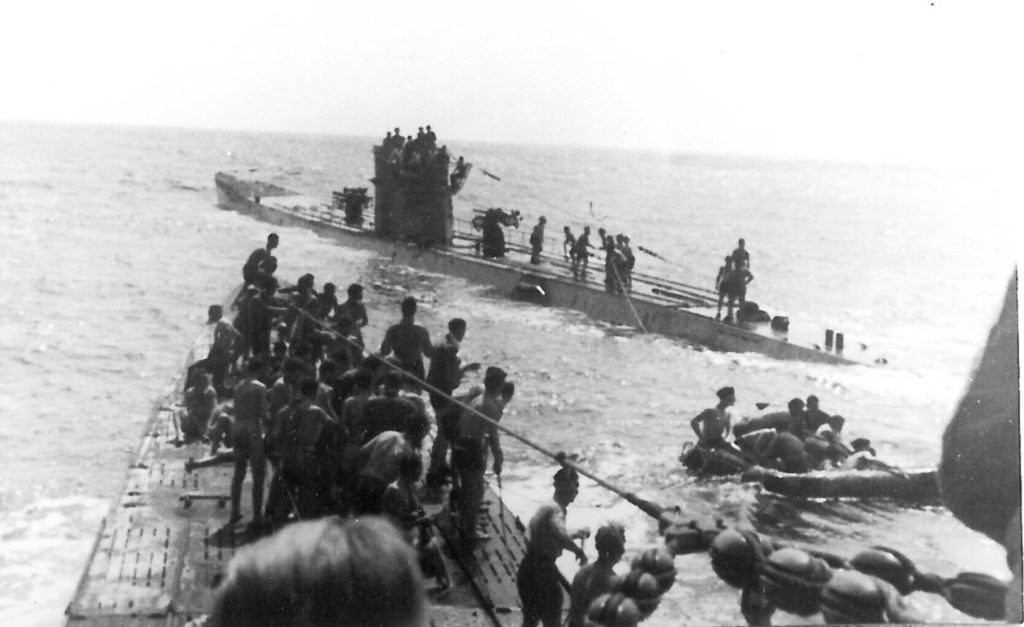
Image: Shuttle service for shipwrecked persons from the Laconia between U156 (foreground) and U507 (background). (Wikimedia Commons.)
On this day in history, September 12, 1942, a German U-boat sinks a British troop ship, the Laconia, killing more than 1,400 men. The commander of the German submarine, Captain Werner Hartenstein, realizing that Italian POWs were among the passengers, strove to aid in their rescue.
The Laconia, a former Cunard White Star ship used to transport troops, including prisoners of war, was in the South Atlantic bound for England when it encountered U-156, a German submarine. The sub attacked, sinking the troop ship and imperiling the lives of more than 2,700 passengers. But as Hartenstein, the sub commander, was to learn from survivors he began taking onboard, among those passengers were 1,500 Italian POWs. Perceiving that he had just risked the lives of so many of his fellow Axis members, he called an Italian submarine and two other German U-boats into the area to help rescue the survivors.
The Laconia Incident changed how Germany treated prisoners of war and was even discussed at the Nuremberg Trials. However, the American prosecutors were left embarrassed when the full details emerged.
This tragic series of events occurred when the German U-boat U-156 sank the British troopship RMS Laconia off West Africa in September 1942. The vessel was carrying 2,732 crew, prisoners of war, passengers, and soldiers.
The ship was constructed in 1921 as a civilian ocean liner and requisitioned to assist with the war effort. By 1942 the Laconia had been turned into a troopship, and at the time of the incident, her route was sailing from Cape Town, South Africa, to Freetown in Sierra Leone.
Just before midnight on September 12, 1942, U-156 was located off the coast of West Africa, between Liberia and Ascension Island. The Laconia was deemed a legitimate target because it was armed, which excluded it from being warned before an attack.
At 10:22 p.m., the ship transmitted a signal advising that a submarine had attacked them, although it is unclear if another vessel picked up the message.
The high death toll occurred despite regular drills being carried out in evacuation techniques. Plenty of lifeboats were on board, but heavy listing due to the damage caused by the submarine, half of the lifeboats could not be launched until the ship had settled. Under the decks, chaos reigned. The Italian POWs were locked in the cargo holds as the Laconia sank. They tried to escape by breaking down the hatches or climbing ventilation shafts. Many were shot. A number of prisoners were bayoneted to death by their Polish guards, who were armed with rifles with fixed bayonets but no ammunition.
The situation for the POWs would not improve. Only one life ever raft left the ship with anyone on board. Those in the water were shot or had their hands cut off with axes if they tried to climb into a lifeboat. The blood attracted sharks, who started a feeding frenzy.
Once the Laconia had gone down, the captain of the enemy submarine Werner Hartenstein started rescue operations. Over 2,000 people were flailing in the water, including women and children. Hartenstein also broadcast his intentions over open radio channels so Allied forces in the vicinity would be informed of his humanitarian actions.
Picking up survivors, U-156 placed them on the foredeck and began traveling under Red Cross banners to Vichy French ships to transfer them. Several other German U-boats joined in the rescue efforts. Surprisingly, seven U-boats were rerouted by Admiral Donitz from a planned covert attack on Cape Town. The Admiral then told his superiors in Berlin about the situation, which angered Adolph Hitler. He ordered Donitz to return the boats to Cape Town per the original plan.
U-156 had picked up nearly 200 survivors and had another 200 in tow in four lifeboats. Hartenstein broadcast a message in English informing all shipping in the area that he had survivors of the sunken ship on board. Still, the British in Freetown thought it was a ruse.
The submarine remained on the surface for the next couple of days and was joined by three more. After the four had collected as many survivors as possible, they headed for the French warships, which had started from Senegal and Dahomey, to meet them. While en route with the survivors, a United States Army Air Force B-24 pilot spotted the procession and reported that they had survivors of the Laconia sinking on the foredecks of their submarines. Their cold-hearted commanders ordered them to attack the submarines.
The B-24 pilot followed his orders and killed dozens of the survivors with bombs and by administering strafing attacks. It forced Hartenstein to order his sub to crash-dive to avoid destruction and cast the survivors off. The U.S. aircrew mistakenly reported they had sunk the submarine and received medals for their bravery.
In the end, one thousand one hundred thirteen people were rescued by other vessels in the area while 1,619 died, mainly Italian prisoners of war who had been under guard below deck.
The Laconia Incident had far-reaching consequences. Until then, U-boat commanders had often assisted the survivors of ships they had sunk with provisions and medical care. However, in response to this incident, Donitz issued an order forbidding U-boats from rescuing survivors
in the future.
At the Nuremberg Trials after the war, Donitz was charged with war crimes, including issuing the Laconia order. It backfired as evidence showed the Allies had acted callously in the same instance and that the Americans had accomplished similar acts from the beginning of the war.
Far from affirming the cold, black hearts of the Nazis, the Laconia Incident showed the humane side of the German commanders. It also proved that sometimes the “good guys” are also occasionally guilty of doing evil things.
Subscribe to History Daily with Francis Chappell Black to receive regular daily updates regarding new content:
Help us with our endeavors to keep History alive. With our daily Blog posts and our publishing program we hope to inform people in a comfortable and easy-going manner. This is my full-time job so any support you can give would be greatly appreciated.
 History Daily With Francis Chappell Black
Leave a comment