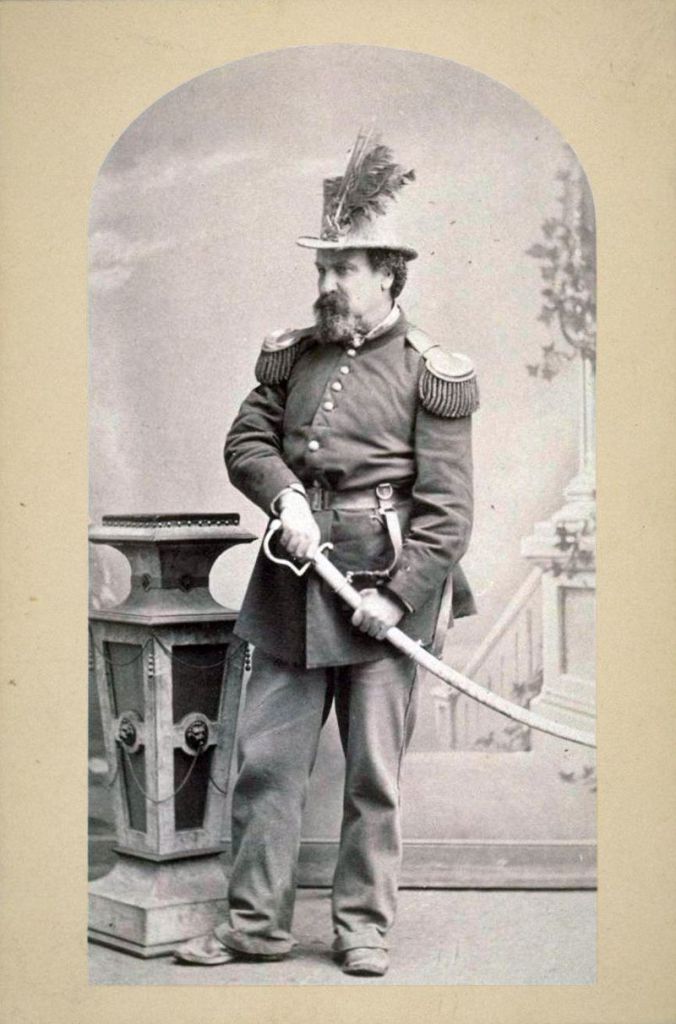
Image: Emperor Norton in full dress uniform and military regalia, his hand on the hilt of a ceremonial sabre, c. 1875. (Wikimedia Commons.)
On this day in history, September 17, 1859, Joshua Abraham Norton, an English-born resident of San Francisco, California, proclaimed himself Imperial Majesty Emperor Norton I, Emperor of the United States of America. He later included the title “Protector of Mexico.” Rather than being harassed for his courageous assertions, he was honored by the people of his hometown of San Francisco and celebrated in the literary works of renowned writers.
Joshua Norton was born on February 4, 1818, in the Kent town of Deptford, today part of London. His mother and father were English Jews who left England for South Africa in 1820 as part of a government settlement program. They became part of the group known as the “1820 Settlers.”
Norton relocated to the United States around the time of the 1849 Gold Rush in California. There he moved into the real estate market in San Francisco, and by 1852 he had become one of the city’s most affluent and esteemed residents.
In late 1852, China stopped all rice exports to other countries because of a famine. This move caused the price of rice in San Francisco to increase rapidly. When a ship arrived in California from Peru carrying 200,000 pounds of rice, Norton, seeing an opportunity, decided to capture the rice market. Shortly after he bought the entire cargo, several other ships from Peru arrived loaded with rice, thus causing the price of rice to plummet. Norton attempted to void the contract for the original purchase, stating that the seller had misrepresented himself regarding the rice’s expected quality. After four years of legal action, the California Supreme Court ruled against Norton. He had no choice but to file for bankruptcy in 1858.
Norton vanished for about a year after the bankruptcy. When he came back into the public eye, many people believed that he had also lost his mind and wealth. On September 17, 1859, he sent messages to newspapers around San Francisco declaring himself Emperor Norton I of the United States. The San Francisco Bulletin went along with his wild assertions and published the statement:
“At the peremptory request and desire of a large majority of the citizens of the United States, I, Joshua Norton, formerly of Algoa Bay, Cape of Good Hope, and now for the last 9 years and 10 months past of S.F., Cal., declare and proclaim myself Emperor of these U.S.; and in virtue of the authority thereby in me vested, do hereby order and direct the representatives of the different States of the Union to assemble in Musical Hall, of this city, on the 1st day of Feb. next, then and there to make such alterations in the existing laws of the Union as may ameliorate the evils under which the country is laboring, and thereby cause confidence to exist, both at home and abroad, in our stability and integrity.”
Emperor Norton’s numerous proclamations about disbanding the U.S. Congress, the country itself, and the abolition of the two main political parties were disregarded by the American government and those leading the American Army. Nevertheless, he was supported by the people of San Francisco. He devoted most of his time strolling the city’s thoroughfares in a blue uniform with gold epaulets that were provided to him by the U.S. Army officers from the Presidio in San Francisco. He also sported a hat adorned with a peacock feather. He would examine the state of the roads, sidewalks, and other public property. In several instances, he spoke on a wide range of educational topics. Two dogs, named Bummer and Lazarus that went along with him during his excursions about the city became superstars as well. Emperor Norton added “Protector of Mexico” to his moniker after the French attacked Mexico in 1861.
In 1867, a police officer apprehended Norton to commit him to care for a mental condition. Local citizens and newspapers voiced intense anger. Police Chief Patrick Crowley ordered Norton freed and delivered a formal expression of regret from the police department. The emperor gave a pardon to the policeman who detained him.
Although destitute, Norton often dined free of charge in the area’s top restaurants. Space was set aside for him at the premieres of plays and concerts. He released his own paper money to repay his bills, and the currency was received in the city as legal tender. Photographs of the emperor in royal attire were marketed to vacationers, and Emperor Norton dolls were produced. He also expressed his affection for San Francisco by proclaiming that employing the name “Frisco” to describe the city was a violation punishable by a $25 penalty.
On December 2, 1859, he proclaimed that Governor Henry Wise of Virginia should exit his office over the killing of abolitionist John Brown, and John Breckinridge of Kentucky should be appointed in his place. On March 23, 1872, he instructed that a suspension bridge be constructed from Oakland Point to Goat Island and on to San Francisco. And finally, on September 21, 1872, he ordered an assessment to decide if a suspension bridge or a tunnel was the best option for linking Oakland and San Francisco.
Of course, Joshua Norton had no real political sway to implement these proclamations, so none were carried out.
On January 8, 1880, Joshua Norton fell ill near the corner of California and Dupont Streets. Police sent for transport to take him to the nearest hospital, but he died before they could arrive.
Exploring Norton’s boarding house room after his death proved he lived in poverty. When he died, he had five dollars on him and a gold sovereign worth $2.50 in his room. His items included walking sticks, multiple hats and caps, and messages penned to Queen Victoria of England.
The original funeral arrangements were intended to bury Emperor Norton I in a pauper’s coffin. Nevertheless, the Pacific Club, a San Francisco businessman’s organization, purchased a rosewood casket suitable for an honorable man. On January 10, 1880, the funeral procession was joined by 30,000 people. The march itself was two miles long. In 1934, his casket was moved to Woodlawn Cemetery in Colma, California, along with the rest of the graves in the city. Nearly 60,000 people attended the new burial. Flags flew at half mast throughout the city, and the engraving on Norton’s new tombstone stated, “Norton I, Emperor of the United States and Protector of Mexico.”
Subscribe to History Daily with Francis Chappell Black to receive regular updates on new content:
Help us with our endeavors to keep History alive. With our daily Blog posts and our publishing program we hope to inform people in a comfortable and easy-going manner. This is my full-time job so any support you can give would be greatly appreciated.
 History Daily With Francis Chappell Black
Leave a comment