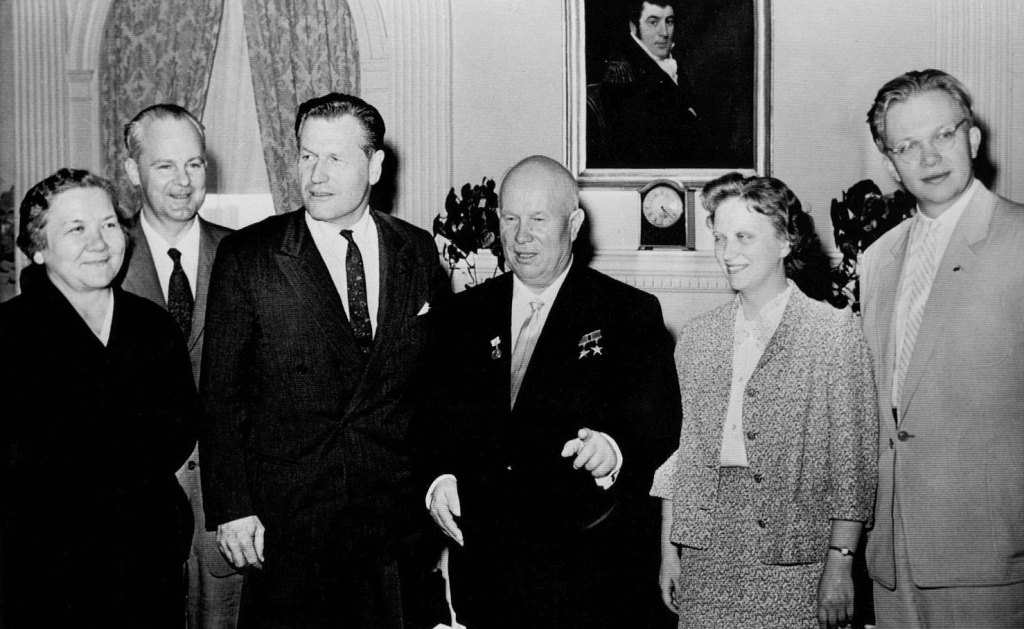
Image: Photo of Nelson Rockefeller (then the Governor of New York) calling on Soviet Premier Nikita Khrushchev and his family, who were visiting the United States. The Khrushchevs were staying at the Waldorf-Astoria in New York. From left-Mrs. Khrushchev (Nina), the Soviet Ambassador to the US, Mikhail Manishikov, Nelson Rockefeller, Premier Khrushchev, Rada Khrushchev (daughter) and Sergei Khrushchev (son). (Wikimedia Commons.)
On this day in history, September 19, 1959, Soviet leader Nikita Khrushchev, after arriving in Los Angeles during a two-week coast-to-coast tour, his first official visit to America, was informed that his planned trip to Disneyland had been canceled, ostensibly for security reasons.
Khrushchev’s tumultuous 20-hour Los Angeles tour is better recalled for the Kremlin boss’ overbearing exploits than for his discussions with President Dwight D. Eisenhower at the White House and Camp David.
Khrushchev’s fixation with Hollywood started that day with a visit to the 20th Century Fox Studios. He was escorted onto the sound stage of “Can-Can,” where he encountered two co-stars from the movie: Shirley MacLaine and Juliet Prowse. Khrushchev gazed at cast members perform a number from the motion picture, then in production. Later, Frank Sinatra put on a lunch for the Russian leader.
The atmosphere blackened, nevertheless, after Spyros Skouras, 20th Century Fox’s head, introduced Khruschev at Los Angeles Town Hall. Skouras, a fervent anti-communist, cited Khrushchev’s claims that the Soviet Union would “bury” capitalism and said that while Los Angeles was not intent on “burying” anybody, it would never shy away from any test.
Reacting indignantly, Khrushchev stated: “If you want to go on with the arms race, very well. We accept that challenge. As for the output of rockets _ well, they are on the assembly line. This is a most serious question. It is one of life or death, ladies and gentlemen – one of war and peace.”
In addition to that apparent affront, Khrushchev discovered he would be prevented from touring Disneyland. He seethed and said: “And I say, I would very much like to go and see Disneyland…. What is it? Is there an epidemic of cholera there or something? Or have gangsters taken over the place that can destroy me? Then what must I do? Commit suicide? This is the situation I am in – your guest. For me, the situation is inconceivable. I cannot find words to explain this to my people.”
Sitting next to Mrs. Khrushchev, Sinatra bent across to actor David Niven and stated, “Tell the old broad you and I will take ‘em down there this afternoon.” (A State Department representative later communicated that Mrs. Khrushchev and her daughters could visit Disneyland, but she had opted to stay with her spouse.)
For his part, Khrushchev kept his hosts captivated with peasant’s humor and a peasant’s rage.
Los Angeles Mayor Norris Paulson cautioned citizens that his goal was to harass, taunt and embarrass the Russian leader.
“Everybody else can be nice to him, but I’m not going to be,” Poulson stated. “I’m going to have my fist out there, but it’s going to be covered with velvet. And under the velvet, I’m going to have a long, sharp knife….”
The studio heads would have liked Khrushchev to concede that socialism would never produce the gathered fame of the superstars gathered around him. Khrushchev only wished to speak to John Wayne.
Smiling, Khrushchev took Wayne by the arm and escorted him to the bar. “I’m told,” Khrushchev stated through his translator, “that you like to drink and that you can hold your liquor.”
“That’s right,” Wayne said slowly as he and Khrushchev discussed the merits of Russian vodka and Mexican tequila. Keeping up with Wayne shot for shot but still stable on his feet, the happy Khrushchev turned his attention to Juliet Prowse’s performance of a saucy cancan.
The next day he would criticize Prowse’s act as sinful and offensive. “A person’s face is more beautiful than his backside,” he would say. Actress Shirley MacLaine, who was showcased in the film, was recounted to have said: “If I had known he felt that way, we’d have done it without pants.”
When Khrushchev left the studio, bystanders stuck tomatoes onto his limousine as the particularly insulted Russian strongman and his 30-car, protected convoy wound its way through the city. Six feet deep at the road’s edge, citizens neither waved nor greeted the open limousine as it drove by.
Police would later state that an explosive device was placed inside a tree along the route and that a 47-year-old man who said he had been “deer hunting” had been arrested for carrying a concealed weapon – a .45-caliber handgun and a bow and arrow – just minutes before the Russian leader’s limousine drove by on Sepulveda Boulevard.
Later that night, the situation became more chaotic. More than 1,000 people – 300 of them delegates of the premier’s entourage – appeared at a lavish banquet held at the Ambassador Hotel. The event was a frustration for the community, as 7,000 citizens of Los Angeles had tried to secure one of the $12.50-per-head tickets to the soiree.
Keeping his word, the less-than-cordial Mayor Poulson grasped the opportunity, shaking his finger at Khrushchev: “We do not agree with your widely quoted phrase, ‘We shall bury you.’ You shall not bury us, and we shall not bury you.” Gasping angrily, Khrushchev threw away his planned speech and tore into the mayor with his own in-your-face tirade.
“Why do you bring that back? I already have dealt with it during my trip.” He said he often was making it apparent that he had often used the word burial as a metaphor – a way of stating that communism would outlive capitalism, both as a power in history and as a philosophy – and that the mayor should have been aware of that.
The only person who had had a very good day was John Wayne, who, at a minimum, found something he always appreciated – a drinking companion who could keep up with him.
When Khrushchev left in the early hours of the following day, neither Poulson nor any other city representative showed up to bid them farewell as they embarked on an 18-car special train to San Francisco with short stops in five cities.
From a photo opportunity with Juliet Prowse to a fiery discussion with the head of a movie studio and the mayor of Los Angeles, as well as an immature eruption about not being permitted to visit Disneyland, Khrushchev’s day in Los Angeles was chock-full of memorable events. The head of the Soviet Union resumed his journey through California without further confrontations and went back to Washington for his conference with Eisenhower.
Three months later, Wayne laughed with pleasure when he received numerous cases of premium Russian Vodka and a note: “Duke, Merry Christmas. Nikita.” Wayne responded by dispatching a pair of cases of Sauza Conmemorativo tequila signed, “Nikita. Thanks. Duke.”
Subscribe to History Daily with Francis Chappell Black to receive daily updates on new content:
Help us with our endeavors to keep History alive. With our daily Blog posts and our publishing program we hope to inform people in a comfortable and easy-going manner. This is my full-time job so any support you can give would be greatly appreciated.
 History Daily With Francis Chappell Black
Leave a comment