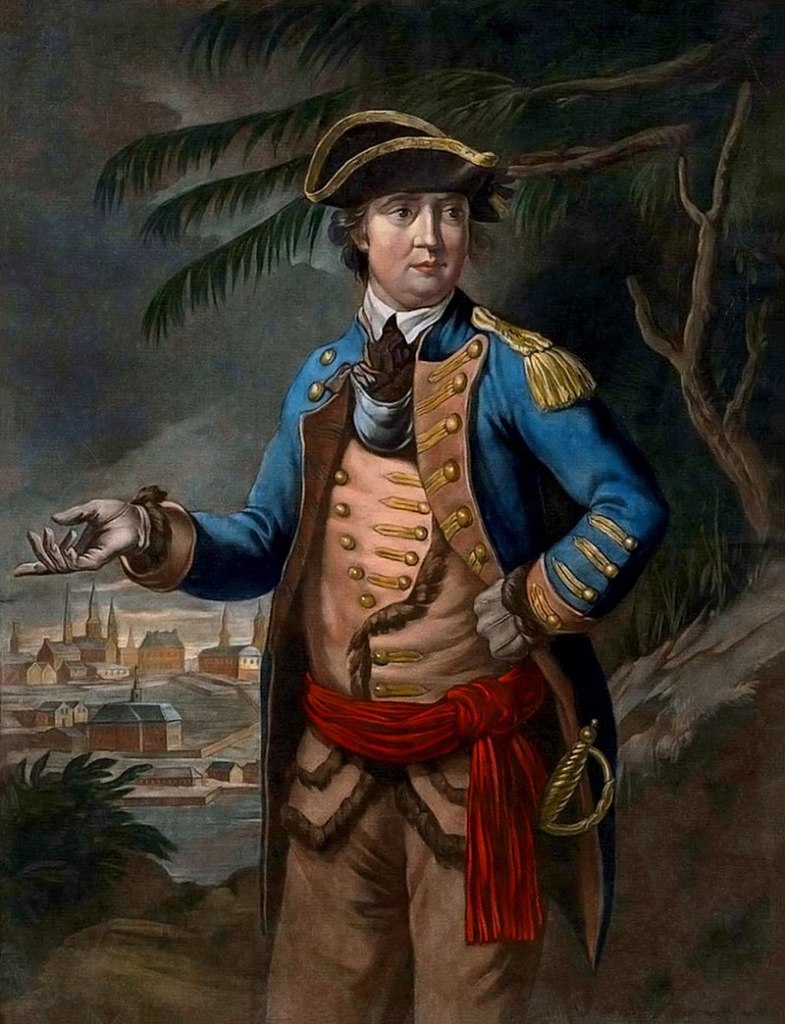
Image: Benedict Arnold (Wikimedia Commons.)
On this day in history, September 21, 1780, during the American Revolution, American General Benedict Arnold meets up with British Major John Andre to talk about giving the fort at West Point to the British in exchange for guaranteeing a substantial amount of cash and a high-ranking position in the British army. The conspiracy was thwarted, and Arnold, a one-time American hero, became equivalent to a “traitor.”
Arnold was born to an esteemed family in Norwich, Connecticut, on January 14, 1741. He apprenticed as an apothecary and became a militia member during the French and Indian War (1754-1763). He would become a prosperous merchant, and he joined the Continental Army when the Revolutionary War broke out in 1775.
During the war, Benedict Arnold demonstrated himself as a courageous and skilled leader, assisting Ethan Allen’s soldiers in seizing Fort Ticonderoga in 1775 and taking part in the failed attack on British Quebec soon after, which promoted him to brigadier general. Arnold became celebrated during the campaigns at Lake Champlain, Ridgefield, and Saratoga and earned the support of George Washington. Despite this, Arnold had rivals inside the military establishment, and in 1777, five men of less significant rank were promoted over him.
Washington sought appointments permitting Arnold to recover from his battle injuries and appointed him Military Governor of Philadelphia in 1777 after the British vacated the area. It was one of the most horrible mistakes of Washington’s career. The job called for political finesse, grit, and a cool head, which was everything Arnold was not. Worse, Arnold was soon charged with misappropriating funds and was openly accused of corruption. This made him angrier and more resentful of his opposite number, who were still earning wealth and fame.
By 1778, he had been injured three times in battle and had lost his business in Connecticut. He was resentful of several contenders who had been promoted over him. By 1779, he was due to be court-martialed for war profiteering, which seemed like an unfair reward for all the self-sacrifice he had made. He was disbelieved and loathed by many of his one-time commanders and colleagues; his only supporter was George Washington. However, in his distrust and skepticism, Arnold thought Washington had deceived him.
Arnold’s work in Philadelphia laid the foundation for his downfall. First, he ultimately fell in love again after losing his wife three years earlier. Her name was Peggy Shippen, the daughter of a British loyalist and former girlfriend of a British officer, Major John Andre. Arnold married Shippen in 1779 and soon discovered that she and her companions ran with the Loyalist crowd instead of the Patriot crowd. One historian stated that the best justification for Arnold’s sedition was that he “married the wrong person.”
In May 1779, one of Peggy’s acquaintances told British General Henry Clinton that Arnold offered knowledge and support. Soon Arnold was in contact with Major John Andre, Peggy’s erstwhile paramour, and by July 1779, was transmitting intelligence about troop concentrations, activities, and materials. In return, Arnold was promised reimbursement of his business damages and a bonus.
After completing his court-martial, Arnold was momentarily disgraced, further reinforcing his hostility towards Washington and the American cause. Shortly, though, Major Andre was pushing him for details about the critical American fort at West Point, New York, which overshadowed the Hudson River. Arnold, in turn, pushed for authority over the fort at West Point, which Washington agreed would be appropriate. Arnold was offered control of West Point in August 1780.
On August 25, Peggy provided Benedict Arnold with his closing offer from the British: a large sum and no compensation for his losses. Arnold, in charge of West Point now, began to intentionally destabilize its defenses and troop morale, exhausting the supplies and refusing to do much-needed repairs: the surrender of West Point to a British army. General Clinton sent Andre to organize the terms with Arnold near West Point. On September 21, 1780, the two men met and planned for the surrender of the fort – essentially handing over the whole Hudson River to the British and conceivably tearing America apart.
Upon returning to British lines, Andre was captured by the New York militia and questioned by Major Benjamin Tallmadge, a member of Washington’s famous spy ring. The documents Andre carried on him unveiled the plot, and Arnold’s betrayal, and the caper was immediately over. The moment Benedict Arnold discovered Andre’s capture, he absconded from West Point, connecting with a British ship on the Hudson and disappearing down the river to New York and the safety of General Clinton’s military base. Before leaving, though, he penned a note to Washington requesting that Peggy be given safe passage.
Washington accorded Arnold’s wife safety – he was a gentleman, after all – but gave no such mercy for Andre, whom he had hanged as a spy. Washington even tried to abduct Arnold in New York, but the turncoat absconded. During the rest of the Revolutionary War, Arnold would act as a general for the British, as well as the incursion into Virginia in 1781.
But Arnold was a shattered man. Even though he attempted to excuse his behavior toward his fellow Americans in a series of letters, he still escaped to England in exile in 1781 and would never return home again. He petitioned the British government for a military posting as a general after the war, only to be refused; Edmund Burke remarked that having deceived one army, it would be unwise to give Arnold another. Arnold would remain in London, taking part in various unsuccessful enterprises and business ventures, until his eventual death in 1801.
Benedict Arnold’s name became synonymous with “traitor” in America, with Benjamin Franklin even saying that “Judas sold only one man, Arnold, three millions.” All of his family’s tombstones were destroyed.
Benedict Arnold bemoaned his choice to the very end of his life.
It is stated that Arnold wished to be dressed in his old Continental uniform on his deathbed, speaking, “Let me die in this old uniform in which I fought my battles. May God forgive me for ever having put on another.”
Subscribe to History Daily with Francis Chappell Black to receive daily updates regarding new content:
Help us with our endeavors to keep History alive. With our daily Blog posts and our publishing program we hope to inform people in a comfortable and easy-going manner. This is my full-time job so any support you can give would be greatly appreciated.
 History Daily With Francis Chappell Black
Leave a comment