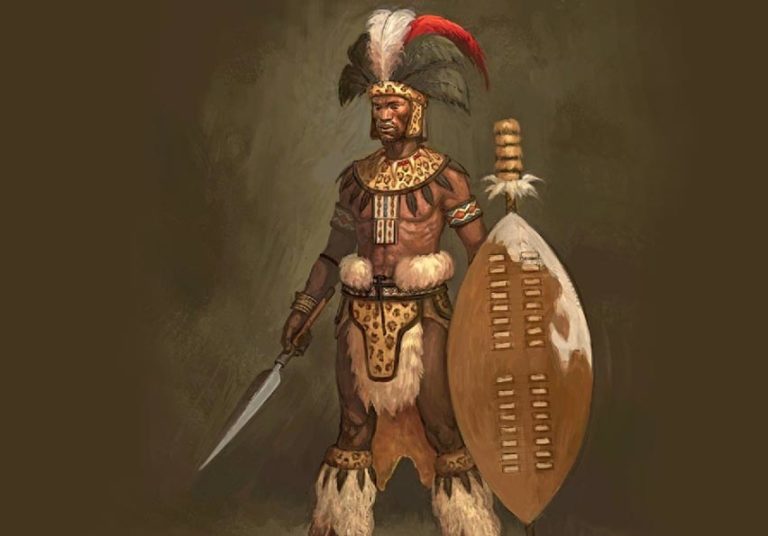
Image: An artistic rendition of Shaka (artist unknown)
On this day in history, Shaka, the originator of the Zulu Kingdom of southern Africa, is assassinated by his two half-brothers, Dingane and Mhlangana, after Shaka’s mental illness threatens the survival of the Zulu tribe.
When Shaka became chief of the Zulus in 1816, the tribe totaled fewer than 1,500 people and was one of the smaller of the many tribes in southern Africa. Nevertheless, Shaka showed that he was a talented military coordinator, creating well-commanded squadrons and equipping his fighters with assegais, a new style of the long-bladed, short spear that was effortless to brandish and lethal. The Zulus quickly defeated bordering tribes, integrating the remnants of the conquered tribes into their society. By 1823, Shaka was in command of all present-day Natal. The Zulu victories significantly disrupted the territory, resulting in a great flood of relocations by displaced tribes.
Shaka, king of the Zulus, was born in 1787 to the Zulu chief Senzangakhona KaJama, and Nandi of the neighboring Langeni clan. One story is that the impregnation of Shaka’s mother was a misstep after his parents got over-exuberant during uku-hlobonga, a ritual for unmarried couples requiring sexual foreplay and no penetrative sex. When Zulu leaders, including the chief himself, realized Nandi was with child, they tried to deny it. Senzangakhona claimed that Nandi’s swollen stomach was an indicator of iShaka, a gastric and parasitic beetle.
Shaka was given his name as a steady reminder of his bastardism, and at age six, Shaka and his mother were banished from his father’s village. Shaka and his mother went to her home, where they were also unwanted and ultimately forced out to join a separate tribe completely, the Mthethwa. In his late teens, Shaka was given an amabutho, or a military regiment of young men split up based on age group. Each amabutho was called upon when required for warfare, manual labor, policing, or hunting.
During this period, he grabbed the interest of the leading chieftain, Dingiswayo. Shaka demonstrated great bravery, ability, and strength. An interested Dingiswayo became a teacher to him.
At age 21, Shaka got his first taste of warfare. By then, he was physically intimidating, standing at six feet, three inches, and full of muscle. Shaka had three assegais, or “light spears,” for throwing and a five-foot 9-inched oval shield. He wore a skirt of fur strips, a cloak with black widow-bird feathers, sandals, and white oxtails around his ankles and wrists.
Battles between the tribes at that time showed power with very little carnage. The two opponents would face each other at 40 or 50 yards and throw their assegais until one side bolted. Even if chased, the escaping side had to drop their assegais and capitulate, and their lives would be saved.
Shaka rapidly demonstrated his instinctive warfare capacity and started modifying the fighting weapons he was issued. First, he removed his sandals because they could make him lose his balance. With enhanced dexterity, Shaka could fight an enemy at close range. He ricocheted spears with his shield, then attacked his opponent. Moving the adversaries’ shield away with his own, he could sink his assegai into his prey.
Shaka also made his own weapon with a short, wide handle and a large blade. In fact, he had produced a sword. He called it the iklwa because of the noise it made when it was shoved in and yanked out of somebody’s dead body.
He became identified as Nodumehlezi, “the one who, when seated, causes the earth to rumble.”
Shaka effectively conquered the force of Zwide, the chief of the Ndwandwe tribe, which won him a generous share of seized cattle. Chief Dingiswayo, in turn, made Shaka his commander-in-chief and, more significantly, helped arrange a reunion between Shaka and his disgruntled father, Senzangakhona.
Senzangakhona made Shaka his successor, but before his murder in 1816, one of his spouses persuaded him to make Shaka’s half-brother Sigujana his replacement as a substitute. But Shaka was not keen to leave things be. With the aid of one of Dingiswayo’s contingents, Shaka murdered Sigujana and took command of the 1,500 Zulus. They were one of the smallest of the more than 800 clans – but under Shaka, this would all shift.
His new territory increased to 100 square miles. Shaka continued as subservient to Dingiswayo until Zwide assassinated the chief in 1817. Dingiswayo’s death caused many Mthethwa to defect to the Ndwandwe, while others enlisted with Shaka. Zwide proved a daunting adversary to him initially, but Shaka’s outstanding military approach would achieve a critical triumph against the Ndwandwe the next year.
This victory allowed Shaka the independence to engage in coalitions with other tribes and strengthened his authority while growing his military.
Shaka was famous for his brutality. Historians believe he became a ruthless tyrant as he formed more coalitions, conquered more chiefs, and extended the Zulu Kingdom. He insisted on devotion from his fighters. If anyone offended his mother or him, he sentenced them to a painful death.
But he continued to be nonviolent to white settlers and even sent representatives from his kingdom to visit them. Under his reign, there were no disputes between the Zulu people and white traders. Though the British did negotiate control over Port Natal – now the city of Durban in South Africa – they did not attempt to confront Shaka. It would only be after Shaka’s death that bloody clashes between his people and the Dutch-Afrikaner settlers known as the “Boers” started.
Shaka ruled over 250,000 people for ten years without any rivals. He could gather over 50,000 warriors at any given time, and it was said that he was to blame for killing some two million people by war alone.
In 1827, Shaka Zulu’s mother, Nandi, died, and the Zulu chief lost his mind. In his grief, Shaka had many Zulus massacred, and he prohibited the sowing of crops and the use of milk for one year. All women found pregnant were killed alongside their husbands. He sent his army on a massive military campaign, and when they returned exhausted, he instantly instructed them to go out again. It was all the lesser Zulu chiefs could stand: On September 22, 1828, his half-brothers assassinated Shaka. Dingane, one of the brothers, succeeded and became king of the Zulus.
Subscribe to History Daily with Francis Chappell Black to receive regular updates on new content:
Help us with our endeavors to keep History alive. With our daily Blog posts and our publishing program we hope to inform people in a comfortable and easy-going manner. This is my full-time job so any support you can give would be greatly appreciated.
 History Daily With Francis Chappell Black
Leave a comment