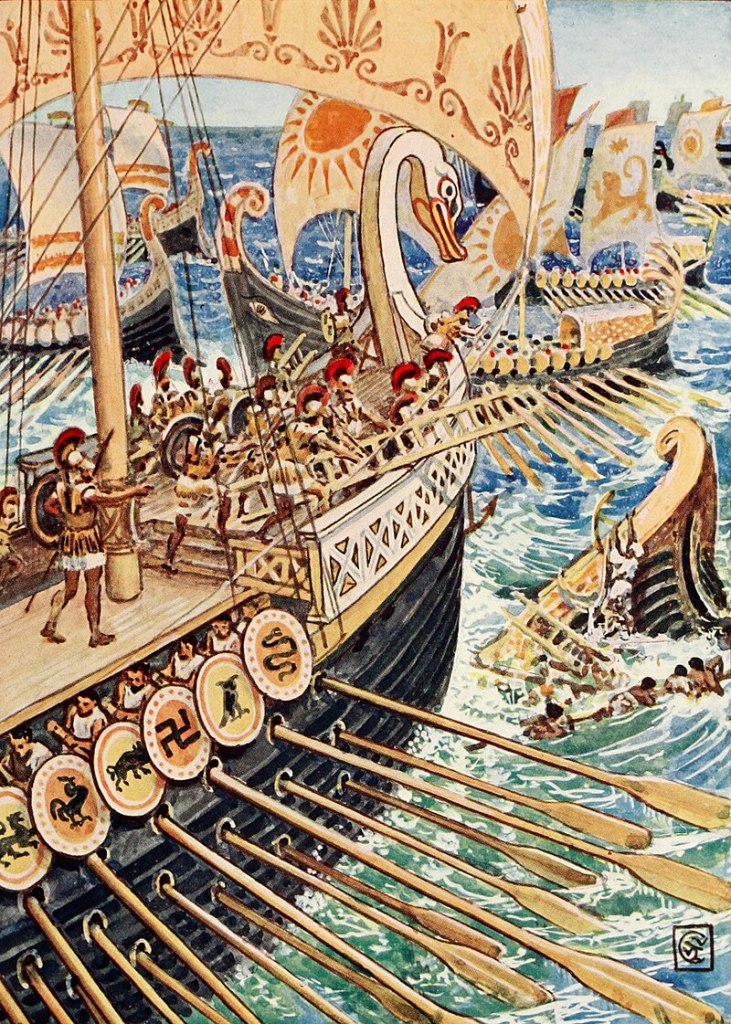
Image: The Battle of Salamis, 19th Century illustration. (Public Domain.)
On this day in history, September 23, 480 BCE, the Battle of Salamis was waged during the Persian Wars (499 to 449 BCE). The struggle at Salamis witnessed the out-numbered Greeks defeating a larger Persian navy in one of the greatest naval battles in history. The war had seen the Greeks driven south and Athens seized. Reorganizing, the Greeks were adept enough to entice the Persian flotilla into the narrow waters around Salamis, an island in the Saronic Gulf near Athens, invalidating their numerical benefit. In the ensuing fight, the Greeks severely trounced their adversary and compelled them to flee. Incapable of providing for their army by sea, the Persians were obliged to withdraw and move north.
Attacking Greece in mid-480 BCE, Xerxes I’s coalition of Greek city-states fought the Persian army. Driving south into Greece, a sizable flotilla helped the Persians offshore. In August, the Persian armed forces met Greek soldiers at the pass of Thermopylae while their navy confronted the allied armada in the Straits of Artemisium. Despite a courageous stand, the Greeks were defeated at the Battle of Thermopylae, pushing the navy to flee southward to assist in the withdrawal from Athens. Helping with this endeavor, the navy later relocated to harbors on Salamis.
Progressing beyond Boeotia and Attica, Xerxes assaulted and scorched those cities that resisted before conquering Athens. To maintain opposition, the Greek army created a newly strengthened position on the Isthmus of Corinth, intending to protect the Peloponnesus. While a powerful location, it could be effortlessly outmaneuvered if the Persians embarked on their soldiers and traversed the Saronic Gulf. To counteract this, some of the allied chiefs debated in support of pushing the navy to the isthmus. Notwithstanding this risk, the Athenian leader Themistocles reasoned that they remain at Salamis.
Offensively inclined, Themistocles realized that the smaller Greek flotilla could nullify the Persian gain in numbers by battling in the constrained waters around the island. As the Athenian fleet made up the more significant part of the Allied navy, he was able to effectively argue for staying. Wanting to address the Greek fleet before moving on, Xerxes first tried to steer clear of battling in the confined waters around the island.
Mindful of disagreement among the Greeks, Xerxes started shifting soldiers towards the isthmus with the expectation that the Peloponnesian groups would abandon Themistocles to protect their native country. This also failed, and the Greek flotilla stayed put. To encourage the idea that the allies were splintering, Themistocles began a ploy by dispatching a servant to Xerxes, asserting that Athenians had been mistreated and wanted to switch sides. He also indicated that the Peloponnesians planned to leave that evening. Trusting this news, Xerxes guided his fleet to prevent access to the Straits of Salamis and the Megara to the west.
While an Egyptian flotilla proceeded to pass through the Megara channel, most of the Persian fleet took up a position near the Straits of Salamis. Also, a small regiment of soldiers was relocated to the island of Psyttaleia. Putting his throne on the hills of Mount Aigaleos, Xerxes got ready to observe the upcoming fight. While the night went by without anything happening, a group of Corinthian galleys was seen proceeding northwest away from the straits the following day.
Thinking the allied fleet was splitting up, the Persians started turning towards the straits with the Ionian Greeks on the left, the Phoenician flotilla on the right, and other navies in the center. Established in three rows, the Persian fleet’s structure began to collapse as it moved into the narrow waters of the straits. Fighting against them, the Allied fleet was positioned with the Spartans on the right, the Phoenicians on the left, and other Allied ships in the center. As the Persians loomed, the Greeks slowly moved their galleys backward, enticing the enemy into the restricted waters and acquiring breathing space until the morning wind and tide.
Turning, the Greeks immediately went on the attack. Pushed back, the first line of Persian galleys was driven into the second and third lines causing the structure of the battle group to break apart. The starting of a growing wave also led the top-heavy Persian vessels to have trouble steering. The Persian admiral Ariabignes was slain in the early hours of the combat on the Greek left, rendering the Phoenicians virtually leaderless. As the battle thundered on, the Phoenicians were the first to flee. Utilizing this hole, the Athenians turned the Persian flank.
In the middle, a bloc of Greek ships was able to thrust through the Persian lines slicing their fleet in half. The Persians’ situation deteriorated throughout the rest of the day, with the Greeks being the final ones to escape. Severely crushed, the Persian fleet withdrew toward Phalerum, with the Greeks chasing them. In the withdrawal, Queen Artemisia of Halicarnassus crashed into an allied ship in an attempt to flee. Viewing from a distance, Xerxes thought she had destroyed a Greek vessel and remarked, “My men have become women, and my women men.”
Total losses for the Battle of Salamis are not known with certainty; nevertheless, it is projected that the Greeks lost about 40 ships while the Persians lost over 200. With the naval battle won, Greek soldiers traversed and destroyed the Persian forces on Psyttaleia. His fleet, mostly destroyed, was sent north by Xerxes to guard the Hellespont.
Because the fleet was essential for replenishing his army, the Persian commander was also compelled to withdraw most of his forces. Planning to complete the invasion of Greece the following year, he left a powerful army in the territory under the authority of Mardonius. A significant tipping point in the Persian Wars was the victory at Salamis, built upon the following year when the Greeks conquered Mardonius at the Battle of Plataea.
Subscribe to History Daily with Francis Chappell Black to receive daily updates on new content:
Help us with our endeavors to keep History alive. With our daily Blog posts and our publishing program we hope to inform people in a comfortable and easy-going manner. This is my full-time job so any support you can give would be greatly appreciated.
 History Daily With Francis Chappell Black
Leave a comment