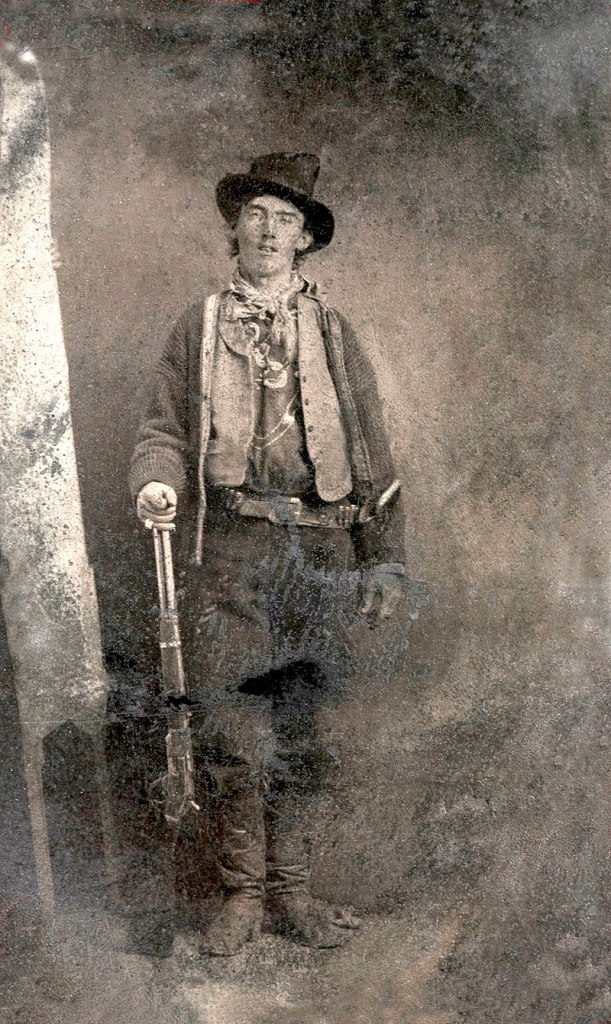
Image: The only surviving authenticated portrait of Billy the Kid, 1880. This tintype portrait sold at auction in June 2011 for USD $2,300,000 to William Koch. (Public Domain.)
On April 9, 1881, after a one-day trial, Henry McCarty, aka “Billy the Kid,” or William H. Bonney, was found guilty of murdering the Lincoln County, New Mexico, sheriff and was sentenced to hang. There is little doubt that Henry McCarty shot the sheriff, even though he did so in the context of the very violent and bloody Lincoln County War; it was a clash between two powerful groups of ranchers and businessmen struggling for financial control of Lincoln County. When his boss, rancher John Tunstall, was slain in front of him in February 1878, the mercurial young McCarty promised revenge. Regrettably, the crew leader who killed Tunstall was Sheriff William Brady of Lincoln County. When McCarty and his partners killed the sheriff several months later, they became outlaws, irrespective of how crooked Brady may have been.
Henry McCarty’s parents were of Irish descent from New York City, and he was born on September 17, 1859. In 1863, the McCarty’s had a second son, Joseph. After the death of her husband, Catherine, and her two boys moved to Indianapolis. There she met William Antrim, and in 1870 they all moved to Wichita, Kansas. After moving again two years later, Catherine married Antrim in Santa Fe, New Mexico Territory. On September 16, 1874, McCarty’s mother, Catherine, died of tuberculosis. William Antrim then abandoned the boys, leaving them orphans. McCarty was then 15 years old.
McCarty had a slim build, sandy blond hair, and blue eyes and wore a sugar-loaf sombrero hat with a wide ornamental band. He could be charming and polite one moment, then angry and violent the next, a quixotic nature he used significantly in his dealings with people. In 1876 he killed his first group of men, some Apache Indians, in the Guadalupe Mountains. McCarty began committing petty crimes and working as a ranch hand until 1877 when he killed another man named “Windy” Cahill, a blacksmith, with whom he got into an argument in a saloon in the village of Bonita. In 1877, he started calling himself “William H. Bonney.” Bonney found work as a rancher and bodyguard for John Tunstall, an English-born rancher who lived in Lincoln, New Mexico. When members of a rival cattle gang murdered Tunstall in 1878, Bonney became involved in the Lincoln County War.
Infuriated at Tunstall’s murder, Bonney became the leader of a vigilante group of “regulators” sent to apprehend the killers. No arrests were made, however. The regulators shot two of the killers dead, and a deteriorating blood feud soon intensified into all-out warfare. After Bonney’s gang shot dead Lincoln Sheriff William Brady, who had authorized Tunstall’s murder, Bonney’s enemies colluded with the territorial authorities to eliminate the regulators.
In July 1878, the rival gang encircled where Bonney and his crew stayed just outside town. The siege lasted five days, and a U.S. Army squadron from Fort Stanton was summoned to help. Still, Bonney and his regulators refused to give up. Suddenly, the regulators attempted a mass escape, and Bonney and several other regulators miraculously managed to shoot their way out of town.
After over two years on the run, Bonney was detained by Lincoln Sheriff Pat Garrett, a man Bonney had befriended before Garrett became a lawman. On April 13, 1881, Bonney was found guilty of murdering Sheriff Brady and was condemned to hang. Upon sentencing, the judge told Bonney he would hang until he was “dead, dead, dead.” Bonney replied, “You can go to hell, hell, hell.”
Following his sentencing, Bonney was taken to Lincoln, where he was placed under guard on the top floor of the town courthouse. On the evening of April 28, 1881, two weeks before his scheduled execution, Bonney wrested a gun away from one of his guards and shot him and another deputy dead in an escape attempt. He grabbed a horse and rode out of town; according to some stories, he sang as he left Lincoln. His escape received widespread national attention.
On July 14, 1881, Garrett and two deputies went to a ranch owned by an acquaintance of Bonney’s named Pete Maxwell. Garrett left two deputies on the porch, and he entered the dark house, found Maxwell’s bedroom, and began questioning him. Maxwell admitted that Bonney had been there, though he was unsure where he was at that moment. Just then, someone appeared at the door, holding a gun and a butcher knife, asking in Spanish who was there.
“Who is it, Pete?” Garrett whispered to Maxwell.
“That’s him,” Maxwell responded.
Bonney soon realized that someone besides Maxwell was in the room and raised his pistol within a foot of Garrett’s chest. “Who’s that?” he asked in Spanish.
Garrett quickly drew his pistol and fired two shots. The first shot hit Bonney in the chest. “He never spoke,” Garrett remembered. “A struggle or two, a little strangling sound as he gasped for breath, and the Kid was with his many victims.” Bonney was dead at age 21.
When Garrett and his deputies examined Bonney’s revolver, they found he had five shells and one cartridge in the chamber, with the hammer resting on it. If Bonney had not hesitated, Garrett might have been the one dead on the floor. “It was the first time, during all his life of peril, that he ever lost his presence of mind or failed to shoot first,” Garrett recalled.
A few hours after the killing of Bonney, a coroner’s jury of six people was convened to investigate the incident. The jury members questioned Garrett and Maxwell, and Bonney’s body and the location of the shooting were inspected. The jury certified the body as Bonney’s, and a local newspaper reported that the jury foreman stated, “It was the Kid’s body that we examined.” The jury ruled that Garrett’s killing of Bonney had been justifiable homicide. Bonney was given a candlelight wake; he was buried the next day, and a wooden marker marked his grave. Garrett noted that the corpse was interred fully intact to stop bottom-feeders from showing skulls, fingers, and other body parts that they maintained had once been part of Billy the Kid. “One medical gentleman has persuaded credulous idiots that he has all the bones strung upon wires,” Garrett wrote with disgust.
Five days after Bonney’s killing, Garrett journeyed to Santa Fe, New Mexico, to take possession of the $500 reward initially offered by Governor Lew Wallace for the gunslinger’s capture, dead or alive. The acting New Mexico governor William Ritch declined to pay the reward. Over the next month, the citizens of Santa Fe, Las Vegas, Mesilla, White Oaks, and other New Mexico towns collected over $7,000 in reward money for Pat Garrett. A year after Bonney’s death, the New Mexico territorial legislature passed a special provision to give Garrett the $500 bounty reward guaranteed by Governor Wallace.
People began to contend that Garrett wrongly ambushed Bonney, so Garrett felt that he had to relate his version of the story, and he asked his friend, journalist Marshall Upson, to co-write a book with him. The book, The Authentic Life of Billy the Kid, Noted Desperado of the Southwest, Whose Deeds of Daring and Blood Made His Name a Terror in New Mexico, Arizona, and Northern Mexico, was published in April 1882. Very few copies sold after its debut, but it would become a valuable resource for historians researching Bonney’s life in time.
Over time, the gunfighters’ legend grew, and many began claiming that Bonney was, in fact, not dead and that Garrett had faked the incident and death out of his friendship with the gunslinger so that Bonney could escape the law. During the next 50 years, several men claimed they were Billy the Kid. Most of these claims were quickly refuted, but two have remained relevant to this day.
In 1948, a Texas man, Ollie Roberts, also known as Brushy Bill Roberts, started to maintain he was William Bonney and went before New Mexico Governor Thomas Mabry asking for a pardon. Mabry dismissed Roberts’ claims, and Roberts died not long afterward. Still, Hico, Texas, where Roberts lived, decided to capitalize on his claim by launching a Billy the Kid museum.
John Miller, from Arizona, also claimed he was Billy the Kid. This was unsupported by his family until 1938, sometime after his death. In May 2005, Miller’s bones and teeth were exhumed and examined without permission from the state. DNA samples from the remains were tested to compare Miller’s DNA with blood samples gathered from the Lincoln County courthouse floorboards and a bench where Bonney’s corpse was allegedly placed after being shot. A July 2015 piece in The Washington Post states that the lab results were “useless.”
Researchers petitioned to exhume the body of Catherine Antrim, Bonney’s mother, in 2004 to compare her DNA with the remains interred in William Bonney’s grave. As of 2012, her body had not been disentombed.
Subscribe to History Daily with Francis Chappell Black to receive regular updates on new content;
Help us with our endeavors to keep History alive. With our daily Blog posts and our publishing program we hope to inform people in a comfortable and easy-going manner. This is my full-time job so any support you can give would be greatly appreciated.
 History Daily With Francis Chappell Black
Leave a comment