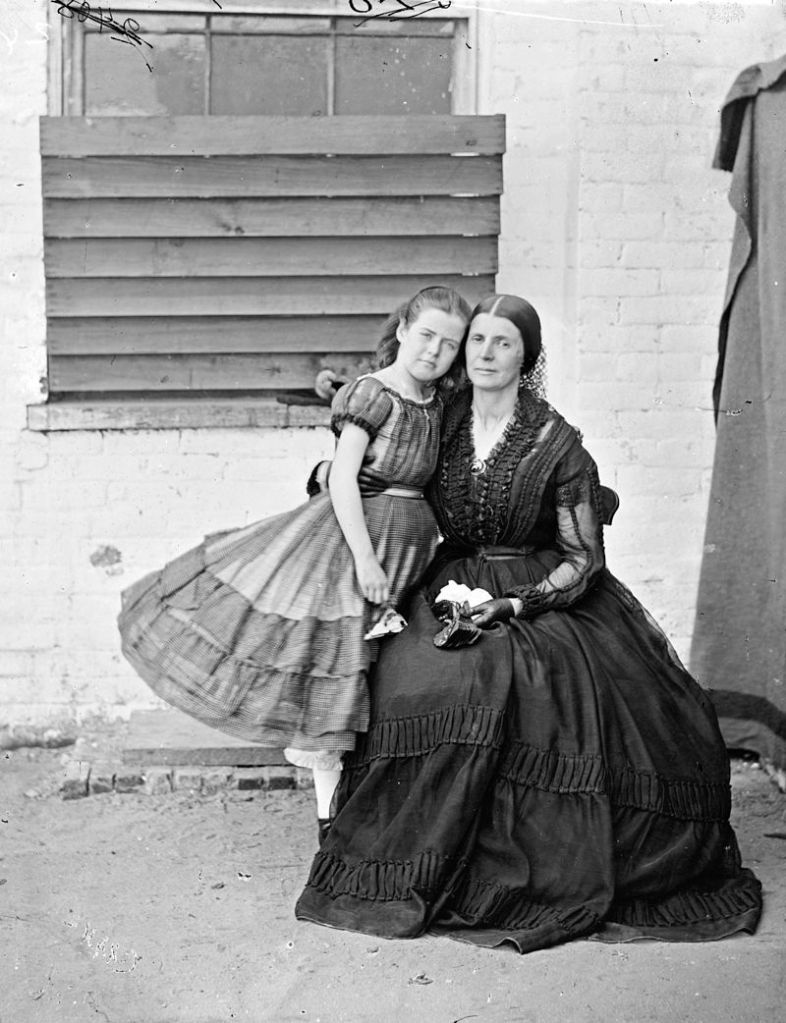
Image: Rose O’Neal Greenhow with her youngest daughter and namesake, “Little” Rose, at the Old Capitol Prison, Washington, D.C., 1862. (Public Domain)
On this day in history, October 1, 1864, Confederate spy Rose O’Neal Greenhow drowns off the North Carolina coast when a Yankee vessel runs her ship aground, and she falls in while holding $2000 in gold. She was returning from a trip to Europe.
Rose O’Neal Greenhow was born to an affluent, wealthy slave-holding family in Maryland in 1817. As a young girl, one of the family’s slaves killed her father. From that moment forth, Greenhow greatly dissented against the movement to abolish slavery.
Greenhow married a wealthy Southern man and moved to Washington, D.C., when she was young. She loved to throw frequent dinner parties with her husband. The guests at these social events often comprised U.S. Congressmen and foreign diplomats. Over the years, Greenhow developed a wide array of friends, including many important political figures. She remained a well-liked hostess even after the death of her husband in the mid-1800s.
Washington was the location of intense political discussion throughout this period. The Northern and Southern areas of the nation had been quarreling over several issues, including slavery, for many years. By 1861, this ongoing dispute had induced several Southern states to secede from the United States and try to create a new country that allowed slavery, the Confederate States of America. Greenhow considered herself a Southerner and backed the Confederate states’ choice to separate. But Northern politicians were determined to keep the Union intact. Before long, war ensued.
As the American Civil War commenced, Greenhow was firmly pro-Southern. One day, Captain Thomas Jordan contacted her about spying for the Confederacy. Jordan represented the Union Army and the U.S. War Department but clandestinely enlisted spies for the South. Greenhow decided to act as a spy and function as the core of a Confederate spy ring in Washington. Her spy network included many prominent Washington citizens, workers in various government departments, and several female couriers. Greenhow amassed intelligence about the Union’s war strategies from the network, her friends, and devotees in Washington. She then handed the information along to Confederate leaders in Richmond, Virginia.
Regrettably, for the Union, Greenhow acquired a copy of the Union’s battle plan and orders. She told her Confederate masters when the Union forces would depart Washington, how many troops they had, what route they would take, and what tactics they planned to employ in the battle. The First Battle of Bull Run began on July 21, 1861. Just as Union forces began to gain the advantage over the Confederacy’s outnumbered forces, a second Confederate force landed to save the day.
The Union forces rendered a hasty retreat, joined by thousands of observers who had ventured from Washington to view the battle. People in the North were stunned that the Confederates had prevailed in the first major battle of the American Civil War. Southerners were thrilled. Confederate president Jefferson Davis thanked Greenhow personally for her role in the triumph. “But for you there would have been no Battle of Bull Run,” he wrote to her.
This early success persuaded Greenhow to become even more daring in her spying. Union officers finally realized what she had been doing and arrested her in August 1861. But they made the error of detaining her outside of her home, in front of eyewitnesses. Greenhow warned one of her agents of the threat by gesturing with a handkerchief. Once brought inside, she faked an attack of heat stroke and was permitted to rest in her room alone. While the naïve Union officers waited for her to regain her composure, she had had sufficient time to destroy evidence of her activities.
Greenhow was now under house arrest. Yet she persisted in sending communications to Richmond. After a while, Union intelligence officers cracked the code she used for her contacts, so at least they knew what information she had revealed to the Confederates. In January 1862, Greenhow was sent to the Old Capitol Prison in Washington, in addition to her daughter and her maid. During her five months there, under severe precautions, she still successfully sent information to Richmond. Sometimes her daughter was involved in her schemes. The guards often brought the young girl a rubber ball and threw it out the window at a specified hour. A corresponding Confederate spy would catch the ball and take the intelligence to Confederate handlers.
Greenhow was finally freed from prison in May 1862. Unable to prevent her from spying, Union officials sent her back to Richmond, where her Confederate superiors greeted her warmly. In August 1863, President Davis sent Greenhow to Europe. Her goal was to persuade England and France’s leaders to endorse the Confederates in their struggle for freedom.
Greenhow was just as popular in Europe as she had been in Washington. She published a book about her spying exploits, My Imprisonment and the First Year of Abolition Rule at Washington, which was a bestseller. She also met with royalty while there. Although she was unsuccessful in persuading European leaders to support the Confederacy, she did manage to get some wealthy Europeans to contribute money to the cause.
During the summer of 1864, Greenhow decided to return to America. She traveled aboard a Confederate ship called the Condor. On October 1, the ship ran aground during an intense storm off the coast of Wilmington, North Carolina. A Union ship soon approached. Afraid she would be captured, Greenhow requested that she be rowed ashore in a small boat. Sadly, the boat overturned in the rough water. Although everyone else on board was saved, Greenhow drowned. She had sewn the $2000 worth of gold that she had accepted in Europe into the fabric of her dress. The gold was so weighty that it pulled her to the bottom of the ocean.
Confederate officers later retrieved both Greenhow’s body and the gold. They appreciated her assistance to the Confederacy and rewarded her with a military funeral in Richmond. The anniversary of her death has been honored every year since then by the Daughters of the Confederacy, who place a wreath on her grave.
Subscribe to “History Daily with Francis Chappell Black” to receive regular updates via email regarding new content:
Help us with our endeavors to keep History alive. With our daily Blog posts and our publishing program we hope to inform people in a comfortable and easy-going manner. This is my full-time job so any support you can give would be greatly appreciated.
 History Daily With Francis Chappell Black
Leave a comment