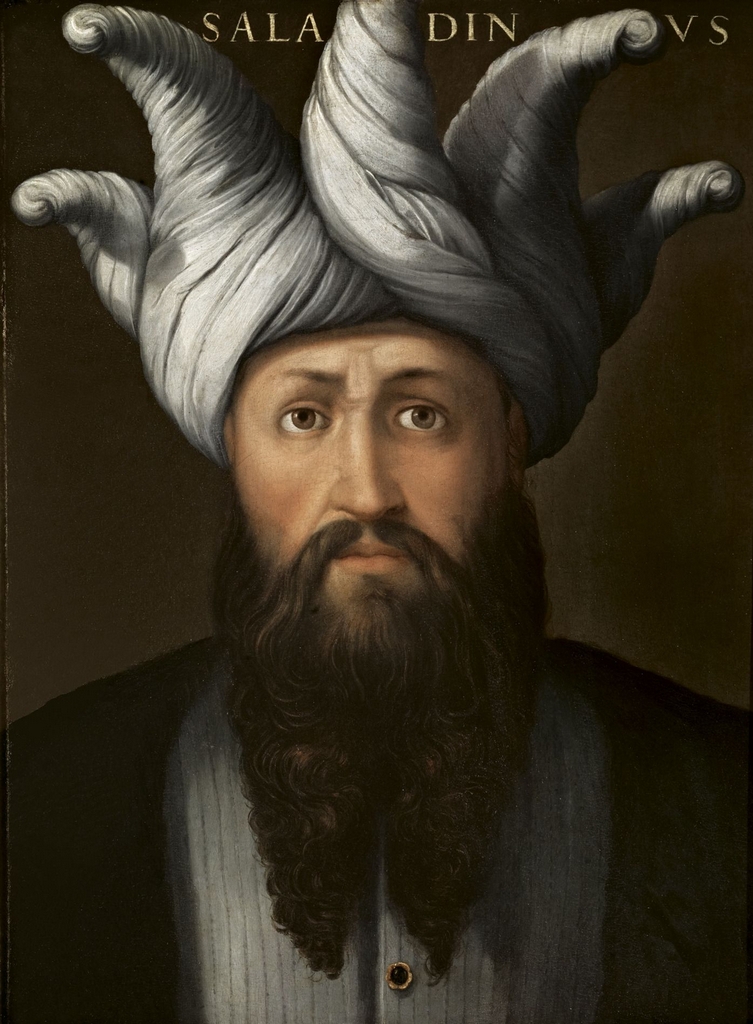
Image: Saladin (Public Domain)
On this day in history, October 2, 1187, the City of Jerusalem, under Balian of Ibelin, a Christian crusader, surrendered to Saladin’s army after 88 years of Christian control. Despite planning to kill all Christians in Jerusalem as revenge for the slaughter of Muslims in 1099, Saladin agreed to let them buy their freedom instead.
Saladin, the Western name of Salah al-Din Yusuf ibn Ayyub, was the Muslim sultan of Egypt and Syria who notably routed an enormous army of Crusaders at the Battle of Hattin and seized the city of Jerusalem in 1187. At the pinnacle of his dominance, he reigned over a unified Muslim territory from Egypt to Arabia. Saladin was commemorated by Muslims and many Westerners of later generations for his political and military abilities, as well as for his charity and gallantry.
In the aftermath of his triumph at the Battle of Hattin in July 1187, Saladin organized a victorious war in the Christian regions of the Holy Land. Among the Christian aristocracy who managed to escape from Hattin was Balian of Ibelin, who first escaped to Tyre. (Balian was a crusader noble of the Kingdom of Jerusalem who was the chief of the city’s defense during the siege of Jerusalem in 1187). A short time after, Balian contacted Saladin to ask for consent for passage through the lines to retrieve his wife, Maria Comnena, and his family from Jerusalem. Saladin permitted this request in exchange for a promise that Balian would refrain from taking up arms against him and would only stay in the city for one day.
Arriving in Jerusalem, Balian was instantly sent for by Queen Sibylla and Patriarch Heraclius, who requested that he command the city’s defense. Anxious about his promise to Saladin, he was eventually persuaded by Patriarch Heraclius, who proposed to absolve him of his obligations to the Muslim leader. Patriarch Heraclius maintained that the greater need for Christendom was more powerful than his vow to a non-Christian. Balian sent a delegation of burgesses to Ascalon to inform Saladin of his change of heart. Entering, they were asked to open dialogue for the city’s surrender. Rejecting this, they told Saladin of Balian’s preference and left the area.
Though enraged by Balian’s decision, Saladin permitted Maria and the family safe transit to journey to Tripoli. Within Jerusalem, Balian’s situation was grim. In addition to arranging for food, stores, and money, he established sixty new knights to strengthen its weak fortifications. On September 20, 1187, Saladin reached the city with his army. Not wanting more carnage, Saladin instantly opened talks for a peaceable end to the situation. These talks went nowhere, with Eastern Orthodox clergyman Yusuf Batit serving as a go-between.
Saladin began a blockade of the city while the talks remained at a standstill. His opening strikes concentrated on the Tower of David and the Damascus Gate. After attacking the walls over numerous days with a mixture of siege engines, Saladin’s men were continually pounded back by Balian’s army. After six days of unsuccessful attacks, Saladin altered his attention to a piece of the city’s wall near the Mount of Olives. This area had no gate and prohibited Balian’s men from fighting the attackers. For three days, the wall was persistently hammered by mangonels and catapults. On September 29, it was mined, and a portion collapsed.
Striking into the breach, Saladin’s men encountered intense fighting from the Christian defenders. While Balian was able to block the Muslims from penetrating the city, he required additional soldiers to force them from the breach. Realizing that the circumstances were desperate, Balian traveled with a delegation to meet with Saladin. Conversing with his opponent, Balian maintained that he was inclined to agree to the bargained surrender that Saladin had initially proposed. Saladin rejected this as his men were in the midst of an attack. When this assault was forced back, Saladin conceded and agreed to a peaceful transition of authority in Jerusalem.
After the combat finished, the two leaders began negotiating details such as ransoms. After extensive negotiations, Saladin maintained that the ransom for Jerusalem’s citizens would be placed at ten bezants for men, five for women, and one for children. Those who could not pay would be sold into enslavement. Requiring funds, Balian reasoned that this amount was too excessive. Saladin then countered with a rate of 100,000 bezants for the entire population. Discussions endured, and ultimately, Saladin settled on a ransom of 7,000 people for 30,000 bezants.
On October 2, 1187, Balian gave Saladin the keys to the Tower of David, finishing the surrender. In an act of mercy, Saladin and his commanders liberated many of those doomed for enslavement. Balian and the other Christian nobles ransomed many others from their private assets. The conquered Christians left the city in three rows, with the first two led by Hospitallers and the Knights Templar and the third column by Balian and Patriarch Heraclius. Balian eventually returned to his family in Tripoli.
Seizing control of Jerusalem, Saladin allowed the Christians to maintain control of the Church of the Holy Sepulchre and authorized Christian pilgrimages. Oblivious to the city’s fall, Pope Gregory VIII delivered a call for a Third Crusade on October 29. The center of this crusade quickly became the retaking of Jerusalem. Getting underway in 1189, this endeavor was commanded by Philip II of France, King Richard of Britain, and Holy Roman Emperor Frederick Barbarossa.
Subscribe to “History Daily with Francis Chappell Black” to receive regular updates regarding new content:
Help us with our endeavors to keep History alive. With our daily Blog posts and our publishing program we hope to inform people in a comfortable and easy-going manner. This is my full-time job so any support you can give would be greatly appreciated.
 History Daily With Francis Chappell Black
Leave a comment