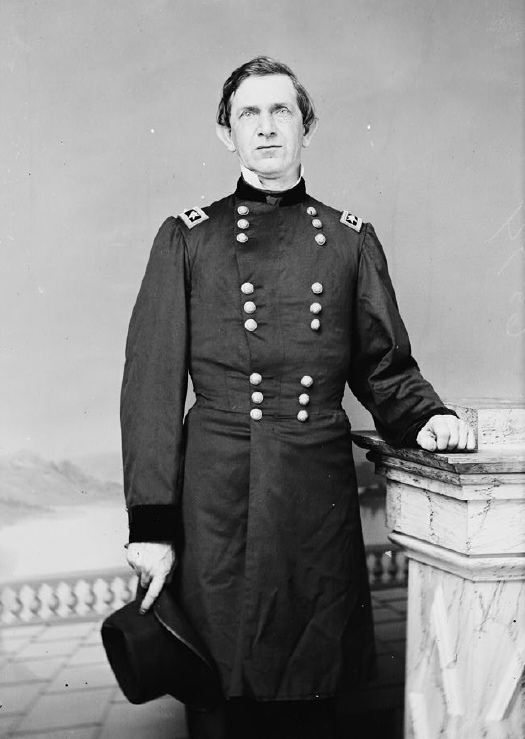
Image: Major General Edward Canby (Public Domain).
On this day in history, October 3, 1873, the United States Army executed by hanging four Native Americans found guilty of killing American Civil War general Edward Canby during the Modoc War in Oregon. Canby was the highest-ranking army officer and the only general ever murdered by Native Americans.
The Modoc War started with a fight over land, as did most American armed conflicts with Native Americans. A treaty thrust upon them in 1864 had forced a group of Modoc people led by Kintpuash – known to Americans as Captain Jack – to move to a reservation in southeastern Oregon controlled by the Klamath people, who saw the Modoc as undesirable interlopers on their traditional lands. Upset with the abuse they received from the Klamath, Kintpuash and his group vacated the reservation in 1870 and returned to their former land and previous lives as hunter-gatherers.
Yet, during the six years that they were gone, white settlers had moved into the Madoc’s former territory. Despite Kintpuash’s repeated promises that his group only wanted peace, most settlers feared the Natives.
In November 1872, President Ulysses S. Grant ordered that the Modocs be moved back to their reservation. On November 29, the war started with the Battle of Lost River. The United States cavalry, commanded by Captain James Jackson, commenced firing on Kintpuash’s camp, compelling the Modocs to divide and escape to the Lava Beds in Northern California. While traveling, Hooker Jim and his men killed eleven settlers. Kintpuash only learned about these killings when Hooker Jim arrived at the Lava Beds. Over the next two months, three major battles occurred as U.S. forces tried to penetrate the Lava Beds: the Battle of Land’s Ranch, the First Battle for the Stronghold, and the First Battle of Scorpion Point.
On January 29, 1873, President Grant selected a peace commission led by General Edward R.S. Canby to connect with the Modocs to terminate hostilities and encourage them to return to the reservation. Between February and March, the dialogue was maintained with the help of two interpreters, Winema (Toby Riddle) and her husband, Frank Riddle. In April, Winema called on the Lava Beds and returned to caution Canby that the Modocs’ intended to murder the peace commissioners if they did not conform with Modoc demands of a reservation along Lost River and exculpation for the slayers of the settlers. Canby disregarded Winema’s cautions and continued the meeting on April 11, 1873. At this summit, Kintpuash and his men tried to discuss their issues, but Canby rejected their arguments, insisting upon their unconditional surrender. General Canby, Alfred B. Meacham, Rev. E. Thomas, and L.S. Dyar, with Frank and Toby Riddle as interpreters, met with Captain Jack, Boston Charley, Bogus Charley, Schonchin John, Black Jim, and Hooker Jim. After some discussion, it became clear that the Modoc were carrying weapons; General Canby advised Captain Jack that the commission would only meet his conditions once instructions came from Washington.
Furious, Schonchin John commanded that Hot Creek, California, be designated for a reservation. Captain Jack stood up and moved away by a few paces. The two Modoc warriors, Brancho (Barncho) and Slolux, who were armed with rifles, came forward from their hiding spot. Captain Jack turned and gave the sign to fire. The first shot killed General Canby. Reverend Thomas fell mortally wounded. Dyar and Frank Riddle evaded the situation by running away. Meacham collapsed, seriously injured, but Toby Riddle saved his life and stopped the Modoc, who intended to scalp him by shouting, “The soldiers are coming!” The Modoc fighters stopped and exited the site.
U.S. efforts for peace stopped when the Modoc murdered the commissioners. Canby’s Cross marks the location where Canby and Thomas perished.
Four battles ensued (the Second Battle for the Stronghold, the Second Battle of Scorpion Point, the Battle of Dry Lake, and the Battle of Willow Creek Ridge) and took the army closer to the Modocs’ stronghold, causing them to scatter. Kintpuash surrendered on June 1, 1873.
The U.S. Army arranged to execute Captain Jack and the other leaders, but the War Department arranged for the Modoc to be held for prosecution. The Army had Captain Jack and his group taken as prisoners of war to Fort Klamath, where they arrived on July 4.
Captain Jack, Boston Charley, Schonchin John, Black Jim, Brancho (Barncho), and Slolux were judged by the military court for the killings of Canby and Thomas and attacks on Meacham and others. The six Modoc were convicted and condemned to death on July 8.
On September 10, President Grant agreed to the death sentences for Captain Jack, Schonchin John, Black Jim, and Boston Charley; Brancho and Slolux were condemned to life sentences in Alcatraz prison. Grant commanded that the remnants of Captain Jack’s group be held as prisoners of war.
On October 3, 1873, Captain Jack and his three warriors were hanged at Fort Klamath.
The remaining members of the Modoc tribe were marshaled onto rail cars and removed to a reservation in the northeastern corner of Oklahoma. By 1909, when the deportees were permitted to return to Oregon, only twenty-nine of the original members of the tribe were still alive. A portion of them and their descendants stayed behind, where they became the Modoc Tribe of Oklahoma.
Apart from the consequences seen by the Modoc captives, the most pronounced effect of the war was that federal policymakers learned very little from the war. Other Indian conflicts ensued during the 1870s, which included the Nez Perce War of 1877, which also started in Oregon. The two wars had several things in common, including the removal of native tribes from areas of the state desired by settlers – but in a more dramatic way than the far more significant number of deaths from disease, epidemics, or the forced migration that ensued from treaties executed in the mid-nineteenth century.
During eight months of warfare, 159 Modoc men, women, and children fought 1,000 U.S. troops. In total, 83 American soldiers, 3 Modoc tribe members, and 14 other Native Americans perished in the war.
Subscribe to “History Daily with Francis Chappell Black” to receive regular updates regarding new content:
Help us with our endeavors to keep History alive. With our daily Blog posts and our publishing program we hope to inform people in a comfortable and easy-going manner. This is my full-time job so any support you can give would be greatly appreciated.
History Daily: 365 Fascinating Happenings Volume 1 and Volume 2 are on sale now for 25 % off the print copies from my publishers site:
Sale ends October 10, 2023.
 History Daily With Francis Chappell Black
Leave a comment