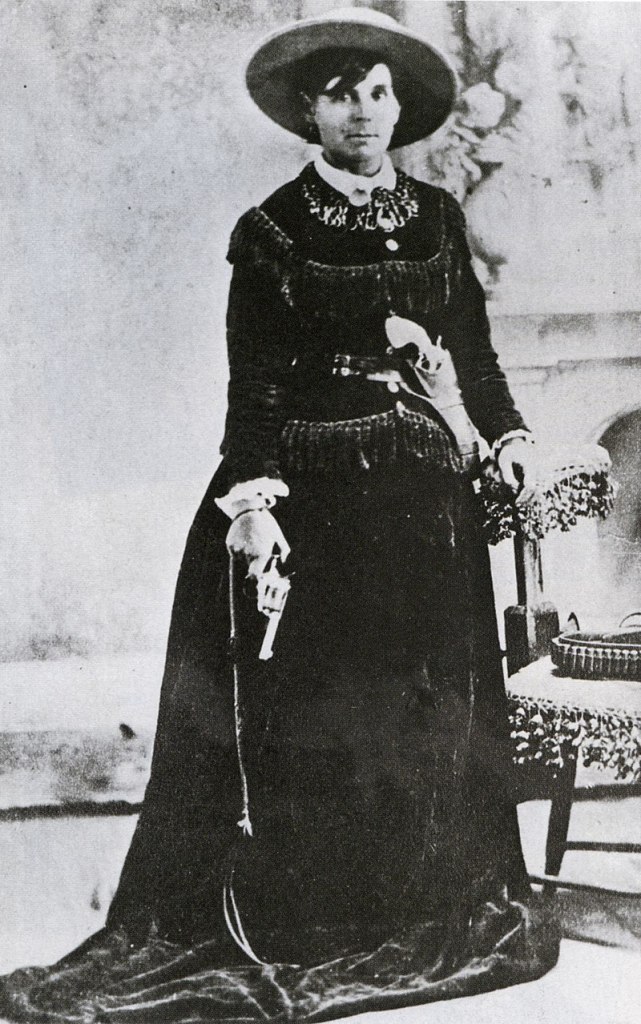
(Image: A studio portrait of Belle Starr probably taken in Fort Smith in the early 1880s. Public Domain.)
Belle Starr was born Myra Maybelle Shirley near Carthage, Missouri, on February 5, 1848. She was called May by her family. Her father, John Shirley, thrived raising wheat, horses, corn, and hogs, though he was viewed as the “black sheep” of a well-off Virginia family which had moved west to Indiana, where he would marry and divorce twice. Belle’s mother, Elizabeth “Eliza” Hatfield Shirley, was a relative of the Hatfields of the famous family feud. During the 1860s, John Shirley sold the farm and transported the family to Carthage, where he purchased a livery stable and blacksmith shop.
May Shirley received a classical education and was taught piano while graduating from Missouri’s Carthage Female Academy, a private school that her father had helped to create. May’s older brother, John “Bud” Shirley, became affiliated with the Jasper County irregular forces called bushwhackers. These were guerilla bands organized to fight federal troops by convincing Missouri to join the war against the Confederacy. Belle supported her brother’s interests and may have even worked as a spy. Regrettably, Bud was killed by federal soldiers in late June 1864. Belle’s father was so distressed by his son’s death that he sold his property and moved his family to the small town of Scyene, Texas, ten miles southeast of Dallas.
Also moving to Scyene at that time was the Reed family. Belle became friends with them and married James Reed on November 1, 1866. Just like her brother Bud, Reed had joined a group of bushwhackers, among whom was the soon-to-be infamous outlaw Jesse James and his brother Frank. So, it was natural that after the war, Reed would embrace a life of crime after being a bushwhacker with the James brothers.
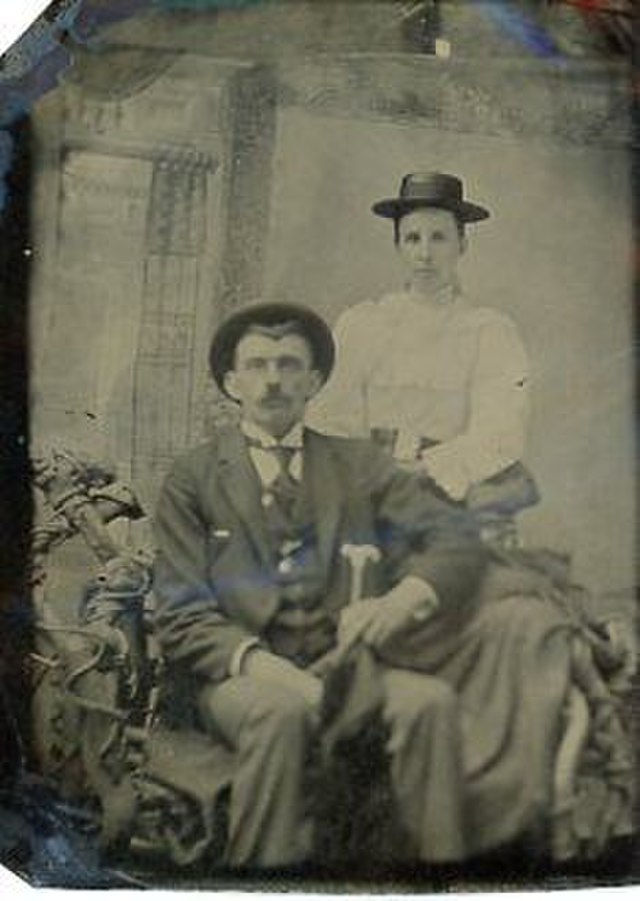
(Image: Jim Reed and Belle Starr. Public Domain.)
Once he became an outlaw, there was no stopping his illegal activities. Marrying Belle did not deter him, nor did their having two children – their first was a girl named Rosie Lee “Pearl,” born in 1868, and their second was a son named James Edwin “Eddie,” born in 1871. They then moved to California. Between 1870 and 1871, while living in California, Reed, it was reported in The Newberry Weekly Herald in October 1871:
“… robbed a man of a large sum of money, left the State, and… [bought] a farm on Cook Creek, Bosque County, where for a while his generous manners won the esteem of his neighbors. Soon, however, ugly rumors floated through the neighborhood, … stock disappeared in that section, and he drew around him the worst class of men, and his place became a rendezvous for horse thieves and desperados…. In February 1873, Dick Cravey, living sixteen miles from Meridian, was called from his bed and murdered. Four men were engaged in the cold-blooded killing… [and] it has since been learned that James and Sol Reed, his brother, were two of the four murderers.
In August of the same year, these two brothers murdered a man named Wheeler, who had been a Confederate… but had become alarmed at the attitude assumed toward the Reed gang by the citizens and had disclosed some things, and for this, and to prevent further disclosures, his life was taken, and his tongue cut out…. Reed then moved to Scyene and bought property…. He floated through the country, always mounted, sometimes in company with the Younger and James brothers and other noted highwaymen.”
In April 1874, with no evidence, Belle Starr was accused of robbing a stagecoach that her husband and others had committed. A warrant was then issued for her arrest. More trouble ensued when Reed was slain by a marshal in Paris, Texas, that same year.
In 1878, it was alleged that Belle Starr had been for a short time married to Charles Younger, uncle of Cole Younger. There was no proof that such a union had taken place. In addition, during the last two years of her life, newspapers associated her with several men, including Jack Spaniard (a Cherokee man raised in the Cherokee Nation with a criminal past), Jim French (a man who was said to be large, powerful, and either half-Native American or half-Black), and Blue Duck, an outlaw who worked in the Oklahoma Territory and is said to have committed armed robberies and cattle rustling.)
Even with these rumors churning about her and Charles Younger, Belle married a Cherokee man by the name of Sam Starr in 1880 and moved to Indian Territory with the Starr family. Sam’s family was infamous for stealing cattle, whiskey, and horses. After their marriage, Belle Starr quickly learned how cattle rustle and began a gang of her own. She was highly successful in her criminal activities. She was also successful enough that she was able to liberally bribe law and city officials so that if any of her associates were incarcerated, she could quickly secure their liberty.
In 1883, Belle and Sam were captured by Bass Reeves, an American lawman famous for being the first Black Deputy U.S. Marshal in the Old West. The pair was charged with horse theft and went on to face ‘the Hanging Judge,” Isaac Parker, in Fort Smith, Arkansas. In an interview with a reporter for the Fort Wayne Daily Gazette, Belle stated that she denied:
“…with great spirit the crime of larceny…and says that the United States juries at Fort Smith are as ignorant as wild hogs…. She claims indeed to have never committed a crime…. The reporter reminded her that she was credited by certain officials with being a member of the border, then said she had nothing to conceal of her connection with the Youngers and would tell the story straight. She went through the war and now was a Southerner and a vindicated one. A mere girl, she had heard of the murder of the mother of the Younger boys… and she sympathized with them and became their friend. She rejoiced in their desperate deeds of revenge… and she was always ready to render them any friendship or aid in her power. She was never one of their gang…. Belle knowingly assured the reporter that she had seen her share of wild life and counted no end of tough characters among her acquaintances, but she had never shed human blood or been a party to any crime, newspaper or official reports to the contrary notwithstanding.”
Despite her claims of innocence, both her and her husband were found guilty. Both were given prison sentences. Belle served nine months at the Detroit House of Corrections in Michigan, where she would be the perfect prisoner and won the respect of the prison matron. During his incarceration, her husband proved to be quite a difficult character. In fact, he was deemed hopeless and detailed to hard labor.
In 1886 Belle Starr was arrested again. Particulars about her illegal activities and arrest were published in Oswego’s Labette County Democrat shortly after that:
“On Friday, June 18, a stranger hired two horses and a buggy at J.M. Grant’s livery stable to drive…to Mr. Pearson’s…. Not returning by noon the next day, Grant sent out to Pearson’s to see if the man had been there. Learning that he had not…he at once concluded that the team had been stolen and put Demps Ballwine and Myron Cook, who are familiar with the Indian Territory, on the trail…. They traced them so far into the Canadian district as to be satisfied that they had been taken to the rendezvous of the notorious female desperado, Belle Starr…. Officers have been working for some time to affect the capture of the gang, and by a special arrangement with the Choctaw authorities, succeeded… yesterday morning. The Choctaw authorities had about eighteen men and the Cherokee ten. They also arrested the noted Belle Starr on the charge of harboring criminals…. Starr will be brought here tomorrow before Commissioner Tufts. The officers recovered some stolen goods, horses, harnesses, buggies, etc., belonging to parties in Oswego, Kansas. This gang has been operating through the Cherokee, Creek, and Choctaw Nations, stealing and terrorizing the people generally.”
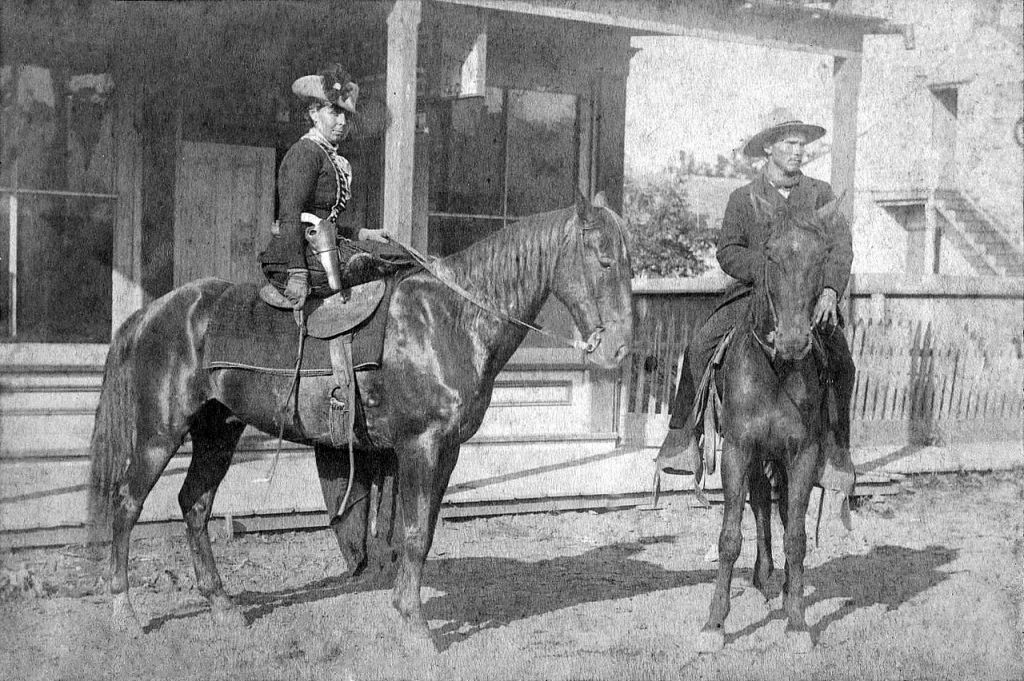
(Image: Belle Starr, Fort Smith, Arkansas, 1886; the man on the horse is Deputy U.S. Marshal Benjamin Tyner Hughes who, along with his posse man, Deputy U.S. Marshal Charles Barnhill, arrested her at Younger’s Bend in May 1886 and brought her to Ft. Smith for arraignment. Deputy U.S. Marshal Charles Barnhill took Starr to Fort Smith for arraignment. Public Domain.)
She was described as follows in The Harper Daily Sentinel:
“In appearance, she is of medium height and build, her eyes are jet black, and her features are almost as dark as a full-blood Indian, and indeed she presents the appearance of an intelligent full-blood Indian…. She appears to be about 35 and is altogether rather attractive and comely.”
Belle was able to avoid conviction this time. However, her husband was not so fortunate a few months later. After arguing with his cousin, law officer Frank West, the two men decided to settle their differences with a gunfight. It happened on December 17, 1886, as Belle watched from nearby. Both men died with the details of their shoot-out related in The Ottawa Daily Republic:
“Sam Starr, the notorious outlaw… was killed Friday night near Oklahoma at a dance. Sam met Frank West, whom he accused of having waylaid him four months earlier. The men went out into the yard. Both drew their pistols, and after facing each other for a moment, Sam raised his weapon and fired. The shot took effect in West’s neck, but he immediately returned fire, catching Sam on the right side.
As West fell, he fired twice more at Sam and then died. [Sam] threw his arms around a small tree and held himself on his feet till he died…. One of West’s shots [also] struck a twelve-year-old Indian boy named Folsom who was standing near.”
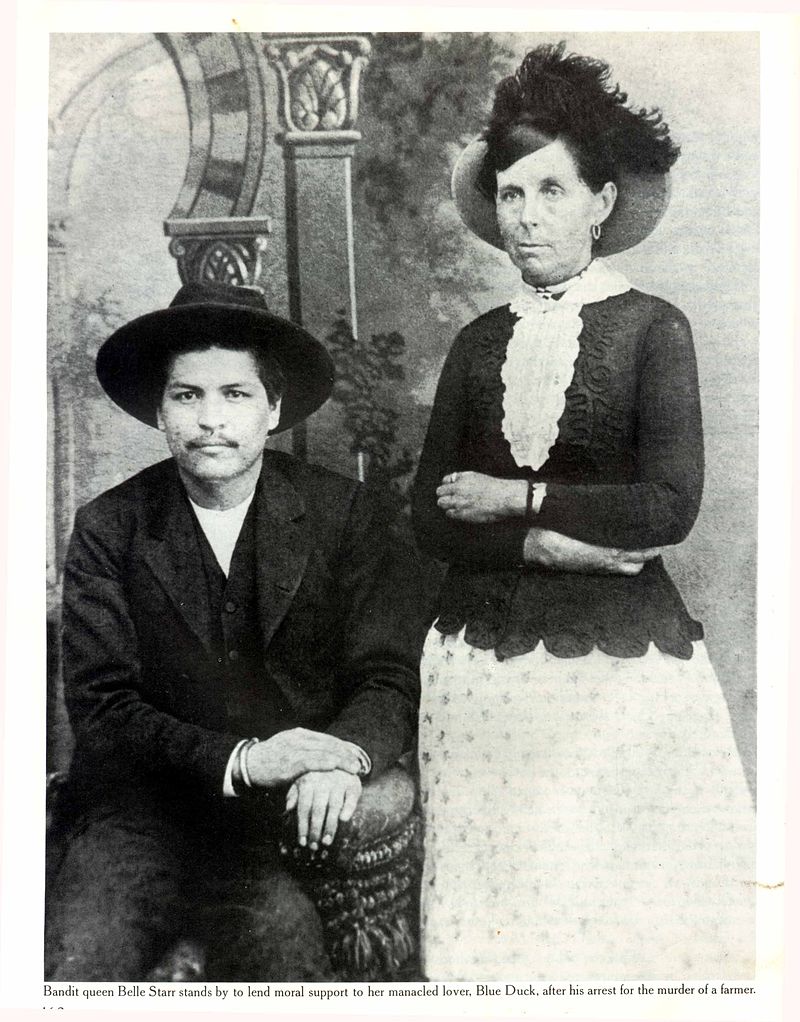
(Image: Blue Duck and Belle Starr, May 24, 1886. Public Domain.)
Soon after, Belle chose to remarry, and this time she married Sam Starr’s adopted brother, James July Starr. He was 15 years younger than her, reportedly spoke English, Creek, Cherokee, and Choctaw, and was described as 5’9″ tall, fair-skinned, with black hair, and weighing 160 pounds. He was a good rider and a “splendid shot,” and there were tales that he had managed to escape several near life-ending events. One such incident occurred when he was captured by eighteen Cherokees but managed to escape without harm despite seventy-five shots being fired at him.
The marriage between James and Belle did not last long, however. She was killed on February 3, 1889, two days before her 41st birthday. One version of her death is that she was riding home from a neighbor’s house and was attacked by an unknown assailant. Wounds were found all over her body and face, and she was reshot after she fell off her horse. Moreover, the legend states she was shot with her own double-barrel shotgun.
There are other versions of her death. According to Frank “Pistol Pete” Eaton, one states that an intoxicated Edgar Watson asked her to dance after dancing with him. She refused, and because of her rejection, he became angry, and he followed her home and shot and killed her when she stopped to give her horse a drink. Eaton maintained that Watson was tried, convicted, and hanged for the murder.
Another version of what happened was that shortly after her death, the publisher of the St. Louis Globe-Democrat, went to her home to “learn the truth.” He said he met her husband, James July Starr, who “had long black hair, falling on his shoulders, a cowboy hat set well back, a cartridge belt at his waist, [and] a Winchester in his hand.” According to the publisher, James maintained that his friend, Charles Acton (known as Bronco Charley), had been close by at the time of his wife’s death and that Acton could provide further details.
Acton related that Belle and her husband rode together to San Bois but split up, with James heading to Fort Smith and Belle returning home. On the way there, she stopped at Jack Roe’s, and among the men present was Watson. He gave her some trouble, but he left after a few minutes. Belle stayed at Roe’s for a short time. She then left, heading towards Younger’s Bend, and about fifteen minutes later, two loud gunshots rang out. The story in the St. Louis Globe-Democrat continued:
“At this time… Acton was on the river in a ferryboat waiting for Belle to come that he might set her over, for she had told him… to be sure to wait for her at the river on Sunday. When… Acton got on the north side of the river with his boat; he was met by Milo Hoyt, a Choctaw, who tied his horse, and both men then seated themselves in the boat, where they waited till the sun was nearly down. Suddenly, about 200 yards below them, Belle’s horse jumped in the river and swam across, but no rider was seen…. Acton, believing Belle’s horse had thrown her, told Hoyt to ride up the road and look for Belle. Hoyt only went as far as the house of a Mr. White, about a quarter of a mile off, when he was told the horse had come by riderless and on a dead run. Hoyt returned and… told … Acton, who insisted on Hoyt making a further search for Belle.
By this time, James Cobb had caught Belle’s horse and came down to the river. Acton called across for Cobb to get another horse, as Belle might be hurt, and Cobb did … and came down to the river with … Pearl Reed, Belle’s daughter. Acton crossed Cobb and Pearl over in the boat, taking their horses with them, and when all three reached the other bank, they were met by Hoyt, who said he had found Belle lying in the road ahead of him and that he believed she was dead….
[They} went to where [she] … was lying …. Acton raised Belle up out of the mud and laid her in Pearl’s lap, but all the life was gone. She never spoke. When found, she was lying on her right side, in the road running alongside the Hoyt farm, her face half buried in mud and water. The assassin had stood on the inside of the field when he fired his first shot, riddling her right shoulder, right hand, and the right side of her face with buckshot, and it was afterward found that three buckshot had struck her right between the shoulders, causing instant death. She fell from her horse, and the assassin had got over a low place in the fence, stepped up close, and discharged his second load, filling the woman’s left side, shoulder, and face full of bird shot….
The next morning some persons went to the scene of the killing and found the assassin’s tracks. From that point … he was tracked about halfway up the mountain closely and from there to … Watson’s field, where he got over the fence again, and when last seen, the tracks were still running in the direction of Watson’s house…. The body was taken home that morning…. Belle Starr’s son arrived that day. February 5, James Starr received the delayed telegram notifying him of Belle Starr’s death and at once started home.”
Other fanciful versions of her violent death provide several other suspects. Among those claims put forward was her husband James, both of her children (her son is said to have wanted her dead because she mistreated her horse), a sharecropper who had been an escaped murderer, and Belle intended to turn him in, and Watson, who soother alleged was tried for her murder twenty years later in 1910, but acquitted.
Whatever the absolute truth about Belle Starr’s death, her husband, James, did not live long after her death. He died on January 26, 1890, in Fort Smith, Arkansas, at 27. Law enforcement officers had attempted to arrest him. He was shot in the process and wounded. James later died from his wounds after being transported to Fort Smith, where he was buried.
Despite starting out as a minor personality in Old West history, Belle Starr’s reputation grew larger after marrying into the Starr family. Despite her relationship with the James-Younger gang, she would be forever linked to the Starr family. Her life was romanticized in dime novels and dramatized in the National Police Gazette. After her death, her notoriety was increased with the publication in 1889 of the book Bella Starr, the Bandit Queen, or the Female Jesse James, which then propagated other stories about her, thus growing her legend.
Belle Starr’s personality also aided in helping to establish her legendary status. She had a good fashion sense and an intense style that she often displayed. She also supposedly rode side-saddle wearing a black velvet riding habit, sporting a plumed and ornamental hat, and packing two pistols with the cartridge belts across her hips. Additionally, like Annie Oakley, she was reported to be a crack-shot and was known for her expert horsemanship.
Eddie Reed, Belle’s son, was found guilty of possession of stolen property and horse theft in July 1889. The judge sentenced him to prison in Columbus, Ohio. Rosie Reed, Belle’s daughter, better known as Pearl Starr, became a prostitute to raise money for Eddie’s release. She eventually acquired a presidential pardon for her brother in 1893. Eddie went on to become a deputy in Fort Smith, and he killed two outlaw brothers named Crittenden in 1895 and was killed in a bar in Claremore, Oklahoma, on December 14, 1896. Pearl owned several brothels in Fort Smith and Van Buren, Arkansas, from the 1890s to World War I.
Subscribe to “History Daily with Francis Chappell Black” to receive regular updates on new content:
Help us with our endeavors to keep History alive. With our daily Blog posts and our publishing program we hope to inform people in a comfortable and easy-going manner. This is my full-time job so any support you can give would be greatly appreciated.
 History Daily With Francis Chappell Black
Leave a comment