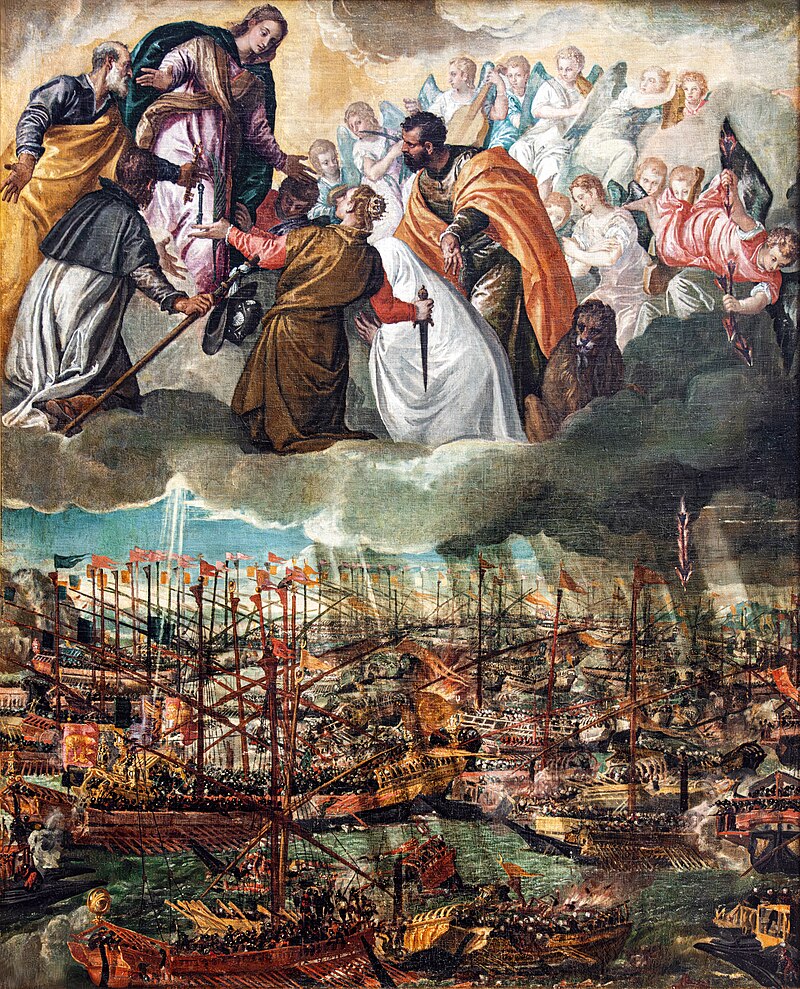
On this day in history, October 7, 1571, The Holy League defeated the Ottoman Empire at the Battle of Lepanto in a significant naval engagement during the Ottoman-Habsburg Wars.
The Battle of Lepanto was a naval action that occurred on October 7, 1571, when an armada of the Holy League, a federation of Catholic nations (including Spain and its Italian lands, numerous independent Italian states, and Malta) organized by Pope Pius V, exacted a major conquest on the navy of the Ottoman Empire in the Gulf of Patras, in the Ionian Sea. The Ottoman forces were navigating westward from their naval base in Lepanto when they crossed a flotilla belonging to the Holy League, which was moving east from Messina, Sicily. The Venetian Republic and the Spanish Empire were the primary nations of the alliance, as Philip II of Spain essentially sponsored the federation, and Venice was the foremost provider of vessels.
In the history of naval conflict, Lepanto is the last key battle in Western civilization to be contested entirely involving rowing ships, specifically the galleys and galleasses, the ancestors of early trireme warships. The battle was an “infantry battle on floating platforms.” It was the most significant naval confrontation in Western history since classical antiquity, including over 400 warships. Over the next few decades, the ever-expanding significance of the galleon and the line of battle approach would replace the galley as the significant combat ship of its period, indicating the start of the “Age of Sail.”
After Suleiman the Magnificent’s demise and Sultan Selim II’s elevation to the Ottoman throne in 1566, preparations began for the ensuing apprehension of Cyprus. Retained by the Venetians in 1489, the island was essentially surrounded by Ottoman assets on the continent and gave safe harbor for Barbary pirates that regularly attacked Ottoman transport. With the end of a long war with Hungary in 1568, Selim decided it was time to attack the island. Landing an assault force in 1570, the Ottomans captured Nicosia after a vicious seven-week siege. They were victorious in several battles before arriving at the last Venetian fort at Famagusta. Unable to access the city’s protections, they blockaded it in September 1570. Trying to gain support for the Venetian struggle against the Ottomans, Pope Pius V worked diligently to create a coalition between the Christian nations in the Mediterranean area.
In 1571, the Christian forces in the Mediterranean region gathered a large navy to fight the growing threat posed by the Ottoman Empire. Mustering at Messina, Sicily, in July and August, the Christian forces were led by Don John of Austria. They possessed warships from Spain, Venice, Genoa, the Papal States, Savoy, and Malta. Cruising under the flag of the Holy League, Don John’s flotilla comprised 206 galleys and six galleasses (large galleys that fitted artillery). Rowing east, the warships briefly stopped at Viscardo in Cephalonia, where it discovered the fall of Famagusta and the torture and killing of the Venetian commanders there. Don John pushed forward to Sami through the stormy weather and arrived on October 6. Heading back to sea the next day, the Holy League navy entered the Gulf of Patras and soon stumbled upon Ali Pasha’s Ottoman flotilla.
Leading 230 galleys and 56 galliots (small galleys), Ali Pasha had left Lepanto and moved west to capture the Holy League’s warships. As the navies saw each other, they readied for combat. Don John, in charge of the Holy League’s fleet, who was aboard the galley Real, decided to separate his navy into four detachments, with the Venetians under Agostino Barbarigo on the left, himself in the center, the Genoese under Giovanni Andrea Doria on the right, and a reserve force led by Alvaro de Bazan, Marquis de Santa Cruz in the rear. He also sailed galleasses out ahead of his left and center detachments where they could shell the Ottoman navy.
Commanding his fleet from the ship Sultana, Ali Pasha led the Ottoman center, with Chulouk Bey on the right and Uluj Ali on the left. As the battle began, the Holy League’s galleasses sank two galleys and disrupted the Ottoman configurations with their bombardment. As the navies approached each other, Doria saw that Uluj Ali’s line reached beyond his own. Moving south to avoid flanking, Doria opened a space between his detachment and Don John’s. Viewing the hole, Uluj Ali went north and assaulted the breach. Doria reacted, and his ships soon fought with Uluj Ali.
Chulouk Bey could turn the Holy League’s left flank in the north but decided that opposition from the Venetians, and the timely arrival of a galleass, hammered away the attack. Soon after the conflict began, the two flagships discovered each other, and a dangerous fight began between Real and Sultana. Fastened together, Spanish troops were twice forced back when they tried to board the Ottoman galley, and forces from other warships were required to win the engagement. On the third attempt, with aid from Alvaro de Bezan’s galley, Don John’s men could take Sultana by killing Ali Pasha during the battle.
Despite the desires of Don John, Ali Pasha was beheaded, and his head was presented on a pike. The vision of their commander-in-chief’s head had a profound effect on Ottoman spirits, and they began retreating from the battle. Uluj Ali, who had been victorious against Doria and seized the Maltese flagship Capitana, withdrew with 16 galleys and 24 galliots.
The Holy League lost 50 galleys at the Battle of Lepanto and experienced roughly 13,000 casualties. This was compensated by emancipating a comparable number of imprisoned Christians from the Ottoman fleet. As well as the death of Ali Pasha, the Ottomans suffered 25,000 killed and wounded and an added 3,500 captured. Their fleet lost 210 ships, of which the Holy League captured 130. Happening at a critical point for Christianity, the victory at Lepanto stopped Ottoman expansion in the Mediterranean and prevented their power from expanding westward. Even though the Holy League could not utilize their success due to the beginning of winter, actions over the next two years essentially reinforced a division of the Mediterranean amongst the Christian nations in the west and the Ottomans in the east.
Subscribe to “History Daily with Francis Chappell Black” to receive regular updates regarding new content:
Help us with our endeavors to keep History alive. With our daily Blog posts and our publishing program we hope to inform people in a comfortable and easy-going manner. This is my full-time job so any support you can give would be greatly appreciated.
History Daily: 365 Fascinating Happenings Volume 1 and Volume 2 are on sale now for 25 % off the print copies from my publisher’s site:
The sale ends on October 10, 2023.
 History Daily With Francis Chappell Black
Leave a comment