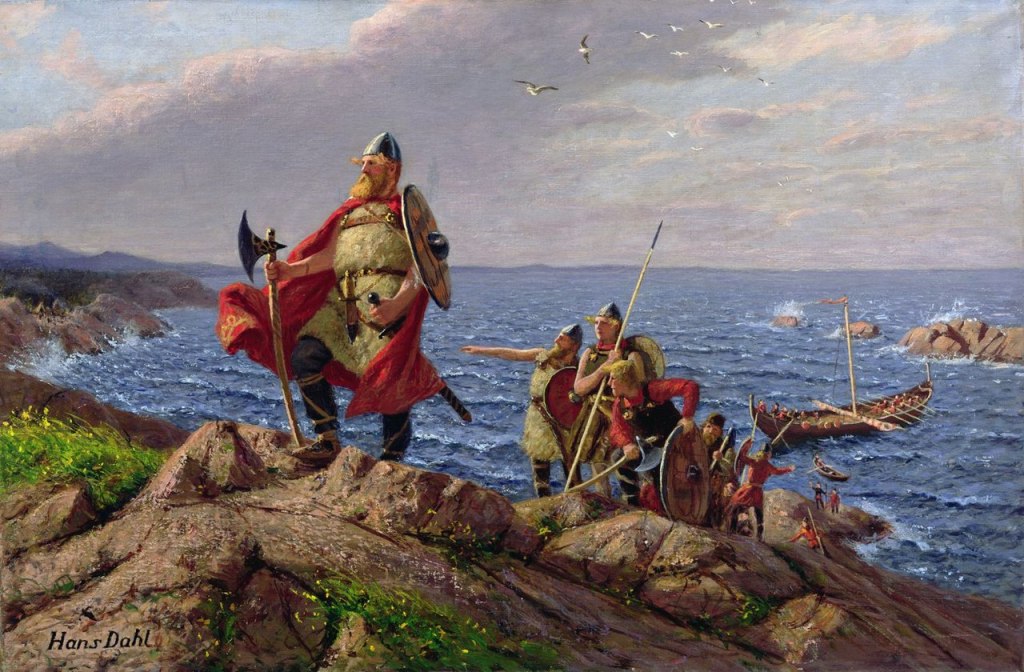
Image: Leif Eriksson Discovers America by Hans Dahl (1849–1937).
On this day in history, October 9, 1000, Leif Erikkson, a Norse explorer and chieftain, discovered Vinland, making him possibly the first European known to explore and set foot in North America, approximately 500 years before Christopher Columbus. The continuing conjecture is that the encampment created by Leif and his crew relates to the ruins of a Norse settlement called L’Anse aux Meadows, found in Newfoundland, Canada.
Leif Erikkson was born in the 970s in Iceland and died between 1018 and 1025 in Greenland. He was one of three sons born to Erik the Red – the first explorer of Greenland – and his wife, Thjodhild. Leif came with his parents from Iceland to Greenland around the year 985. In the 990s, Leif showed himself at King Olaf Tryggvason of Norway’s court, who “showed him much honor, as Leif appeared to him to be a man of good breeding.” To attend an admired ruler was part of the education of any chivalrous young Norseman.
According to some sources, Leif became a Christian at Olaf’s insistence. When Leif stated that he intended to return to Greenland, Olaf presented him with a priest and other clergy and instructed him to establish Christianity there. Some historians believe this could only have occurred a decade after 1000.
Yet, archaeological evidence from the Greenland colony has revealed the existence of a Christian church and a nearby cemetery where people were buried beginning in the 990s. Apart from Leif’s beliefs, the bond between the Norseman and Olaf and the status Leif would have enjoyed by having the king’s support is enough to show that he may have undertaken the religious commission.
Leif is well known for his explorations in North America, which he embarked on around the year 1000. The stories of his role widely vary. In The Saga of the Greenlanders, written in 1387, Leif chooses to investigate areas traveled by the Icelander Bjarni Herjolfsson fifteen years before, when Bjarni’s ship sailed off course on its way from Iceland to Greenland. Bjarni had observed three areas: from north to south, Leif named Helluland, Markland, and Vinland.
Helluland, meaning Land of Stone Slabs, was a terrain full of glaciers, mountains, and rock. It is believed to be the region from Resolution Island and Baffin Island in Nunavut to the Torngat Mountains in northern Labrador. Farther south was Markland (Land of Forests), which was likely a large area around Hamilton Inlet in central Labrador. South of Markland, bordering the Gulf of St. Lawrence, was Vinland (Land of Wine), so named because the Norse explorers detected wild grapes there.
In The Saga of the Greenlanders, Leif created a base for additional searching in Vinland, calling it “Leif’s Camp.” The camp’s exact location remains a subject of discussion among academics, some of whom feel that it is L’Anse aux Meadows in northern Newfoundland. The Vinland sagas hold various stunning passages of clashes with Indigenous peoples who would have been the ancestors of the Mi’kmaq, the Beothuk, and the Innu. It is unsure whether Leif was there during these meetings, partially because the stories have been blended and merged.
The Norse voyages to Vinland lasted only a few years, probably because the developing new colony of Greenland, which numbered only a few hundred people, had no requirement for added land. The assets of Vinland were too far away to be practical. Vinland was as far from Greenland as Norway, and the same stuff could be acquired in Europe, where other essentials such as iron, grain, salt, and spices were also accessible. Nonetheless, familiarity with the New World continued among the Norse in Greenland, and there were intermittent visits to Markland (Labrador) for lumber.
Leif is recounted in The Saga of the Greenlanders as having all the attributes that specify the Norse standard of a leader: “tall and strong, of striking appearance, shrewd, and in every aspect moderate and wise.” He became “very wealthy and was held in much respect.” Even his vision was superior to most people’s. On his homecoming to Greenland from Vinland, he noticed 15 men stranded on a reef before his crew could view them. He provided the marooned men generosity in keeping with a leader, coordinating accommodations for the group and welcoming their leader and his family to stay the winter with him. After this, Leif was known as “Leif the Lucky.”
With the death of his father, Erik, shortly after 1000, Leif took over the family estate at Brattahlid, Greenland. He became the paramount chieftain of the colony Erik had founded. Leif never returned to Vinland as chieftain but permitted family members to go there.
Leif was still living in 1018 when, according to The Saga of St. Olaf, King Olaf II banished his defeated rival Hraerik “to Leif Erikkson in Greenland.” Olaf hoped that the colony’s isolation would guarantee that Hraerik would never return. By roughly 1025, Leif had died, and his son Thorkell became the chieftain at Brattahlid. Brattahlid remained the paramount chieftain seat, but whether Leif’s descendants continued as leaders are still being determined.
Leif’s wife is not referred to in any source, and little is known about his lineage other than that he had two sons. One, name Thorgils, was born out of wedlock in the Hebrides (several islands off the west coast of Scotland) during Leif’s early journey to Norway. Thorgil’s mother’s name was Thorgunna, a Hebridean noblewoman. While Leif recognized Thorgils as his son, he refused to marry his mother – a slight that she proposed Thorgils would pay back when he got old enough: “it’s my guess that he will serve you as well as you have served me now with your departure.” She sent Thorgils to Greenland, where people saw him as somewhat strange. Thorkell, Leif’s other son, was born to Leif and his wife, making him the rightful heir to the chieftainship of Brattahlid.
Leif Erikkson was the first European to investigate the east coast of Canada, from the Arctic to New Brunswick, around 1000. He made these voyages approximately five hundred years before Christopher Columbus’s excursion across the Atlantic Ocean in 1492. Today, efforts by archaeologists to decisively determine the whereabouts of Leif’s transient base in Vinland are continuing.
Subscribe to “History Daily with Francis Chappell Black” to receive regular updates regarding new content:
Help us with our endeavors to keep History alive. With our daily Blog posts and our publishing program we hope to inform people in a comfortable and easy-going manner. This is my full-time job so any support you can give would be greatly appreciated.
 History Daily With Francis Chappell Black
Leave a comment