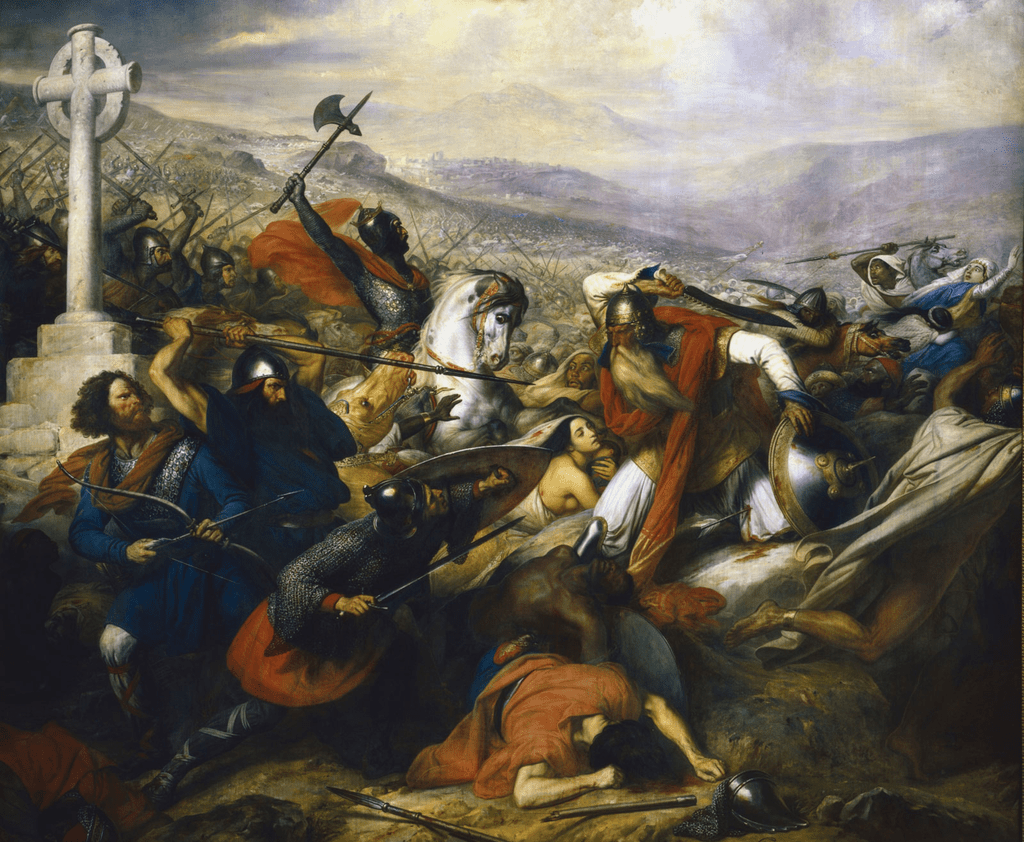
Image: Charles de Steuben’s Bataille de Poitiers en octobre 732 romantically depicts a triumphant Charles Martel (mounted) facing Abdul Rahman Al Ghafiqi (right) at the Battle of Tours. (Public Domain).
On this day in history, October 10, 732, the Battle of Tours was fought and was a significant battle during the Umayyad invasion of Gaul. It brought about the victory for the Frankish and Aquitanian armies, led by Charles Martel, over the invasive Muslim army of the Umayyad Caliphate (who were a dynasty of caliphs based in Damascus that ruled from A.D. 661 to 750), led by Abd al-Rahman al-Ghafiqi, governor of al-Andalus. Numerous historians have acknowledged that the Christian triumph in the confrontation was a significant component in restricting the Islamization of Western Europe.
Al-Ghafiqi died in the battle, and the Umayyad military retreated after the clash. The battle assisted in laying the groundwork of the Carolingian Empire and the Frankish dominance of Western Europe for the next century. Most historians acknowledge that the formation of Frankish supremacy in Western Europe modeled that continent’s future, and the Battle of Tours proved that domination.
In 711, the armies of the Umayyad Caliphate entered the Iberian Peninsula from Northern Africa and immediately began invading the region’s Visigothic Christian kingdoms. They used the area to strengthen their place on the peninsula as a stage for initiating attacks over the Pyrenees into modern-day France. At the outset, they met little resistance, they were able to secure a toehold, and the army of Al-Samh ibn Malik entrenched their headquarters at Narbonne in 720. Initiating assaults against Aquitaine, they were stopped at the Battle of Toulouse in 721. This saw Duke Odo defeat the Muslim intruders and kill Al-Samh. Returning to Narbonne, Umayyad soldiers rddddd west and north, moving as far as Autun, Burgundy, by 725.
In 732, Umayyad armies commanded by the governor of Al-Andalus, Abdul Rahman Al Ghafiqi, proceeded in force into Aquitaine. Encountering Odo at the Battle of the River Garonne, they won a definitive triumph and began sacking the territory. Escaping northward, Odo requested assistance from the Franks. Appearing before Charles Martel, the Frankish mayor of the palace, Odo was assured help only if he agreed to submit to the Franks. He agreed to the conditions, so Martel raised an army to fight the intruders. In the years prior to this, having judged the situation in Iberia and the Umayyad attack on Aquitaine, Charles grew to think that a professional army, rather than raw recruits, was required to protect the kingdom from conquest. To raise the funds needed to create and train a force that could resist the Muslim horsemen, Charles began grasping Church lands, securing the anger of the religious community.
Moving to capture Abdul Rahman, Charles used side roads to prevent from being detected and permitted him to choose the battlefield. With almost 30,000 Frankish soldiers under his command, he took up a position between the towns of Tours and Poitiers. Charles selected a high, wooded plain for the coming battle that would cause the Umayyad cavalry to ride uphill across a harsh landscape. This battlefield had trees in front of the Frankish line, which would help break up the cavalry’s attacks. Creating a large square, his men shocked Abdul Rahman, who did not guess that he would meet a large enemy force, and this caused the Umayyad emir to stop for a week to think through his choices. This delay helped Charles as it enabled him to gather more of his veteran soldiers to Tours.
As Charles reinforced his army, the progressively more frigid weather began to affect the Umayyads, who were surprised by the more northern climate. On the seventh day, after rallying his army, Abdul Rahman attacked with his Berber and Arab cavalry. In one of the few occurrences when medieval infantry stood up to cavalry, Charles’s troops routed recurring Umayyad assaults. As the battle continued, the Umayyads finally crashed through the Frankish lines and endeavored to kill Charles. He was quickly encircled by his personal guard, who resisted the attack. As this was happening, scouts Charles had sent out earlier were penetrating the Umayyad camp and releasing prisoners and enslaved people.
Thinking that the loot from the war was being robbed, a sizable portion of the Umayyad force broke away from the battle and ran to safeguard their camp. This withdrawal looked like a retreat to their companions, who soon began to take flight from the battlefield. While struggling to prevent the visible retreat, Abdul Rahman was encircled and slain by Frankish soldiers. Momentarily chased by the Franks, the Umayyad retreat became a complete withdrawal. Charles re-formed his troops, fully anticipating another assault the next day. Still, much to his amazement, it failed to materialize as the Umayyads maintained their retreat all the way to Iberia.
While approximate casualties for the Battle of Tours are unknown, some histories report that Christian losses numbered close to 1,500 while Abdul Rahman suffered around 10,000. Since Martel’s triumph, historians have debated the battle’s importance, with some feeling that his win saved Western Christendom while others believe that its impacts were insignificant. Nevertheless, the Frankish victory at Tours, along with successive campaigns in 736 and 739, effectively halted the progress of Muslim armies from Iberia, permitting the future development of the Christian nations of Western Europe.
Subscribe to “History Daily with Francis Chappell Black” to receive regular updates regarding new content:
Help us with our endeavors to keep History alive. With our daily Blog posts and our publishing program we hope to inform people in a comfortable and easy-going manner. This is my full-time job so any support you can give would be greatly appreciated.
 History Daily With Francis Chappell Black
Leave a comment