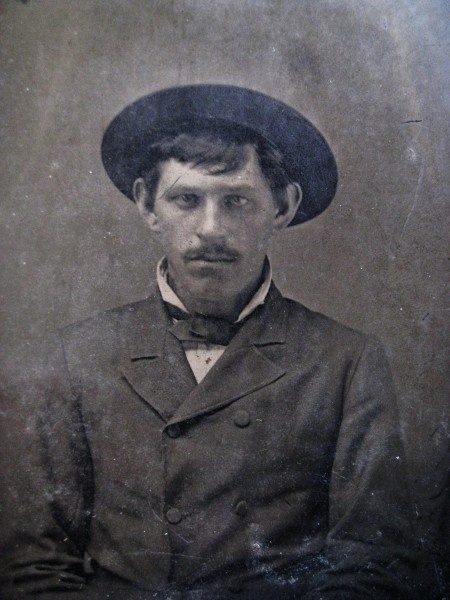
Image: Dave Rudabaugh (Public Domain)
Nicknamed “Dirty Dave” because he scarcely bathed and wore filthy clothes, Dave Rudabaugh was a cowboy, outlaw, and gunfighter in the American Old West.
Dave Rudabaugh was born on July 14, 1854, and was a young boy living in his birth state of Illinois when his father was killed during the American Civil War. Circumstances caused the family to move to Ohio and later to Kansas. Life was hard in the 1860s and 1870s for young war widows left to their own devices with children to raise. Later Rudabaugh lived in Greenwood County, Kansas, before following the cattle trail west into Colorado. His life was little known until he joined the “outlaw trail.”
The outlaw career of Dave Rudabaugh truly began in Arkansas during the early 1870s. He was part of a group of outlaws who robbed and took part in cattle rustling along with Milt Yarberry and Mysterious Dave Mather. The three allegedly killed a rancher and bolted from the state. It was thought all three ventured to Decatur, Texas, but other accounts have Rudabaugh going to the Black Hills of South Dakota, where he took up stagecoach robbing.
In 1876 Rudabaugh took up with outlaws Milt Yarberry and Dave Mather, and they became known as the “Trio.” Mather went by the moniker of “Mysterious” Dave owing to his aloof demeanor. Rudabaugh, Yarberry, and Mather were suspected in the death of a local rancher. They may have “told on themselves” because all three men fled Arkansas for safer pastures. Some say the fugitives migrated to Decatur, Texas, but this may not be true. Mather returned to Clinton, Connecticut, and signed on as part of the ship’s crew, eventually making his way to New Orleans. Rudabaugh is believed to have gone to South Dakota, where he found stagecoach robbing a lucrative line of work.
A disputed story from around this period states that Rudabaugh showed Doc Holliday how to use a gun while Doc taught him the finer points of playing cards. Doc Holliday may have taught Rudabaugh how to play cards, but he was already adept with side arms before leaving Georgia.
In 1877, Rudabaugh robbed a Sante Fe Railroad construction camp and then fled south. Commissioned as a deputy US marshal, Wyatt Earp was sent to capture him. Earp trailed Rudabaugh for 400 miles out toward Fort Griffin, Texas. Rudabaugh arrived at the frontier town, situated on the fork of the Brazos River, a few days before Earp. When Earp arrived, he entered the Beehive Saloon, owned by John Shanssey, whom Earp had known from a young age. Shanssey informed Earp that Rudabaugh had passed through town earlier that week but had no idea where he was headed. He suggested that Earp ask a gambler named Holliday about Rudabaugh, as they had been playing cards together a few days back. This was the occasion that Earp first met Doc Holliday. Despite his hatred of lawmen, Holliday, for some reason, told Earp that Rudabaugh was headed back toward Kansas. Earp telegraphed this information to Ford County Sheriff Bat Masterson, and Rudabaugh was soon taken into custody.
If this was true, then Rudabaugh’s custody was fleeting because, in late January 1878, the Trio tried to rob a train near Kinsley, Kansas. During the holdup, everything that might have gone wrong did, and the outlaws came away empty-handed. The next day, Sheriff Masterson led a posse (which included John Joshua Webb) and captured Rudabaugh with Ed West. Rudabaugh then made a deal with the county attorney: freedom in exchange for testifying against his friends.
There was a thin line between being a lawman and an outlaw. This was true in the case of Bat Masterson, who, after Rudabaugh’s release from the county jail, hired him to join a gang of gunfighters who had been employed by the Atchison, Topeka, and Sante Fe Railway Company during the Railroad Wars. The Railroad Wars were a series of conflicts between competing railway companies, which were not unusual in the old west. Most of the time, the fights took place inside a court of law, but there were violent clashes, mainly in the last quarter of the 19th century.
Rudabaugh eventually became a close associate of John Joshua Webb. After the Railroad War, Rudabaugh and Webb traveled to Las Vegas, New Mexico, where they joined with the Dodge City Gang—a group of thugs from Dodge City, Kansas, who moved to New Mexico and ended up dominating the political and economic scene (1879-80). Las Vegas was booming and thought to be the future metropolis in New Mexico. By this time, the gang included Mysterious Dave Mather and was led by Hyman Neill, whom everyone called Hoodoo Brown. Brown was a justice of the peace. Holliday was also in Las Vegas. He maintained cordial relations with gang members but was not affiliated with them.
When Webb was arrested for murder in the spring of 1880, Rudabaugh and another member of the Dodge City Gang tried to break him out of jail. This attempt failed, and Rudabaugh shot and killed town deputy Antonio Lino Valdez. Rudabaugh fled to Fort Sumner, New Mexico, where he joined up with Jim Greathouse and William H. Bonney.
On November 29, 1880, Bonney, Rudabaugh, and Billy Wilson eluded a posse led by Deputy Sheriff James Carlyle. Cornered at the Greathouse ranch, Bonney told Carlyle they held Greathouse as a hostage. Carlyle fell for this trick and offered to exchange places with Greathouse; Bonney accepted. Later, when Carlyle attempted to escape, one of the outlaws shot him three times, killing him. When the posse withdrew, Rudabaugh, Bonney, and Wilson escaped.
A few weeks later, still riding with Bonney and accompanied by Wilson, Charlie Bowdre, Tom Pickett, and Tom O’Folliard, the men rode into a trap laid for them at Fort Sumner. Unknown to the outlaws, a posse led by Pat Garrett was waiting for them. The lawmen opened fire, killing O’Folliard, but the rest of the gang got away.
At Stinking Springs, near present-day Taiban, New México, on December 23, 1880, Pat Garrett’s posse captured Dave Rudabaugh, Billy the Kid, Billy Wilson, and a few others. They were taken in custody to Las Vegas, but the threat of a lynch mob prompted Garrett to move them to Sante Fe. In February 1881, Rudabaugh pleaded guilty to several counts of mail robbery and was sentenced to 99 years in prison. He was then found guilty of the murder of Deputy Valdez and sentenced to death by hanging.
In jail, Rudabaugh was reunited with Webb. The two men escaped from jail when a fellow prisoner named Thomas Duffy died. Rudabaugh fled to Arizona. Some believe that Rudabaugh had signed on with the Cochise County Cowboys and was present at Iron Springs when Wyatt Earp killed Curly Bill Brocius. The breakup of the Clanton Gang sent Rudabaugh to Mexico, where he labored as a cowboy and a rustler.
On February 18, 1886, Rudabaugh had been playing cards in a cantina in Parral, Chihuahua, Mexico, when a dispute exploded. Rudabaugh drew his gun, killed two men, wounded a third, and left the saloon unhurt. Then, unable to locate his horse, Dave re-entered the cantina a few minutes later. This was Rudabaugh’s final mistake because someone standing in the shadows shot him several times as he entered the saloon. Rudabaugh was then decapitated with a machete, and his head placed on a pole at the outskirts of town. For the next several days, his killers were said to have paraded through town with his head on a stick. At the time of his death, Rudabaugh was 31 years old.
Since his head was left on the pole for several weeks, no one attended his funeral.
Subscribe to “History Daily with Francis Chappell Black” to receive regular updates regarding new content:
Help us with our endeavors to keep History alive. With our daily Blog posts and our publishing program we hope to inform people in a comfortable and easy-going manner. This is my full-time job so any support you can give would be greatly appreciated.
 History Daily With Francis Chappell Black
Leave a comment