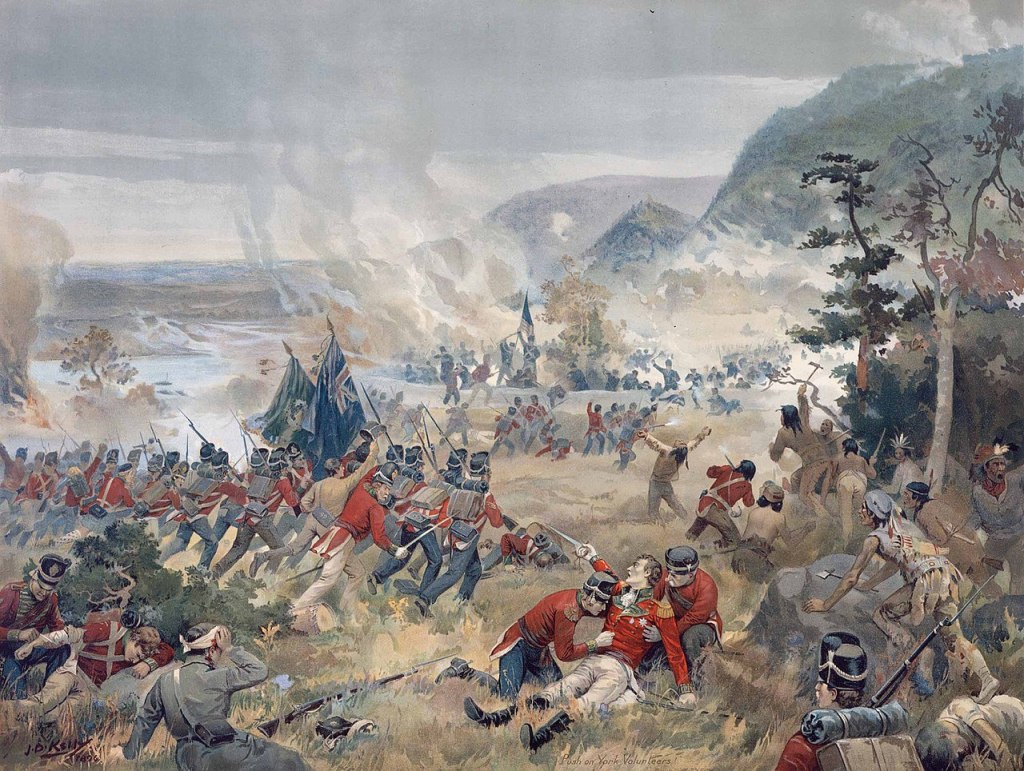
Image: The death of General Brock at the Battle of Queenston Heights by John David Kelly (1862 – 1958) published 1896. (Public Domain)
On this day in history, October 13, 1812, British and Indigenous forces under Sir Isaac Brock conquered an American Army at the Battle of Queenstown Heights on the Niagara frontier in Ontario, Canada. The British triumph, in which over 1,000 U.S. soldiers were killed, wounded, or captured, essentially ended any additional U.S. attack on Canada. Sir Isaac Brock, Britain’s most brilliant general during the war, was killed during the battle.
Major-General Sir Isaac Brock was deemed one of Canada’s first heroes. He is recalled for his inspirational leadership and courageous actions during the War of 1812. Brock was a vigorous and intelligent child born on the island of Guernsey in the English Channel in 1763. Brock excelled at sports and developed the athleticism required to allow him to serve in the military effectively.
Like his three older brothers, Brock purchased a commission allowing him to join the military when he was just 15 years old. Brock rose quickly through the ranks by buying more commissions or receiving promotions. At 28, Brock became a Lieutenant Colonel in the 49th Regiment of the British Army. In 1802, he crossed the Atlantic Ocean to resume his military service in Quebec, where he stayed for eight years. Subsequently, Brock was reassigned to Upper Canada, where he became Commander in Chief of His Majesty’s Forces. This was a prestigious role for Brock, earning the title of Major-General. He also became the administrator of the whole province.
When the War of 1812 began, American Major-General William Hull invaded Upper Canada in July but withdrew to Fort Detroit upon realizing that Brock was leading troops to meet him. Brock arrived at Fort Amherstburg and learned from captured correspondence about serious dissent among Hull’s officers and his increasing fear of defeat. Brock met Tecumseh, and the two became solid allies. Brock chose to act rapidly before Hull was reinforced. On the night of August 15-16, 1812, Tecumseh and his warriors traversed the Detroit River to be followed by Brock and his soldiers the next morning. Brock intended to form up his troops and entice Hull to exit his strong, well-armed fort to fight in the open. But, on hearing of American soldiers at his rear, Brock decided on the direct attack. He led his troops forward even though all they could see opposite them as they advanced were two 24-pounder guns, their gunners standing ready to fire.
Brock was advised to let his officers go before him, and he declined because he would never order his men to go anywhere he would not lead them. He was calculating that Hull would back down, and he was correct. Hull ordered his gunners not to fire without asking anyone, raised a white flag at the fort, and sent two officers to seek terms from the British. Brock sent his aides into the fort, where they agreed to Hull’s total surrender. His calculated risk produced a surprising victory by capturing an American army, fort, territory (Michigan), and vast quantities of war material. A mood of pessimism in Upper Canada turned to optimism that the soldiers, militia, and Indigenous allies could protect the province.
On the night of October 13, 1812, American General Stephen Van Rensselaer traversed the Niagara River from Lewiston, N.Y., with 3,000 soldiers to the village of Queenston. The arrival was resisted by 300 British troops, who blocked the Americans from seizing the town. Scaling a nearby path, the Americans soon secured control of the nearby heights, acquiring a small redan battery with an 18-pounder cannon that dominated the area.
Woken by the gunfire, Brock mounted a horse and galloped from Fort George to the ongoing battle. Upon his entrance, he gathered the British forces now convened below the heights and led them up the hill to retake the battery. Repelled, he coordinated a second push and again launched an assault. Magnificent in his red uniform, cocked hat, and gold lace, Brock was recognized by an American sharpshooter (some say it was a Kentucky rifleman) and shot in the chest.
It is at this point that Brock passes into legend. Some reports claim that Brock, now fatally wounded, urged the York Volunteers to “push on” and take the battery. Modern explanations indicate that Brock was instantly killed by the bullet that struck him. Ultimately, the British recaptured the heights, won the battle, and captured nearly 1,000 prisoners.
While Brock should have never subjected himself to such risk, his abrupt charge at the head of his men was entirely in keeping with his spirit. As observed at Fort Detroit and again at Queenston Heights, Brock was not a man to be controlled by judgment and restraint. He may even have been quietened into a false sense of imperviousness, as are many men of careless heroism.
While Brock often gets recognition for succeeding at Queenston, he died early in the fight, wildly leading an attack straight up the escarpment. His substitute, the inept Sir Roger Hale Sheaffe, won the day with a clever flanking maneuver, with assistance from Mohawk forces, who kept the Americans trapped until Sheaffe arrived.
Brock could evaluate most situations. Yet he was far too reckless regarding battle tactics. He should never have led the charge up Queenston Heights. Neither should he have ridden in front of the gunners at Detroit. A single, well-placed American bullet could easily have killed Brock and saved the fort. And then the War of 1812 might have ended differently for Canada.
After the battle, Brock was buried in the northeast bastion of Fort George alongside his aide-de-camp, Lieutenant-Colonel Macdonell, who had also died in the fight. Brock had been made a Knight of the Bath for his victory at Detroit, but the news did not reach him before he was killed at Queenston Heights. For the remainder of the war, other British commanders stepped up and performed their duties well. None, however, demonstrated the natural inclination and aggressive temperament so ably shown by Brock. While his loss was severe, his victories made it unimaginable for his successors that they abandon Upper Canada.
Subscribe to “History Daily with Francis Chappell Black” to receive regular updates regarding new content:
Help us with our endeavors to keep History alive. With our daily Blog posts and our publishing program we hope to inform people in a comfortable and easy-going manner. This is my full-time job so any support you can give would be greatly appreciated.
 History Daily With Francis Chappell Black
Leave a comment