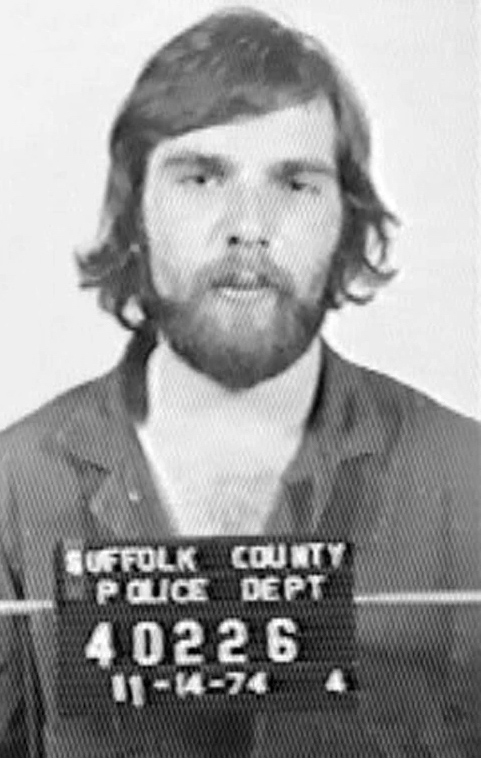
Image: Mugshot taken of Ronald DeFeo, taken following his arrest. (Public Domain)
On this day in history, October 14, 1975, Ronald DeFeo Jr. went on trial for slaughtering his parents and four brothers and sisters in their Amityville, New York, home. The family’s house was afterward thought to be haunted and provided the idea for the Amityville Horror book and movies.
The real-life dreadfulness started on November 13, 1974, when 23-year-old Ronald DeFeo Jr. mortally wounded his parents and four younger siblings while they were fast asleep in their home in Amityville, New York. Later, hours after killing them, DeFeo proceeded to a neighborhood bar, pleading for assistance.
At the start, DeFeo told the authorities that the killings were a mob hit, and he was so compelling that he was taken to a police station for safety. Soon the cracks began forming in his narrative, and by the following day, he had admitted to killing his family.
Nevertheless, the Amityville Murders case was not over. When DeFeo went on trial, his lawyer stated that he was an “insane” man who happened to hear demonic voices in his head, making him kill. About a year after the murders, a new family moved into the house where the killings happened. They bolted from the house after only 28 days, asserting ghosts haunted it.
On the exterior, the DeFeo’s seemed happy on Long Island during the early 1970s. They were seen as “a nice, normal family.” The family contained Ronald DeFeo Sr. and Louise DeFeo and their five children: Ronald Jr., Dawn, Allison, Marc, and John Matthew.
They lived in a wealthy part of Long Island called Amityville. Yet the Defeos were an unusual family behind closed doors.
Ronald DeFeo Sr. supervised an auto dealership, a job that didn’t support the family’s extravagant lifestyle. Instead, most of their funds derived from Louise’s father, Michael Brigante, who bought the family’s home for them, permitting them to leave their tiny Brooklyn apartment.
“Big Ronnie” was also allegedly a violent and vicious man. Mostly, he took his rage and irritation out on his oldest son, Ronald Jr., And as DeFeo Jr. grew up, he tried to find some common ground with his dad.
He and his father persisted in their fighting – Ronald Jr. once drew a gun on Ronald Sr.
He spent most of his time doing drugs or drinking, getting into fights, and arguing with his parents. However, nobody anticipated that Ronald Jr.’s problems would cause him to perpetrate the Amityville Murders.
Ronald Jr.’s constant quarreling with his father ended violently when he mortally shot Ronald Sr. with a .35-caliber Marlin rifle as he slept early on November 13, 1974. Yet, he didn’t stop with killing his father. He also shot his mother, Louise DeFeo. Then, 23-year-old Ronald Jr. killed his sleeping brothers and sisters: 18-year-old Dawn, 13-year-old Allison, 12-year-old Marc, and 9-year-old John Matthew.
After murdering his family, Ronald Jr. took a shower and got dressed. Then, he continued with his day.
He pretended not to know why his father hadn’t shown up to work as expected and left work and spent the afternoon with friends, making sure he was noticed trying to contact his family. Then, he waited for the detection of his family’s remains.
In the early evening, Ronald Jr. went to a neighboring bar, yelling for help. He told the regulars that “someone” had shot his family and pleaded for them to return with him to his house. There, the alarmed bargoers were welcomed by an extremely horrifying display.
Each member of the DeFeo family was discovered lying face down in bed – with fatal gunshot wounds.
The police reached the scene and discovered Ronald DeFeo Jr. waiting for them. DeFeo initially told the police that the mob had pursued his family. Initially, the authorities were inclined to believe his story. They even secured him in a police station for his protection. But they soon detected cracks in his report that didn’t line up.
For one, DeFeo maintained that he couldn’t have killed his family because he had been working all morning and with friends all afternoon. But police quickly determined that the family had been killed in the early morning, well before DeFeo would have left for work.
And after DeFeo declared an infamous mob hitman could have killed his family, police soon realized that the assassin was out of state.
By the following day, Ronald DeFeo Jr. had admitted to the offense. He told the cops, “Once I started, I just couldn’t stop. It went so fast.”
DeFeo’s trial in October 1975 captured attention for two reasons: his offense’s pure brutality and the defense’s remarkable aspects. His lawyer built a case claiming that his client was insane and he killed his family in “self-defense” because of the demonic voices in his head.
Ultimately, DeFeo was found guilty on six charges of second-degree murder in November. He was sentenced to six consecutive sentences of 25 years to life in prison. But that did not end the story of the Amityville Murders.
Perhaps most alarmingly, the killer’s motive remained unclear. Though DeFeo had many issues with his father, it mystified many why he would kill the rest of his family. And because DeFeo would change his story many times in prison, he cast very little light on the mystery.
And then, in December 1975, a new family moved into the DeFeo’s old home. George Lutz, his wife Kathy, and their three children stayed at the residence for 28 days before escaping the property in terror – asserting that the ghosts of the dead DeFeos haunted the property.
From green slime from the walls to windows suddenly shattering to family members allegedly levitating in bed, their claims sounded like something directly out of a horror film.
And just a couple of years later, in 1977, author Jay Anson published a novel titled The Amityville Horror, based on the Lutz family’s claims of paranormal activity in the home. In 1979, as a film by the same name was released, people tried to visit the real Amityville Horror House in search of paranormal activity.
In the intervening period, DeFeo tried many times to free himself, growing progressively more resentful of the attention he received in prison. He changed his story of the Amityville Murders multiple times. He remained in prison until he died at age 69 in 2021.
Subscribe to “History Daily with Francis Chappell Black” to receive regular updates regarding new content:
Help us with our endeavors to keep History alive. With our daily Blog posts and our publishing program we hope to inform people in a comfortable and easy-going manner. This is my full-time job so any support you can give would be greatly appreciated.
 History Daily With Francis Chappell Black
Leave a comment