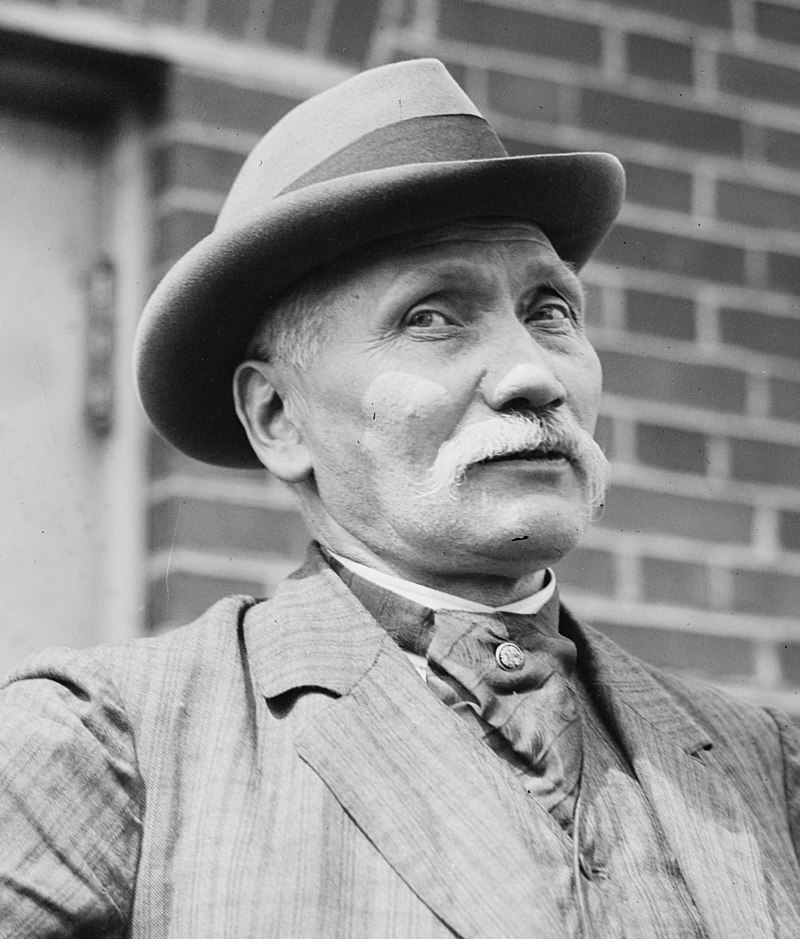
Image: Wilhelm Voigt in 1910. (Public Domain)
On this day in history, October 17, 1906, Wilhelm Voigt, a 57-year-old German shoemaker, masquerades as an army captain and directs a whole platoon of soldiers to aid him in stealing 4,000 marks. Voigt, who had an extensive criminal record, embarrassed the German army by manipulating their blind subservience to authority and getting them to facilitate his daring robbery,
One day in 1906, while browsing a second-hand store, Voigt found a remarkable captain’s uniform from the 1st Regiment of the Prussian Guards. He bought the ensemble, which included a pair of army boots and a captain’s cap. He went home, put his uniform on, and then went for a walk on the streets of Berlin.
Cavalierly strolling about, he was amazed at the interest he unexpectedly drew and the esteem people now showed him. This gave him a sensation that he had acquired a newfound force.
A squad of ten troopers marched by and energetically saluted him; Voigt was seemingly motivated to action. He commanded them to stop and then ordered them to follow him, to “execute some official matters of importance.” The “captain” then marched his unit to the train station, where they proceeded to Kopenick, east of Berlin.
Once there, he inhabited the local city hall with his troops and instructed them to protect all the doors. He ordered the local constabulary to ensure law and order and to stop any calls to Berlin for one hour while posted at the post office.
Voigt initially intended to force his way in to receive a passport. When he entered, however, he realized that the passport office was not in the town hall but at the other end of town. Desperate, he immediately arrested the town’s mayor and treasurer for “irregularities committed in connection with the public sewage works.”
The sight of the captain, soldiers, rifles, and bayonets instantly deflated the town officials. They yielded to apprehension and followed the captain’s order to seize the municipal funds, handing him 4,000 Reichsmarks. They lingered while he counted the money, convinced he would put everything in order and free them soon. They waited quite a while before realizing that the captain and the money had vanished.
The captain’s flash of luck and triumph finally came to an end. Ten days afterward, he was detained. The story should have finished there, but amazingly it did not. Within days, word of his ridiculously successful sham spread like the plague throughout Germany, Europe, and the world. A regular shoemaker had bested the Germans with their attention to “Ordnung” and their strict Prussian control, and basically, he had deprived them of their weaponry.
In the days after the event, the German press wondered what had happened. At the same time, the army managed its own inquiry. The bravery of the offender entertained the public.
Voigt was arrested on October 26, 1906, after a former prison cellmate who knew about Voigt’s scheme had told the police, hoping for a significant cash reward. On December 1, Voigt was imprisoned for four years for forgery, impersonating an officer, and wrongful imprisonment. Nevertheless, public opinion was on his side. German Kaiser Wilhelm II pardoned him on August 16, 1908, after two years in prison. The Kaiser had been amused by the incident, calling him an “amiable scoundrel,” and was happy with the dominance and feelings of reverence that his military commanded in the general populace.
In the October 27, 1906, issue of The Illustrated London News, writer G.K. Chesterton pointed out:
“The most absurd part of this absurd fraud (at least, to English eyes) is one which, oddly enough, has received comparatively little comment. I mean the point at which the Mayor asked for a warrant, and the Captain pointed to the bayonets of his soldiery and said, ‘These are my authority’. One would have thought anyone would have known that no soldier would talk like that.”
And what about Wilhelm Voigt, the man who started the whole affair? Although sentenced to four years in prison, after two years, he was pardoned. Voigt chose to profit from his newfound fame. A mere four days after his release, there was a wax sculpture of him wearing a captain’s uniform at the Unter den Linden Wax Museum. He even showed up numerous times to take pictures and sign autographs. Voigt also starred in many plays, and even wrote a book in 1909 called Leipzig: How I Became the Captain of Kopenick, a bestseller. Although his United States tour was almost canceled because the immigration authorities refused to allow him a visa, he reached the U.S. in 1910 via Canada. He also stimulated the creation of a waxwork in Madame Tussaud’s Museum in London.
He then journeyed around Germany, making money by selling postcards decorated with his portrait. In 1909 he was in Luxembourg City, living at No. 5, Rue de Fort Niepperg. He used Luxembourg as his home base and toured various countries with different circuses as the Captain of Kopenick. However, he always returned to Luxembourg, and in later years, he lived there as a pauper wrapped in his old gray military coat with the captain’s cap on his head.
When World War I started in 1914, the Germans occupied Luxembourg – and Wilhelm Voigt was arrested again for “inadmissibly wearing a uniform.” They gathered the truth sometime later, and Voigt was released again.
The Captain of Kopenick, who had obtained all his military facts from books in prison libraries, died in 1922. His funeral was paid for publicly, but the authorities would not purchase him a tombstone. Nevertheless, the people at the Circus Sarrasani, with whom he had occasionally worked, paid for a monument, and the Sarrasanis also kept his resting place well-manicured.
Subscribe to “History Daily with Francis Chappell Black” to receive regular updates regarding new content:
Help us with our endeavors to keep History alive. With our daily Blog posts and our publishing program we hope to inform people in a comfortable and easy-going manner. This is my full-time job so any support you can give would be greatly appreciated.


History Daily: 365 Fascinating Happenings Volume 1 and Volume 2 are for sale now from my publisher’s site:
Order your copy today to support our efforts.
Thank you.
Francis
 History Daily With Francis Chappell Black
Leave a comment