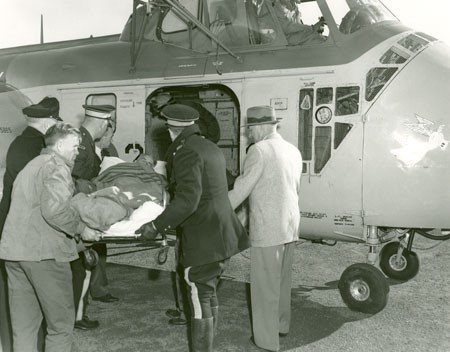
Image: Injured miner being taken to hospital by helicopter, Springhill Mine Disaster, 1958. (Public Domain)
On this day in history, October 23, 1958, a “bump” wracked the No. 2 mine in Springhill, Nova Scotia, Canada. The Springhill Mine Bump was an underground earthquake that trapped 174 miners in No.2 colliery at Springhill, the deepest coal mine in North America. By November 1, 1958, rescuers had dug out 100 victims, with the death toll rising to 74.
The Springhill Coalfield in Nova Scotia began operation in the 19th century and was the site of more than one serious accident. In 1891, a coal-dust fire broke out in Number 1 and 2 collieries that were linked by a tunnel. With 125 miners killed and many more injured, it was a disaster that shocked Canada. In 1956, Number 4 Colliery experienced an explosion when the runaway train cars carrying coal dust hit a power line. A massive blast destroyed surface buildings and killed or trapped over 100 miners (39 dead, 8 brought out alive after an extraordinary effort by rescue crews).
Two years later, on October 23, 1958, Number 2 colliery at the Springhill Coal Mine was shaken by the most horrible “bump” in North American mining history. A bump is an underground quake caused when bedrock weakened by mining activity gives way, creating a shockwave with a domino effect that causes further collapses. The bump on October 23 was so severe that it felt like a small earthquake on the surface. The mining community of Springhill immediately realized that this signified disaster and rushed to the mine to begin a long wake as a frantic rescue effort was organized.
Springhill’s No. 2 mine was one of the deepest coal mines in the world. Inclined shafts of 14,200 feet (4,300 meters) led to a vast maze of corridors more than 4,000 feet (1,200 meters) below the surface. Mining procedures there had been altered 20 years before the 1958 bump, from “room and pillar” to “long wall retreating” after research had revealed the more significant risk of “bump” phenomena stemming from the former method.
On October 23, a slight bump happened at 7:00 p.m. during the night shift; it was overlooked, as this was an ordinary happening. However, an hour later, at 8:06 p.m., a massive bump “severely impacted the middle of three walls being mined and the ends of the four levels nearest the walls.”
The bump moved as three distinctive shock waves, reminiscent of a small earthquake throughout the area, warning citizens on the surface of the disaster. Teams of miners entered No.2 colliery to begin the rescue attempt. They met survivors at the 13,400-foot (4,100 meters) level walking toward the surface. Gas freed by the bump was encountered in large amounts at the 13,800-foot (4,200 meters) level where the ceiling had fallen, and rescuers were required to work down shafts partially collapsed or blocked by rubble.
Of the 174 miners in the No.2 mine at the moment of the bump, those not located in side galleries or some other housings were instantly flattened, the coal galleries and faces being utterly annihilated. Nevertheless, 75 miners had made it to the surface by 4:00 a.m. on October 24, 1958, and rescue teams kept trying to find 24 others, but many rockfalls and debris slowed movement.
Meanwhile, Canadian and international news media had arrived in Springhill. The public relations spokesperson for the mining company transmitted news of rescue (and later recovery) movements to the miners’ families and reporters. The disaster was the first major international event reported in live television broadcasts (on the Canadian Broadcasting Corporation (CBC)). Rescuers continued their work below ground, trying to reach trapped survivors, while the world waited and those family members on the surface kept their vigil. Rescue teams began arriving from other coal mines throughout Nova Scotia.
After five and a half days (the morning of Wednesday, October 29, 1958), contact was confirmed with 12 survivors on the other side of a 160-foot (49 meters) rockfall. A rescue tunnel was excavated; it reached the miners at 2:30 a.m. on Thursday, October 30, 1958.
On Friday, October 31, the disaster site was visited by several public figures, notably the Premier of Nova Scotia, Robert Stanfield, and HRH Prince Philip, the Duke of Edinburgh, who was visiting Ottawa.
Another cluster of survivors was found on Saturday, November 1, 1958. These would be the last miners found. Instead, dead bodies were brought out in aluminum coffins because of the advanced decomposition of the bodies sped up by the Earth’s heat in the depths of the No. 2 mine at 13,000-14,000 feet (4,000-4,300 meters).
In the media frenzy at the shaft entrance, reporters jostled to speak with survivors, especially the two clusters of miners trapped until Thursday and Sunday. When asked what he desired most, miner Douglas Jewkes replied, “A 7Up.” After this unsolicited “plug,” the 7 Up company hired him as a company spokesman.
Some miners and rescuers were invited to appear on The Ed Sullivan Show. Miner Maurice Ruddick was chosen as Canada’s “Citizen of the Year.” The “miracle miners” enjoyed public notoriety for a short period after their rescue. For Ruddick, the lone Black man in the group, racism made his moment in the spotlight less bright. An aide to the Governor of the U.S. state of Georgia took advantage of the media coverage to encourage tourism to that state by giving the survivors free vacations to Jekyll Island, an exclusive holiday destination. Yet much to the segregationist governor’s chagrin (who had been on a hunting trip in Manitoba, Canada, when the tragedy occurred), he learned of Ruddick’s race, creating a public relations nightmare. Upon realizing that Ruddick was Black, the Governor declared that Ruddick would have to be segregated. Ruddick decided to accept the Governor’s terms so that the other miners’ holiday would not be spoiled, but he and his family stayed in a trailer away from his colleagues.
The Springhill coalfields were closed after the 1958 disaster, which was disastrous for the community and left some of the world’s deepest coal mines to fill with water. But the flooded mines would later be used to provide a valuable source of geothermal energy for local industries.
Subscribe to “History Daily with Francis Chappell Black” to receive regular updates regarding new content:
Help us with our endeavors to keep History alive. With our daily Blog posts and our publishing program we hope to inform people in a comfortable and easy-going manner. This is my full-time job so any support you can give would be greatly appreciated.
 History Daily With Francis Chappell Black
Leave a comment