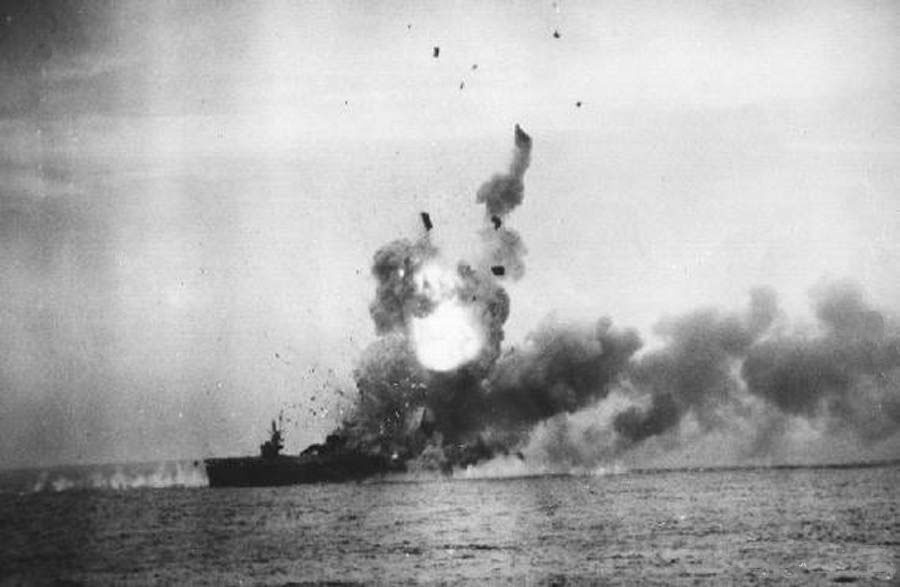
Image: St. Lo exploding after a kamikaze strike. (Public Domain)
On this day in history, October 25, 1944, during the Battle of Leyte Gulf, the Japanese utilize Kamikaze (“divine wind”) airplanes against American warships for the first time. It will prove disastrous – to both sides.
This decision to engage suicide bombers against the American ships at Leyte, an island of the Philippines, was centered on the breakdown of standard naval and aerial actions to stop the American onslaught – Japanese naval Captain Motoharu Okamura stated: “I firmly believe that the only way to swing the war in our favor is to resort to crash-dive attacks with our planes…. There will be more than enough volunteers for this chance to save our country.”
By mid-1944, the Japanese air force had become depleted of skilled pilots, modern aircraft, and fuel. At the same time, the American military persisted in moving westward as they leaped across the islands of the Pacific Ocean. The circumstances became even more disastrous for the Japanese after the United States seized Saipan in July 1944, bringing the Japanese home islands within the bounds of the United States’ new long-range B-29 bombers.
With World War II slithering away and conventional assaults unable to halt the American offensive, the Japanese forces were determined to turn their aviators into suicide bombers. “In our present situation, I firmly believe that the only way to swing the war in our favor is to resort to crash-dive attacks with our planes. There is no other way,” declared Japanese naval Captain Motoharu Okamura. The Japanese would attack like bees, he said. “They sting, they die.”
The use of suicide pilots was supported as a last hope by a Japanese population recoiling in panic in the face of impending defeat under bombs from American B-29s. The Japanese high command was motivated by a “combination of pragmatic military objectives,” comprising the need for a significant weapon against an adversary who ruled the skies and “specific Japanese sociocultural compulsions, such as face-saving and symbolic gestures of contrition regarding failure.”
The new horror originated from above during the Battle of Leyte Gulf in October 1944. During the battle, kamikaze pilots, named for the legendary “divine wind” that had saved Japan twice from 13th-century Mongol invasions launched by Kublai Khan, intentionally flew their improvised Zeros into American warships.
The first kamikaze force comprised 24 volunteer pilots from Japan’s 201st Navy Air Group. As the battle ended, Vice Admiral Takijiro Onishi put his Special Attack Units into operation from bases on Luzon. He initiated Kamikaze attacks against the Allied fleet in Leyte Gulf and the escort carrier ships off Samar. This was the second kamikaze assault by Japanese forces in World War II after the kamikaze attack on a previous escort carrier group a few hours earlier off Surigao Strait.
On October 25, 1944, the Kamikaze Special Attack Force carried out its first mission during the Battle of Leyte Gulf. Five A6M Zeros, led by pilot Lieutenant Seki, were escorted to the target by pilot Hiroyoshi Nishizawa where they attacked several escort carriers. One Zero tried to strike the bridge of USS Kitkun Bay but exploded on the catwalk and fell into the sea. Two others flew at USS Fanshaw Bay but were destroyed by anti-aircraft fire. The last two, Seki among them, flew at USS White Plains. Seki, however, under heavy fire smoking badly, aborted the attack on the White Plains and instead flew toward USS St. Lo, diving into the flight deck, where his crashed plane caused fires that caused the bomb magazine to explode, causing several internal explosions, killing 100 American sailors, and sinking the carrier. Six Grumman FM-2 Wildcat fighters and five Grumman TBM Avenger torpedo bombers went down with St. Lo. Japanese pilots damaged 34 ships in the Leyte Gulf Battle.
For their kamikaze attacks, starting in the spring of 1945, the Japanese used both regular aircraft and specially fabricated planes called Ohka (“cherry blossom”) by the Japanese. Still, the Americans called them Baka (“fool”), who saw them as desperate acts. The Ohka was a rocket-powered plane that was taken to its target fastened to the belly of an aircraft.
“There will be more than enough volunteers for this chance to save our country,” Okamura predicted. However, many more suicide pilots were forced to become kamikazes than were eager partakers. “The majority were not elite military academy graduates or successors of the samurai worldview. Few wrote farewell poems in rock gardens while cherry petals fell around them. Mostly, they were scarcely educated farm boys in their teens and college students whose military adjournments had been withdrawn by the deteriorating war situation in 1943 and who had decided on the air force rather than the infantry.
Using kamikazes peaked during the vicious Battle of Okinawa when suicide pilots swarmed American ships. In one 80-minute period alone, more than 20 kamikazes assaulted the destroyer USS Laffey, which somehow survived the attack. No divine wind, nevertheless, could prevent Japan from being defeated in World War II. In August 1945, the United States attacked Hiroshima and Nagasaki with atomic bombs, and Soviet armies invaded Japanese-occupied Manchuria. Emperor Hirohito announced Japan’s capitulation on August 15, ending World War II.
In conclusion, more than 1321 Japanese aircraft smashed themselves into Allied warships during the war, determined to overturn the growing Allied gains in the Pacific. While nearly 3,000 American and British sailors died from these kamikaze strikes, the damage failed to block the Allied capture of Okinawa, Iwo Jima, and the Philippines.
Subscribe to “History Daily with Francis Chappell Black” to receive regular updates regarding new content:
Help us with our endeavors to keep History alive. With our daily Blog posts and our publishing program we hope to inform people in a comfortable and easy-going manner. This is my full-time job so any support you can give would be greatly appreciated.
 History Daily With Francis Chappell Black
Leave a comment