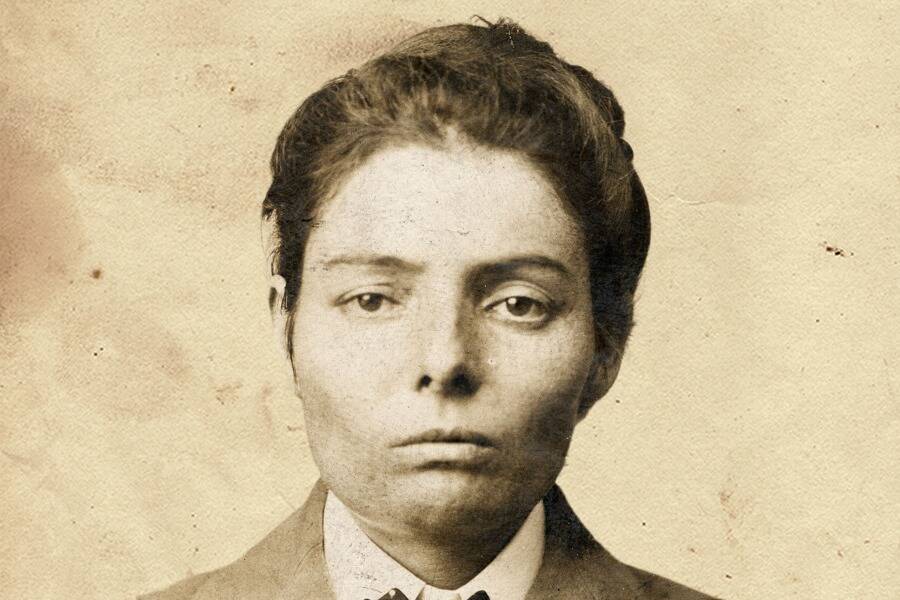
Image: Laura Bullion was one of five women who spent time with Butch Cassidy’s Wild Bunch outside of Fannie Porter’s brothel. (Public Domain)
Laura Bullion was an outlaw in the American Old West. In the 1890s, she was a member of Butch Cassidy’s Wild Bunch gang; her associates were fellow outlaws, including the Sundance Kid, Kid Curry, and “Black Jack” Ketchum. During the 1890s, she was passionately involved with outlaws William “News” Carver and then, after his death, with outlaw Ben Kilpatrick (“The Tall Texan”), a bank and train robber who was friends with her father, who had been an outlaw as well.
Bullion was arrested in November 1901 in St. Louis, Missouri. She was found guilty, convicted of robbery, and sent to prison for five years for her part in the Great Northern Train Robbery. She was released from the Massachusetts Correctional Institute for Women, in Framingham, Massachusetts, on September 19, 1905, after serving three years and ten months of her sentence.
By 1918, Laura Bullion had moved to Memphis, Tennessee, presenting herself as a war widow and using assumed names. She worked as a householder, seamstress, and later as a dressmaker, drapery maker, and interior designer. Her fortunes dropped in the late 1940s when she was without work. In 1961, she died of heart disease in Memphis. She is interred at the Memorial Park Cemetery in Memphis.
Laura Bullion was born in Knickerbocker, Texas, though her birth date is up for debate. Her death certificate records her birthday as October 4, 1876. At various times in her life, however, she gave the year of her birth as 1873 and 1887. Most sources and Bullion’s grave marker agree that 1876 was the year of her birth.
Her parents were Henry Bullion and Freda Byler, both disagreeable people who were criminals. Henry Bullion was rarely in the picture, and Freda Byler often sought the company of several disreputable men. She abandoned her children, including Laura, to the care of her parents, Elliot and Serena Byler. Despite the valiant efforts of her grandparents, Laura Bullion was attracted to the less-than-reputable outlaws that traveled past the area.
Bullion’s father had been an outlaw and bank robber and was familiar with bandits Ben Kilpatrick (“The Tall Texan”) and William “News” Carver, both of whom Laura Bullion became acquainted with when she was about thirteen. Her aunt, Viana Byler, became married Carver in 1891 but died from fever soon after the marriage began. At age 15, Bullion became romantically involved with Carver, who, after his wife’s death, was associated with female outlaw Josie Bassett, sister to Butch Cassidy’s girlfriend, Ann Bassett. She also became friends with outlaw brothers Sam and Tom “Black Jack” Ketchum.
When she was just 15, Laura left her grandparents’ home for good. She traveled to San Antonio, where she began working as a prostitute, or “soiled dove,” at Fannie Porter’s bordello. While there, Bullion used the name Della Rose.
Fanni Porter’s bordello was a popular spot for many outlaws who passed through the area, including William Carver and Ben Kilpatrick. Other frequent patrons were Robert Leroy Parker and Harry Longabaugh, also known as Butch Cassidy and the Sundance Kid.
Many men – outlaws, and lawmen – passed through Fannie Porter’s brothel doors, but Laura Bullion kept their identities confidential. Her reliability was one of the qualities that Ben Kilpatrick admired about his friend, who was “News” Carver’s girlfriend.
As Carver moved his attention from Laura to another one of Fannie Porter’s women, Kilpatrick moved in to seduce Laura. When Kilpatrick became a member of the Wild Bunch in 1898 and went to their Wyoming hideout, called the Hole-in-the-Wall, Bullion accompanied him.
Laura Bullion was a benefit to the Wild Bunch. She could fence stolen goods without causing suspicion. She could also procure much-needed supplies for the gang without raising undue concerns. In addition, Bullion had good observational skills and could glean information which helped the men of the Wild Bunch to steal horses and rob trains.
The members of the Wild Bunch called Bullion “Della Rose” and the “Thorny Rose of the Wild Bunch.” Laura was considered a true outlaw, distinguishing her from the other women who hung around the Wild Bunch’s Hole-in-the-Wall hideout.
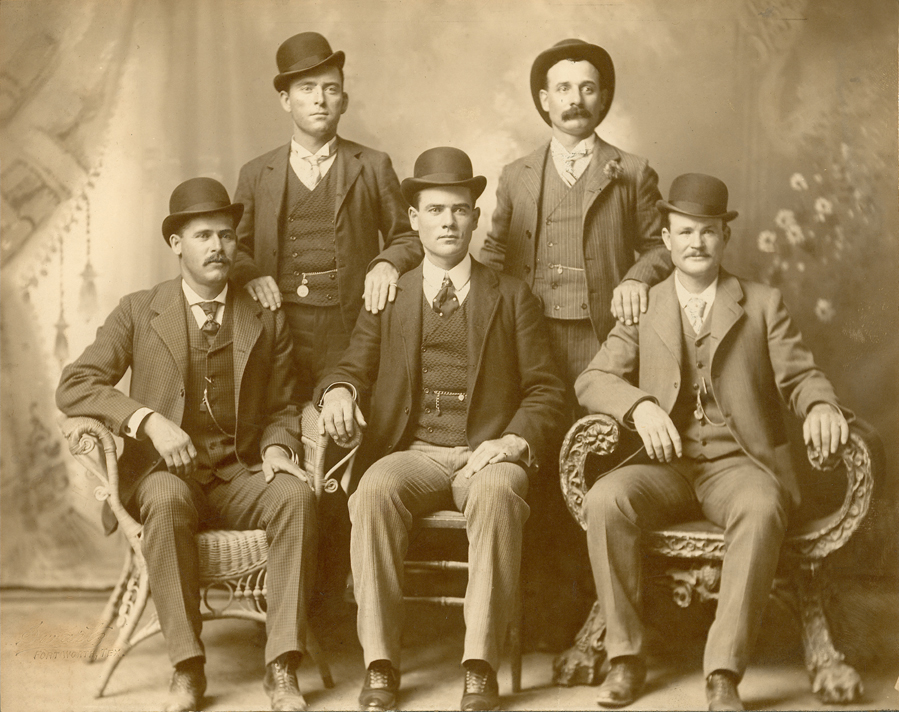
(Image: This image is known as the “Fort Worth Five Photograph.”
Front row left to right: Harry Longabaugh, alias the Sundance Kid, Ben Kilpatrick, alias the Tall Texan, Robert Leroy Parker, alias Butch Cassidy; Standing: Will Carver & Harvey Logan, alias Kid Curry; Fort Worth, Texas, 1900. Wikimedia Commons.)
Historians say only four other women, including Laura Bullion, ever spent time at the gang’s legendary hideout. They were Etta Place, the Sundance Kid’s girlfriend; Ann and Josie Bassett, sisters and girlfriends to Butch Cassidy and Will Carver; and Maude Davis, Elzy Lay’s lover.
It is unknown how many train robberies Bullion took part in with Kilpatrick and the rest of the Wild Bunch. While she appeared proficient at using her feminine charms, Bullion was depicted as having a “masculine face.”
Wearing men’s clothes, she could easily pass for a boy or young man, making it difficult for lawmen to definitively say she was involved in robberies credited to Butch Cassidy’s gang.
That is, until the Great Northern Train Robbery in 1901.
On the evening of July 3, 1901, the Great Northern Railway No. 3 left the small town of Malta, Montana, en route to Wagner, Montana. On board were three of Butch Cassidy’s Wild Bunch, Ben Kilpatrick, Harvey Logan, better known as Kid Curry, and O.C. Hanks. Before reaching Wagner, Logan drew his pistol and instructed the engineer to halt the train. He demanded that the engineer detach the express and baggage cars from the passenger cars, but just as he was doing so, he was viewed at work by a nearby rancher.
The rancher, John Cunningham, observed that the train had stopped and that railway workers were separating some of the cars. He rode over to investigate the problem and soon gathered that the train was being held up. Cunningham quickly turned around, intending to warn law enforcement in Malta of the situation. Bel Kilpatrick shot the horse out from underneath Cunningham. The rancher was unhurt and proceeded to Malta on foot, but the disturbance was loud enough to alert the passengers that something terrible was happening on the train.
According to witnesses, Kilpatrick fired a few warning shots at the passengers and ordered them to remain seated. The three outlaws then moved to the express car, where Kilpatrick blew up the safe with dynamite and emptied it of its contents.
They managed to secure an estimated $50,000 from the safe. At this point, witnesses remarked that a fourth bandit – someone not on the train but waiting nearby when it had stopped – met up with the others.
Some reports claim this fourth person gave Kilpatrick the dynamite he used to open the safe. Other witnesses claimed that this person only provided the robbers with getaway horses.
Whatever the truth, witnesses depicted this fourth bandit as trim, clean-shaven, wearing a work shirt, boots, trousers, and duster. They assumed that this was a man or boy. Still, another theory began to surface after Ben Kilpatrick and Laura Bullion were apprehended by Pinkerton detectives in St. Louis with cash from the robbery in their possession.
The Wild Bunch crew nicknamed Laura Bullion “Della Rose,” a name she came by after becoming acquainted with Kid Curry’s girlfriend, Della Moore. Bullion was also called the “Thorny Rose of the Wild Bunch.” When her boyfriend, Ben Kilpatrick, and she escaped east to skirt the law after the train robbery in 1901, the couple moved about under the names “Mr. and Mrs. Benjamin Arnold.”
(Image: Ben Kilpatrick, 1900. Wikimedia Commons.)
In the arrest report after the train robbery, dated November 6, 1901, Bullion’s name was indicated as “Della Rose,” and her aliases were listed as “Clara Hays” and “Laura Casey and [Laura] Bullion.” The arrest report records her profession as a prostitute. According to the New York Times, she was impersonating a “Mrs. Nellie Rose” at the time of her arrest. The same report also mentions that she was thought to be “disguised as a boy” and may have taken part in a train robbery in Montana. The paper quotes Chief of Detectives Desmond: “I would’nt [sic] think helping to hold up a train was too much for her. She is cool, shows absolutely no fear, and in male attire, would readily pass for a boy. She has a masculine face, which would give her assurance in her disguise.” Instead of “Clara Hays,” Bullion would also use “Clare Hayes” or “Clara Hayes” as her assumed name. Other aliases that she used at this time were “Wild Bunch Rose,” “Desert Rose,” and “Clara Casey.”
On November 1, 1901, Ben Kilpatrick and Laura Bullion pulled into St. Louis by train and checked into the Laclede Hotel under the names Mr. and Mrs. J.W. Rose. At 11:50 pm on November 5, Kilpatrick was arrested at Josie Blakely’s resort at 2005 Chestnut Street. The authorities located a key to a room at the Laclede Hotel in his pocket. On November 6, they entered the hotel lobby, where Laura Bullion was checking out with her luggage. They discovered $8500 in unsigned banknotes secured in the Great Northern Train Robbery in one suitcase. Laura was arrested on federal charges of “forgery of signatures to banknotes.”
News accounts of the Laura Bullion and Ben Kilpatrick trial were quick to connect the couple to Butch Cassidy and the Sundance Kid. In fact, they attributed the Great Northern Train Robbery to this gang, even though there was no proof to connect the notorious outlaw duo to this crime.
Nevertheless, the gang members, the Wild Bunch, were involved, so the robbery was claimed to have been the work of Buth Cassidy and the Sundance Kid. This purported fact helped sell more newspapers and increase the public’s interest in the forthcoming trial.
Bullion and Kilpatrick were tried separately in early December 1901. Both were found guilty of train robbery; however, Kilpatrick’s sentence was much harsher. Curry managed to escape capture on December 13, 1901, killing two Knoxville police officers in the process. Bullion was sentenced to five years in prison and was sent to the Massachusetts Correctional Institute for Women in Framingham, Massachusetts. Kilpatrick was given a 20-year sentence and sent to the state prison in Jefferson City, Missouri. Bullion served three and a half years before being released in 1905. Kilpatrick was not freed from prison until 1911.
During her imprisonment, her popularity with the public increased. The public was fascinated with the thought of a woman as rough and tumble as the Old West outlaws yet attractive and feminine as well.
They portrayed Bullion as a romantic young woman who would do anything for Kilpatrick, who was equally loyal to her. The love between Bullion and Kilpatrick grew during their incarceration. They wrote letters to each other. Bullion also communicated with Kilpatrick’s mother, who was quite fond of Laura.
In September 1905, Bullion was freed from prison. She returned to St. Louis, where she took a meeting with the assistant district attorney to plea for Kilpatrick’s early release. He stated that she should petition President Roosevelt, and if he approved it, the bid would be returned to St. Louis for authorization by the U.S. District Attorney. But, by this time, Kilpatrick had been transferred to Atlanta. While waiting to hear from the president, Bullion rented a room directly across from the prison holding Kilpatrick.
After serving just a third of his prison term, Kilpatrick was released from jail on June 13, 1911, but Bullion did not achieve the happy reunion she had hoped for. As soon as Kilpatrick left the prison, he was arrested by lawmen from Texas and extradited there to answer to the charges for an 1897 murder.
Once again, Laura Bullion followed Kilpatrick in hopes of assisting him in fighting the charges. The indictments were eventually dropped against Kilpatrick, and Laura finally got her reunion.
By this time, the Wild Bunch gang had split up. Butch Cassidy, the leader of the gang, his partner, the Sundance Kid, and his girlfriend, Etta Place, escaped from the United States and headed to South America. It is recorded that the outlaws died in a shootout in Bolivia in 1908.
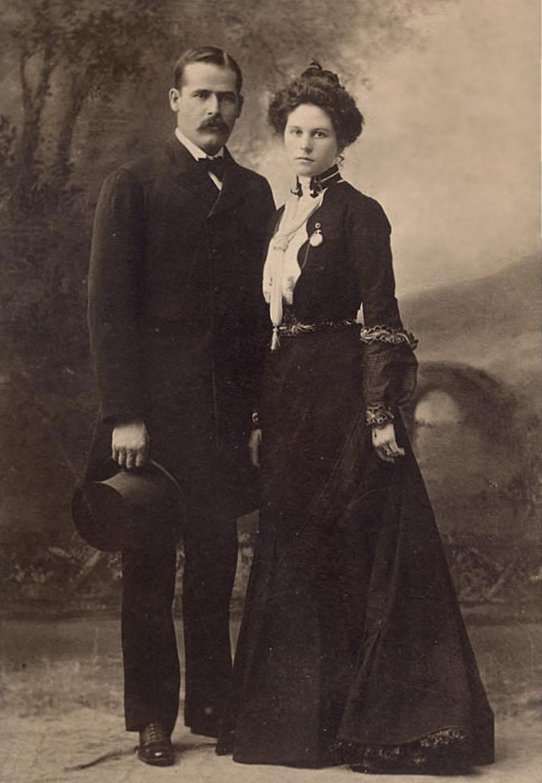
(Image: Sundance Kid and Etta Place before they left for South America (c. 1901) Wikimedia Commons.)
Etta Place’s fate remains a mystery. As for other members of the Wild Bunch, most ended their lives violently. William “News” Carver was killed in 1901 by a Texas marshal and his deputies. Kid Curry, aka Harvey Logan, was implicated in a train robbery in Colorado in 1904. As he and the other bandits escaped, they stole horses from a local rancher. That rancher summoned some friends and set out to reclaim their stolen horses. They shot Kid Curry, thus wounding him. The bandit did not want to be captured alive. As they closed in to arrest him, he shot himself in the head.
Elzy Lay, however, found redemption. He was apprehended in New Mexico in 1899 and given a life sentence in prison. He was an excellent prisoner and became a trustee to the warden. He escorted the warden to Santa Fe. There, several of the inmates rioted and took the warden’s wife and daughter hostage. Lay conversed with the prisoners and negotiated the release of the two women. For his work, the governor of New Mexico gave him a full pardon. He withdrew from his life of crime, remarried, and raised a family in California.
On March 12, 1912, Ben Kilpatrick joined forces with another outlaw, E. Welch, to hold up a Southern Pacific train near Sanderson, Texas. According to the plan, the train would be made to stop because of a fire on a railroad bridge.
Although never proven, it is thought that a third outlaw was most likely Bullion disguised as a boy who had set the fire on the bridge and waited close by with the horses. The robbery did not go as well as the Great Northern Train Robbery had years prior.
Kilpatrick and Welch led the railroad workers from car to car to retrieve valuables from the mailbags, but they made a critical error. At one point, Kilpatrick and Welch led the way. They had their backs to the railroad workers, which was a critical mistake. One of the railroad employees grabbed a mallet and struck Kilpatrick in the back of the head with it, splitting open his skull. He then grabbed Kilpatrick’s gun and killed Welch.
From the time of the failed Sanderson, Texas, robbery until about 1917, Laura Bullion’s whereabouts were unknown. She finally reappeared in 1918 in Memphis, Tennessee.
The story she used was that she was a widow, the wife of Maurice Lincoln, who had died in World War I. She spent the rest of her days laboring as a seamstress, householder, and later as a drapery maker, interior designer, and dressmaker. Only her closest friends knew she was the “Thorny Rose of the Wild Bunch.”
Her obituary noted that Bullion died of heart disease at the Shelby County Hospital on December 2, 1961. She was interred in the Memorial Park Cemetery. Bullion was the final surviving member of the Wild Bunch gang.
Her grave marker reads:
Freda Bullion Lincoln
Laura Bullion
The Thorny Rose
1876 – 1961
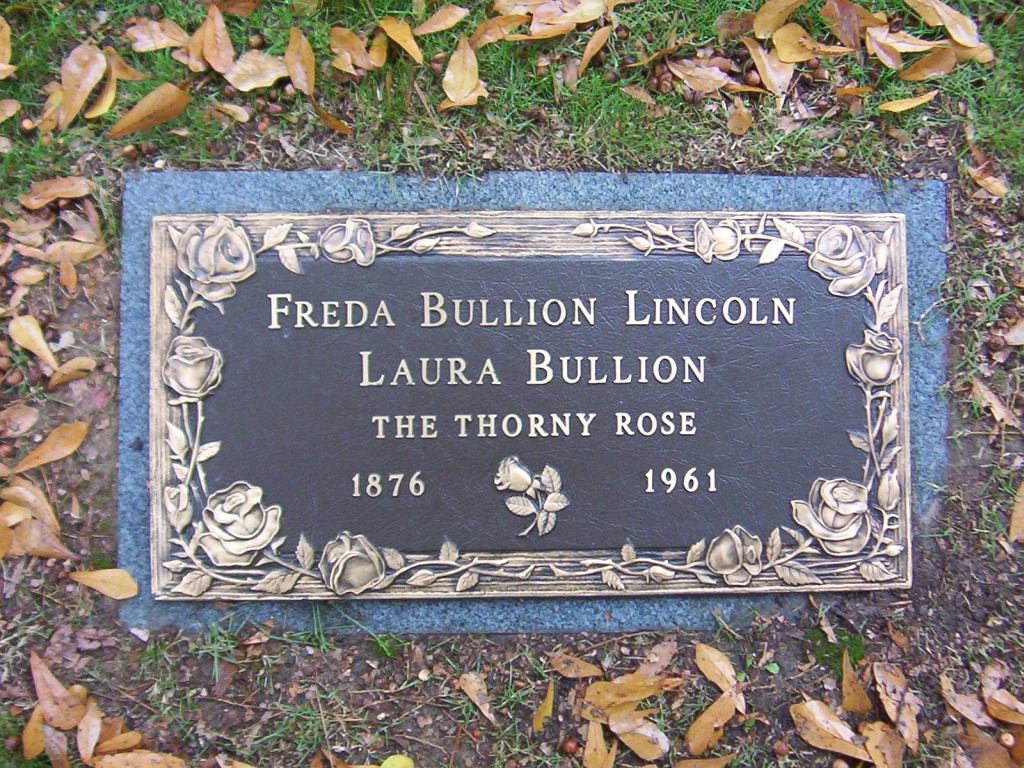
(Image: Laura Bullion bronze grave marker at Memorial Park Cemetery, Memphis, Tennessee. Wikimedia Commons.)
Bullion was one of only three people who had known the mysterious Etta Place, the girlfriend of Wild Bunch gang member the Sundance Kid for several years before her death. Place vanished in 1909 after the Kid’s supposed death in Bolivia. Only Bullion, Josie Bassett, and Ann Bassett could possibly have shed light on the facts about Etta Place. Ann Bassett died in 1956. In 1964, Josie Bassett died.
Subscribe to “History Daily with Francis Chappell Black” to receive regular updates regarding new content:
Help us with our endeavors to keep History alive. With our daily Blog posts and our publishing program we hope to inform people in a comfortable and easy-going manner. This is my full-time job so any support you can give would be greatly appreciated.
 History Daily With Francis Chappell Black
Leave a comment