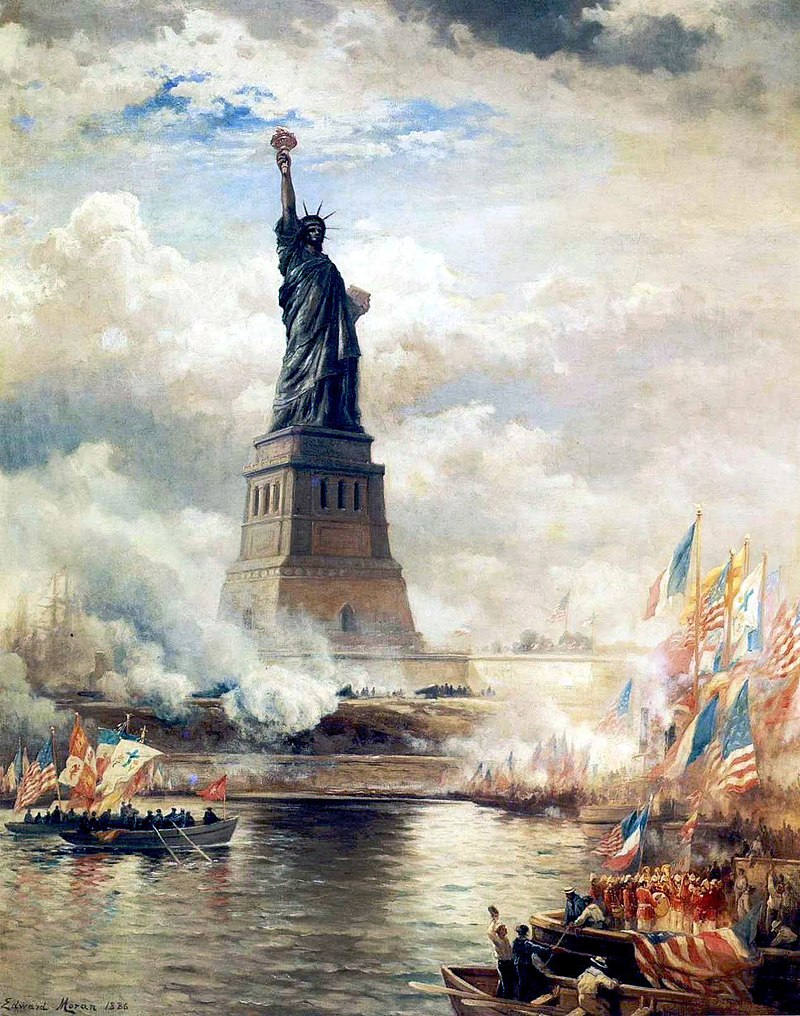
Image: A painting by Edward Moran depicting the unveiling of the Statue of Liberty on October 28, 1886. (Public Domain).
On this day in history, President Grover Cleveland consecrated the Statue of Liberty, a gift of solidarity from the citizens of France to the citizens of the United States, in New York Harbor.
Originally referred to as “Liberty Enlightening the World,” the statue was suggested by French historian Edouard de Laboulaye to commemorate the Franco-American alliance during the American Revolution. Designed by French sculptor Frederic-Auguste Bartholdi, the 151-foot statue was a woman with an uplifted arm holding a torch. Its framework of steel reinforcements was designed by Eugene-Emmanuel Viollet-le-Duc and Alexandre-Gustave Eiffel, the latter famous for his design of the Eiffel Tower in Paris. The problem was how to pay for the statue.
The project’s promoters in France formed an organization, the French-American Union, in 1875. The group called for donations from the public and presented a general plan detailing that France would pay for the statue while Americans would pay for the pedestal upon which the statue would stand.
That meant fundraising operations would have to occur in both France and America. Donations began accumulating throughout France in 1875. France’s national government declined to donate money for the statue, but over 180 cities, towns, and villages donated funds.
Thousands of French schoolchildren gave small amounts to the fund. Descendants of French soldiers who had fought in the American Revolution a century before, including ancestors of Lafayette, gave donations. A copper company donated the copper sheets required to create the statue’s skin.
When the statue’s hand and torch were displayed in Philadelphia in 1876, and later in New York’s Madison Square Park, donations dripped in from inspired Americans.
The fund drives were most effective, but the statue’s cost kept increasing. Facing a shortage of money, the French-American Union held a lottery. Merchants in Paris donated prizes, and tickets were sold.
The lottery was a sensation, but more money was still required. The sculptor Bartholdi eventually sold miniature versions of the statue with the buyer’s name engraved on them.
Finally, in July 1880, the French-American Union declared that sufficient funds had been raised to complete the statue’s construction.
The total cost for the massive copper and steel statue was nearly two million francs (estimated to be about $400,000 in American dollars at the time). Nevertheless, another six years would go by before the statue could be assembled in New York.
While the Statue of Liberty is a revered iconic symbol of America today, getting the people of America to accept the gift of the statue at the time took a lot of work.
The sculptor Bartholdi went to America in 1871 to stimulate the idea of the statue, and he returned for the nation’s centennial festivities in 1876. He was in New York City on the Fourth of July 1876, visiting the future location of the statue at Bedloe’s Island.
But despite Bartholdi’s endeavors, the statue idea took a lot of work to sell to Americans. Some newspapers, like the New York Times, often condemned the statue as foolishness and intensely resisted paying any money for it.
While the French had declared that the money for the statue was in place in 1880, by late 1882, the American donations, which were needed to build the pedestal, were sadly trailing.
Bartholdi remembered that when the torch was first shown at the Philadelphia Exposition in 1876, some New Yorkers were concerned that Philadelphia might end up with the statue. So Bartholdi tried to create more competition in the early 1880s and started a rumor that if New Yorkers didn’t want the statue, maybe Boston would be happy to have it.
The tactic worked, and New Yorkers, suddenly afraid of losing the statue completely, began raising funds for the pedestal, which was supposed to cost about $250,000. Even the New York Times abandoned its hostility toward the statue.
Even with the controversy, the money still came in slowly. Various events were held, including an art show, to raise money. At one point, a rally was held on Wall Street. But no matter how much effort took place, the outlook for the statue was very much uncertain in the early 1880s.
There was still a considerable likelihood that the statue would never leave France while being finished in Paris as it would have no place to go in America.
Joseph Pulitzer, who had bought The World, a New York City newspaper, in the early 1880s, began promoting the cause of the statue’s pedestal. He created a dynamic fund drive, confirming that he would print each donor’s name, no matter the donation size.
Pulitzer’s daring plan worked, and millions of people around the country began donating what they could. Schoolchildren across America began donating pennies. In one case, a kindergarten class from Iowa donated $1.35 to Pulitzer’s fund drive.
Pulitzer and the New York World were eventually able to declare, in August 1885, that the final $100,000 needed for the statue’s pedestal had been collected.
Construction work on the structure proceeded, and in 1886 the Statue of Liberty, which had been shipped from France packed in crates, was erected on top.
A dedication ceremony was held on October 28, 1886. President Grover Cleveland, a one-time New York governor, moderated the occasion. On the day of the dedication, a parade was held on the streets of New York City; the estimated number of people who viewed the celebration was close to a million people. President Cleveland headed the procession, then took to the reviewing stand to see marchers and bands from across America. President Cleveland told the assembled crowd Lady Liberty’s “stream of light shall pierce the darkness of ignorance and man’s oppression until Liberty enlightens the world.”
When the torch was illuminated on the night of the statue’s dedication, it created only a faint beam, hardly visible from Manhattan. The World considered it “more like a glow-worm than a beacon.” Bartholdi recommended gilding the statue to increase its ability to reflect light, but this was too costly.
Today the Statue of Liberty is a treasured attraction and is cared for by the National Park Service. And the thousands of visitors visiting Liberty Island each year might never realize that getting the statue built in New York was a long, uphill struggle.
Subscribe to “History Daily with Francis Chappell Black” to receive regular updates regarding new content:
Help us with our endeavors to keep History alive. With our daily Blog posts and our publishing program we hope to inform people in a comfortable and easy-going manner. This is my full-time job so any support you can give would be greatly appreciated.
 History Daily With Francis Chappell Black
Leave a comment