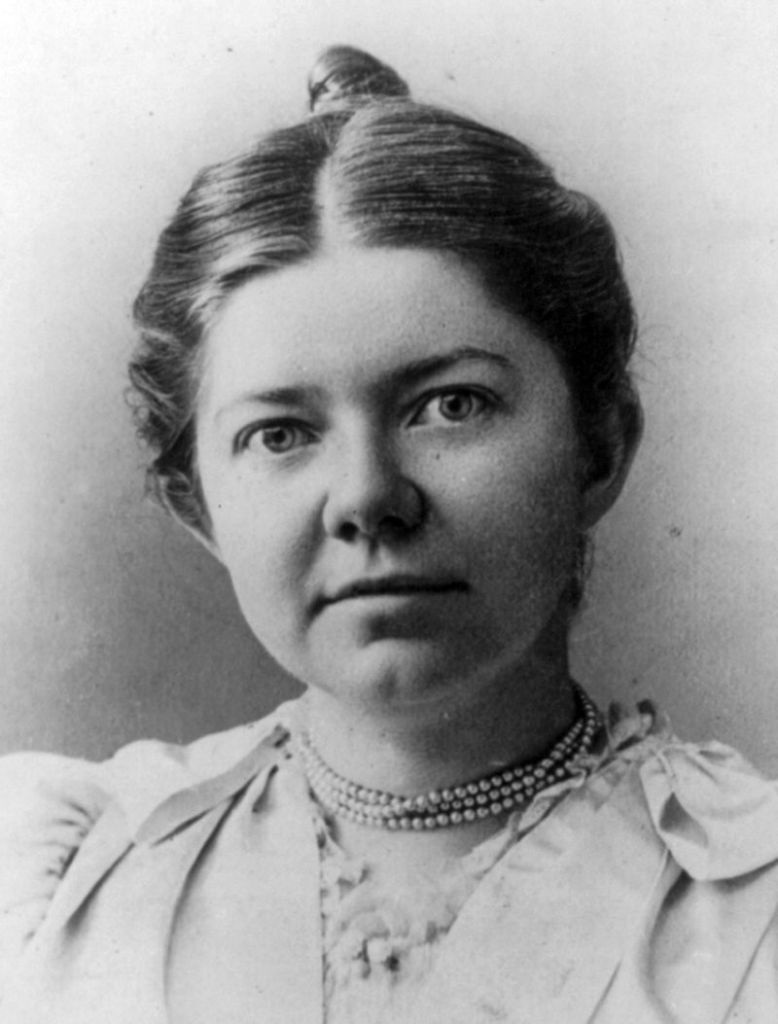
Image: American composer and pianist Amy Beach (1867-1944) (Public Domain)
On this day in history, October 30, 1896, Amy Beach’s “Gaelic Symphony” debuts by the Boston Symphony Orchestra, the first significant work by an American female composer to receive “public and journalistic acclaim.” She was the first American composer to triumph without the advantage of European training and one of her era’s most respected and acclaimed American composers. As a pianist, she was praised for concerts featuring her music in the United States and Europe.
Amy Marcy Cheney was born on September 5, 1867, in Henniker, New Hampshire, to Charles Abbott Cheney and Clara Imogene (Marcy) Cheney.
Amy could sing forty songs precisely by age one, was skilled in improvising countermelody by age two, and taught herself to read at age three. At age four, she composed three waltzes for piano during one summer furlough at her grandfather’s farm in West Henniker, NH, despite lacking a piano; instead, she created the pieces mentally and played them mentally when she returned home. She could also play music by ear. The family endeavored to keep her musically stimulated and meet her demands. Her mother played and sang for her but tried to keep Amy from playing the family piano herself, believing that indulging the child’s wishes in this respect would harm parental authority. Amy often decided what music was played at home, becoming angered if it did not meet her criteria.
Beach was eventually permitted to make her public debut as a performer. But when her family discussed with a prominent conductor how to further her growth as a composer, he suggested self-study. While American composers of the time typically ventured to Europe for private schooling, women were perceived as intuitive musicians and needed to be more competent for intensive training. Beach devoted herself to a complete immersion in the orchestral repertoire, systematically examining scores and comparing them to performances she heard at the Boston Symphony.
Amy was married in 1885 to Dr. Henry Harris Aubrey Beach, a Boston Surgeon, Harvard lecturer, and amateur singer twenty-four years older than her (she was eighteen then). Her name would be printed on concert programs and published sheet music as “Mrs. H.H.A. Beach.” The marriage was made upon her commitment to live according to her status: performing her duties as a society matron and patron of the arts. She promised her husband never to teach piano, an activity widely associated with women. She also agreed to only perform two recitals a year, with profits donated to charity, and to devote more of her time to composition than to performing (although, she wrote, “I thought I was a pianist first and foremost.”) Her self-taught education in composition was also necessitated by Dr. Beach, who disliked his wife engaging a tutor. Constraints like these were typical for middle and upper-class women of the time.
A major compositional triumph came with her Mass in E-flat major, played in 1892 by the Handel and Haydn Society orchestra, which since its creation in 1815, had never performed a piece composed by a woman. Newspaper music critics reacted to the Mass by proclaiming Beach one of America’s foremost composers, comparing the piece to Masses by Bach and Cherubini.
Beach followed this with a fantastic watershed moment in music history: her Gaelic Symphony was the first Symphony composed by an American woman. It premiered on October 30, 1896, and was performed by the Boston Symphony Orchestra “with exceptional success.” However, whatever the merits or defects of the Symphony were believed to be, critics went to extraordinary lengths to link them to the composer’s gender.
Composer George Whitefield Chadwick wrote to Beach that he and his colleague Horatio Parker had attended the Gaelic Symphony’s premiere. He very much enjoyed it: “I always feel a thrill of pride whenever I hear a fine work by any of us, and as such you will have to be counted in, whether you (like it) or not – one of the boys.” They were a circle of composers known as the Second New England School, including Chadwick and Parker, John Paine, Arthur Foote, and Edward MacDowell. With the addition of Beach, they became known as the Boston Six.
In 1900, the Boston Symphony debuted Beach’s Piano Concerto, with the composer as a soloist. Beach was the first American woman who received considerable popularity for composing symphonies.
Beach’s husband died in June 1910 (the couple had been childless), and her mother seven months later. Her father had previously died in 1895. Beach could not work for a while, so she traveled to Europe, hoping to recover there. While there, she altered her name to “Amy Beach.”
In 1912, she gradually restarted giving concerts; her European debut was in Dresden in October 1912, playing her piano and violin sonata with violinist “Dr. Bulau,” to positive reviews.
She used her status as the premiere female American composer to advance the careers of young musicians. She coached and provided feedback to young composers, musicians, and students. Beach functioned as a mentor for these young composers inspiring them to spend time perfecting their craft through lengthy practicing. She wrote in her document, “Music’s Ten Commandments as Given for Young Composers,” that young musicians analyze works from every genre and their technical progress and use variety whenever possible. From 1904 to 1943, Beach published several articles on programming, preparation, and studying techniques for piano players, basing many of her thoughts on her practice routine. Given her stature and advocacy for music education, she was in huge demand as a speaker and performer.
Heart disease caused Beach to retire in 1940, and died in New York City in 1944.
The first American woman to successfully compose symphonies, Amy Beach is a central figure in the history of women in music. After several decades of unjust neglect, many of her works have been revived. She is at last beginning to be acknowledged as one of the finest American composers of her time. Some modern critics consider her Gaelic Symphony the first Symphony of importance written by any American composer. In contrast, others have suggested that her Piano Concerto could become a welcome alternative to those of Tchaikovsky and Rachmaninoff as a repertoire piece. The Mass in E-flat, the Canticle of the Sun, the Violin Sonata, the Quintet, and the Piano Trio are also among Beach’s most distinguished works. They are beautifully written and stand up in any age.
Subscribe to “History Daily with Francis Chappell Black” to receive regular updates regarding new content:
Help us with our endeavors to keep History alive. With our daily Blog posts and our publishing program we hope to inform people in a comfortable and easy-going manner. This is my full-time job so any support you can give would be greatly appreciated.
 History Daily With Francis Chappell Black
Leave a comment