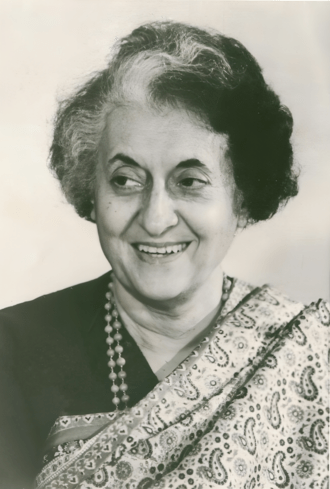
Image: Indira Gandhi in 1983. (Public Domain)
On this day in history, October 31, 1984, Indian Prime Minister Indira Gandhi was assassinated at 9:30 a.m. at her Safdarjung Road, New Delhi residence. Beant Singh and Satwant Singh, both Sikhs, shot Gandhi as she walked from a neighboring bungalow to her office. Although the two attackers surrendered instantly, they were both shot in a subsequent altercation, with Beant dying.
Jawaharlal Nehru, India’s first prime minister, tried to create a unified nation from many religious, ethnic, and cultural factions that flourished under British rule until 1949. His daughter, Indira Gandhi (no relation to Mohandas Gandhi), came to power in 1966, struggling with many of the same difficulties as her father had. Her political career was varied, from the highs after India’s victory over Pakistan in 1971 to the lows of being expelled from office in 1977 after proclaiming a state of emergency in 1975. During that time, she ended civil liberties and incarcerated her political enemies. Although many criticized her for being a dictator, most of the population backed her because of her massive social programs.
In 1980, Gandhi once again became prime minister, with a wide margin of popularity. However, in June 1984, she commanded the army to raid a Sikh temple in Punjab to extract armed Sikh extremists, causing numerous death threats. Due to the ever-present danger of assassination, Beant Singh, her bodyguard of ten years, was to be transferred off her guard detail because he was a Sikh. However, Gandhi personally overturned the transfer order because she implicitly trusted him after his ten years of outstanding service. This would prove to be a fatal mistake for both.
Born in Allahabad, India, on November 19, 1917, Indira Gandhi was the only child of Kamala and Jawaharlal Nehru. Nehru, as a member of the Indian National Congress, had been profoundly influenced by party leader Mahatma Gandhi and was committed to India’s struggle for independence. He endured years of imprisonment for Jawaharlal and a difficult childhood for Indira, who attended a Swiss boarding school, and later studied history at Somerville College, Oxford. Her mother died in 1936 of tuberculosis.
In March 1942, despite her family’s unhappiness, Indira became married Feroze Gandhi, a Parsi lawyer (not Mahatma Gandhi), and they had two sons: Rajiv and Sanjay.
In 1947, Nehru became the newly created nation of India’s first prime minister. Gandhi agreed to go to New Delhi and become his hostess, welcoming diplomats and world leaders at home and traveling with her father on his travels worldwide. She was selected for the prestigious 21-member working committee of the Congress Party in 1955 and, four years after, was designated its president. When Nehru died in 1964, Lal Bahadur Shastri became the prime minister, and Indira became the Minister of Information and Broadcasting. After Shastri died two years later, Indira was appointed by Congress Party leaders to become prime minister.
Gandhi soon gained enormous popularity for introducing highly effective programs that transformed India into a country self-sufficient in food grains—also known as the Green Revolution.
In 1971, she began supporting the Bengali movement to separate East from West Pakistan, providing sanctuary for the ten million Pakistani civilians who came to India to escape the pillaging Pakistan army and eventually offering soldiers and arms. India’s victory over Pakistan in December led to the formation of Bangladesh, for which Gandhi was posthumously given Bangladesh’s highest state honor 40 years later.
After the 1972 elections, Gandhi was accused of misconduct by her opponents and, in 1975, was found guilty of electoral corruption by the High Court of Allahabad and forbidden from participating in another election for six years. Instead of resigning, she declared a state of emergency on June 25, where citizens’ civil liberties were withdrawn, the press was severely censored, and most of her opposition was jailed without trial. Throughout what became known as the “Reign of Terror,” thousands of dissidents were jailed without due process.
Predicting that her former popularity would assure her re-election, Gandhi ultimately eased the emergency restrictions and called for a general election in March 1977. Upset by their limited liberties, however, the people overwhelmingly voted in favor of the opposition party, and Morarji Desai became the new prime minister.
Within a few years, democracy was restored, but Desai had little success fixing the nation’s severe poverty. In 1980, Gandhi crusaded under a new party—Congress (I)—and was elected to her fourth term as prime minister.
In 1984, the Golden Temple in Amritsar, Punjab, was overrun by Sikh extremists seeking an autonomous state. In retaliation, Gandhi sent Indian troops to regain the temple by force. In the storm of gunfire that followed, hundreds of Sikhs were killed, starting a rebellion in the Sikh community.
On October 31, 1984, Indira Gandhi was murdered at her home by two of her faithful bodyguards, seeking vengeance for the events at the temple. Following her assassination, riots broke out in New Delhi. Over 1,000 Sikhs were killed in random attacks over the next few days. Gandhi’s son, Rajiv, became the new prime minister.
Her allies refer to her leadership during victories over rivals China and Pakistan, the Green Revolution, a burgeoning economy in the early 1980s, and her anti-poverty campaign that led her to be known as “Mother Indira” (a pun on Mother India) among the country’s poor and rural classes. However, critics make note of her authoritarian rule of India during the Emergency and the major atrocities carried out during the raid on the Sikh temple and the Punjab Insurgency.
Subscribe to “History Daily with Francis Chappell Black” to receive regular updates regarding new content:
Help us with our endeavors to keep History alive. With our daily Blog posts and our publishing program we hope to inform people in a comfortable and easy-going manner. This is my full-time job so any support you can give would be greatly appreciated.
 History Daily With Francis Chappell Black
Leave a comment