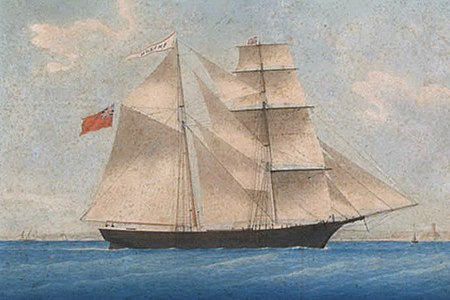
Image: Mary Celeste in 1861. (Public Domain)
On this day in history, November 7, 1872, the brigantine Mary Celeste left New York harbor for Genoa, Italy, with Captain Benjamin Briggs, a crew of eight, his wife and two-year-old daughter, and a cargo of some 1,700 barrels of crude alcohol. After the Dei Gratia found the ship on December 5, Captain Morehouse and his men secured the vessel, and it was abandoned, with its sails somewhat damaged, numerous feet of water in the hold, and a lifeboat and navigational instruments gone. Nonetheless, the ship was operational, the cargo unharmed, and food and water reserves were on board.
The final record in the captain’s log indicated that the Mary Celeste had been nine days and 500 miles from where the Dei Gratia found the ship. The Mary Celeste had been floating toward Italy on her projected course for 11 days with nobody at the wheel to direct her. Captain Briggs, his family, and the vessel’s crew were never located, and the cause of the desertion of the Mary Celeste had never been established.
On December 5, 1872, while navigating rough seas, the Canadian brig Dei Gratia found the abandoned Mary Celeste floating through the Atlantic between Portugal and the Azores Islands. The brigantine had left New York almost a month earlier.
When the crew of the Dei Gratia embarked on the Mary Celeste, they found nothing out of place. The crew’s clothing was even carefully bundled away. Yet there was nobody to be found on the vessel.
The only clues explaining the crew’s location were a disassembled pump in the hold and an absent lifeboat.
Captain Benjamin Briggs was a master mariner who had captained three ships before the Mary Celeste.
Captain Briggs chronicled the rough journey in his log, but strangely, he stopped making entries on November 25, 1872, at 5 a.m. The night prior, his diary stated, the ship and its crew had endured rough seas and winds of more than 35 knots, but by the morning, they had come out unharmed with the island of Santa Maria in sight. All, it appeared, was okay.
When the Dei Gratia discovered the Mary Celeste a week later, on December 5, Captain Morehouse sent a boarding party to examine the Mary Celeste and found the ship in faultless condition.
The only thing missing was its crew.
It made little sense that Briggs, a veteran captain, would ditch a seaworthy vessel.
Furthermore, Morehouse had dined with Briggs in New York before each of the men, and their separate crews set sail, and he considered him a friend. He knew Briggs as an outstanding captain and man.
Morehouse and his crew towed the Mary Celeste to Gibraltar, where authorities investigated the incident, which ultimately generated no definite results. At this point, numerous theories began to arise.
English inspector Frederick Flood first theorized about the vanishing of the crew. Knowing that Morehouse and Briggs were friends, the inspector speculated that the two captains may have devised a plot to defraud the insurance company and share the profit earned from the subsequent liquidation of the Mary Celeste.
According to the laws of the sea, the abandoned ship now belonged to Morehouse.
The inspector then speculated that Briggs had murdered his crew and hidden away in the hold of the Dei Gratia. Flood’s theory, however, was faulty. Briggs had held property shares in the ship so that he would have gained nothing from such an endeavor. The hypothesis never considered Briggs’ wife and daughter.
The crew of the Dei Gratia ultimately received payment for the salvage right to the Mary Celeste. Yet, it was only one-fifth of the total $46,000 value of the ship. Apparently, the authorities were skeptical about their guiltlessness.
Other speculations suggested that the crew had gotten drunk off the Mary Celeste’s alcohol cargo and mutinied – but there were no signs of violent behavior. Some said pirates raided the ship, yet no valuables were missing.
Indeed, tales of sea monsters became connected to the missing crew, as did accounts of waterspouts and, much later, alien kidnapping.
Yet for all these conjectures, none of the evidence ever corresponded. The most reasonable assumption was that gases from the alcohol had caused the hatch cover to blow off. Then, thinking that fire was imminent, the crew abandoned the ship. However, the hatch cover was firmly secured, thus leaving no reasonable rationalization.
The Mary Celeste was severely off course – 120 miles west of where it needed to be. The captain estimated that he would spot land three days before he did.
According to the captain’s log, everything had been going as arranged with the direction of the Mary Celeste – until about five days prior to Briggs’ last journal entry.
Notably, Briggs’ logs show that the ship had adjusted course the day before it reached the Azores – Briggs was now moving precisely north towards Santa Maria Island. The boat was probably looking for a safe harbor from the nasty weather.
But even this would not make a captain leave his vessel.
However, the ship had transported a load of coal on a prior voyage. Coal dust and debris from recent repairs had hypothetically choked the ship’s pumps, meaning any water in the ship’s lower decks did not have a way to escape the vessel.
It’s possible that Briggs then determined that, with the ship off course, the crew’s best chance was to try to save themselves by leaving the boat and heading to the nearest land. In this instance, it was Santa Maria Island. Their lifeboat may have capsized, causing all ten people to drown.
This theory is not entirely accepted or even verifiable, but it at least coincides with the proof (the disassembled pump, for example) in a way that other assumptions do not.
Finally, some 150 years after the crew of the Mary Celeste strangely disappeared, the mystery continues to fascinate people who seek a conclusion to the puzzle.
Subscribe to “History Daily with Francis Chappell Black” to receive regular updates on new content:
Help us with our endeavors to keep History alive. With our daily Blog posts and our publishing program we hope to inform people in a comfortable and easy-going manner. This is my full-time job so any support you can give would be greatly appreciated.
 History Daily With Francis Chappell Black
Leave a comment