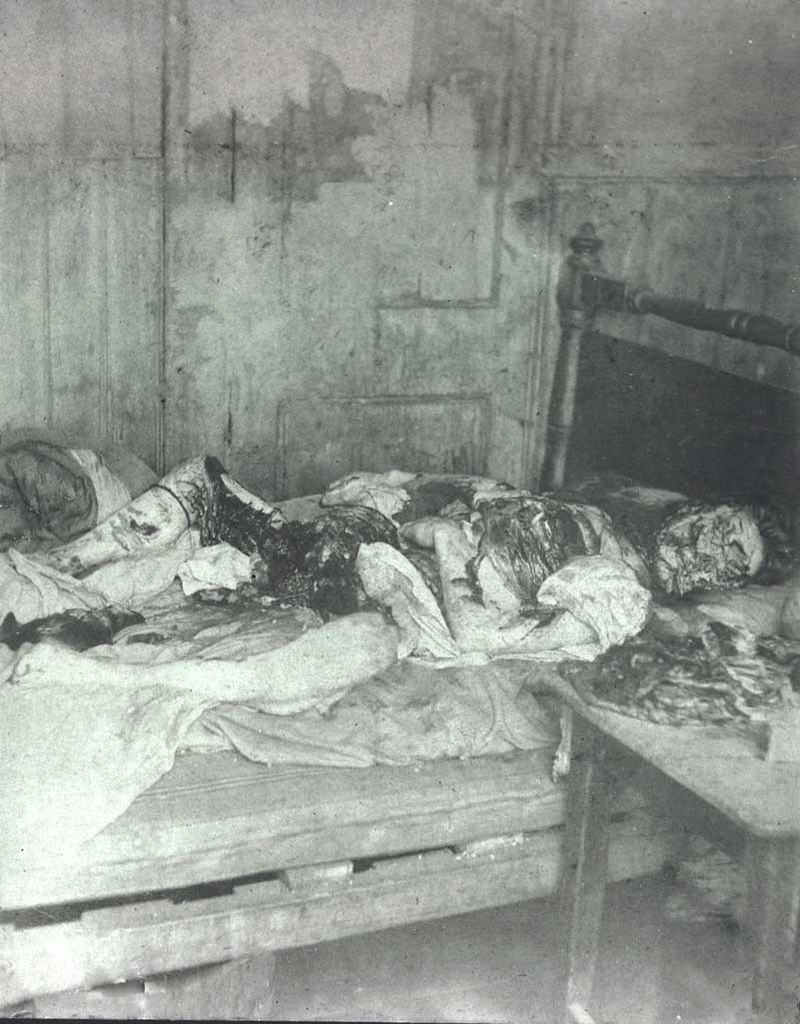
Image: Police photograph of the murder scene of Mary Jane Kelly. (Public Domain)
On this day in history, Mary Jane Kelly, the fifth and final victim of Victorian serial killer Jack the Ripper, was found murdered on November 9, 1888. Mary Jane Kelly’s mutilated body was found on her bed in the room she rented on Dorset Street in the Spitalfields district of East London, a slum area commonly inhabited by prostitutes and criminals.
Because of the ghastliness of her killing, the police wanted to control the flow of information to halt the spread of rumors. Nonetheless, the endeavors to suppress rumors had the reverse consequence; Kelly’s mysterious persona led to a stack of exaggerated or conflicting facts about the unfortunate woman’s life.
Jack the Ripper frightened London in 1888, murdering five women and dismembering their bodies in an unorthodox manner, revealing that the killer had an extensive understanding of human anatomy. The perpetrator was never apprehended – or even identified – and Jack the Ripper remains one of England’s, and the world’s, most legendary killers.
All five murders credited to Jack the Ripper happened close to each other, in or near the Whitechapel area of the East End of London, from August 7 to September 10, 1888. Many other killings happening around that time have also been examined as the work of “Leather Apron” (another nickname given to the murderer).
The culprit supposedly sent several letters to the London Metropolitan Police Service (often known as Scotland Yard), jeering officers about his horrific actions and contemplating murders yet to occur. The name “Jack the Ripper” stems from a letter – which may have been a trick – published during the period of the assaults.
Despite many investigations asserting definitive proof of the vicious killer’s identity, their name and intentions are still unspecified.
Numerous assumptions about Jack the Ripper’s identity have been given over the past one hundred years, which include allegations accusing the famous Victorian painter Walter Sickert, a Polish migrant, and even the grandson of Queen Victoria. Since 1888, over 100 suspects have been named, causing extensive mythology and twisted entertainment around the unknown assailant.
Mary Kelly was born in Limerick, Ireland, in 1863. Her father was employed as an ironworker named John Kelly, and facts about her mother are unspecified. One of six or seven children, she and her family relocated to Wales when she was young.
When she was 16 years old, she wed a man named Davies or Davis, who died in a mining accident. Nevertheless, there is no evidence of a marriage. Kelly then moved to Cardiff, and after deciding to live with her cousin, she began prostituting herself on the streets. She then went to London in 1884, where she started to work at a fashionable brothel.
Kelly eventually ended up living in London’s dangerous East End. Mary Jane Kelly began to drink heavily once she began living in the East End and soon found herself cohabitating with a married couple for a few years. She ditched that situation to live with a man and then another man after that.
An unidentified prostitute stated that in 1886, Mary Jane Kelly was residing at a Lodging House (a cheap home where many people typically share rooms) in Spitalfields when she met Joseph Barnett, her most recent lover before her death.
She had only met Barnett a couple of times before the two agreed to live together. They were thrown out of their first location for not paying rent and for getting drinking alcohol, and then they moved to the lethal room on Dorset Street, named 13 Miller’s Court. It was damp and dirty, with boarded-up windows and a padlocked door.
What occurred after the move to Dorset Street is even cloudier. Kelly was no longer prostituting herself but resumed doing it when Barnett lost his job. When Kelly wanted to share her room with another prostitute, she argued with Barnett, who then left.
Though Barnett never returned to live with Kelly, he visited her regularly and even saw her the night before her death. Barnett said he didn’t stay long and left at about 8 p.m.
Her whereabouts for the rest of the night is mostly unknown. Some say they saw her with another prostitute drunk at around 11 p.m.; a neighbor claimed he saw her with a man in his thirties, while some said Kelly could be heard singing early the next day.
Early on November 9, 1888, Kelly’s landlord sent his employee to retrieve Kelly’s rent. When he knocked, she did not answer. Peering through the window, he saw the blood-stained and mutilated body. The police were alerted, and the door to the room was pried open after they appeared on the scene. The spectacle was unbearable.
In the empty room, Mary Jane Kelly’s body was placed in the middle of her bed, her head turned. Her left arm, partially severed, was also located on the bed. Her abdominal cavity was emptied, her breasts and face were removed, and she was detached from her spine to her neck. Her detached organs and body parts were placed in different areas of the room, and her heart was absent. The bed was coated in blood, and the wall by the bed was sprayed with it.
Mary Jane Kelly was 25 years old when she was killed, the youngest Ripper victim. The Daily Telegraph stated that Kelly “usually wore a black silk dress, and often a black jacket, looking shabby genteel in her attire, but generally neat and clean.”
Mary Kelly was buried on November 19, 1888, in East London at a burial ground called Leytonstone.
Subscribe to “History Daily with Francis Chappell Black” to receive regular updates regarding new content:
Help us with our endeavors to keep History alive. With our daily Blog posts and our publishing program we hope to inform people in a comfortable and easy-going manner. This is my full-time job so any support you can give would be greatly appreciated.
 History Daily With Francis Chappell Black
Leave a comment