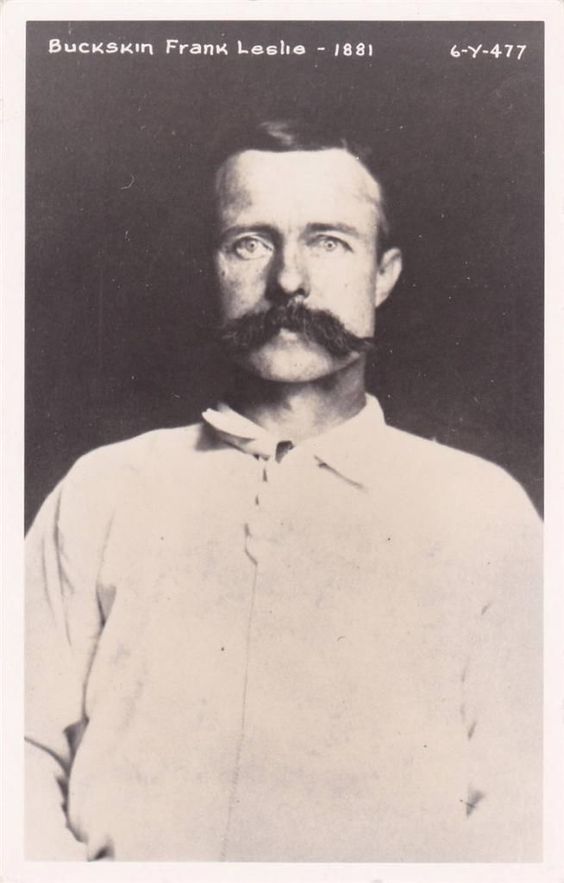
Image: Nashville Franklin “Buckskin Frank” Leslie, a lawman, U.S. Army scout, gambler, and an outlaw of the American Old West. He assisted Wyatt and Warren Earp in their search for those they held responsible for maiming Virgil Earp and assassinating Morgan Earp. 1881. (Public Domain)
“Buckskin” Frank Leslie was a U.S. Army scout, gambler, bartender, rancher, miner, gunfighter, and con man. He was well-known for his fringed buckskin coat. He became famous in Tombstone, Arizona, for murdering two men in self-defense. Leslie was well known for having killed Billy Claiborne, a member of the infamous Clanton Gang, who fought with the Earps while in Tombstone. One story states that he took his mother’s last name after a falling out with his father, though this has never been confirmed. He married the widow of one of his victims a mere eight days after killing her husband. After their divorce, Leslie shot live-in-love “Blonde” Mollie Williams while drunk and jealous. He was condemned to a life sentence in prison but only served six years before being pardoned. He was last recorded alive on January 27, 1920, in the United States Census in Sausalito, California. No other public records exist beyond that date; it is not known where or when he died.
Leslie was born in San Antonio in 1842 (other sources state that he was born in Virginia), the son of Thomas Kennedy and Martha Leslie. Like many Old West characters, his origins and early life details are sketchy. Leslie told vibrant, often conflicting – and highly questionable – stories about his life. Nothing has been recorded regarding Leslie’s first 36 years, although he told some colorful and dubious stories concerning those missing years. Leslie told writers his version of occurrences from his early life on two occasions. In 1880, Leslie said, “in 1861, I joined the Southern Army and continued with it till April 9, 1865, when I was attached to General Gordon’s division as a First Lieutenant in the 10th Cavalry.” He claimed he “was Deputy Sheriff of Abalene [sic]… under the notorious J.B. Hickock [sic] or ‘Wild Bill,’” and that he was a “rough rider in Australia” and a [ship] pilot in the Fiji Islands and that he “has exhibited, as a fancy rifle shootist in different parts of the world.”
In 1893, he told another story to the San Francisco Chronicle, in which he maintained that his life story was a romance. “Born in Virginia in 1842 of a good family, he went to Heidelberg to study medicine. At the same time, his brother attended West Point for a military education.” When the Civil War began in 1861, Frank returned to his old home in Virginia and joined the Confederate Army as a bugler while his brother joined the Union forces.
Leslie also maintained that he worked as a U.S. Army scout in Texas, Oklahoma, and the Dakota during the 1870s, but no documentation has been found to support this assertion. The record does show that in 1878, Frank Leslie was residing in San Francisco, working as a barkeeper. He worked in that capacity in at least two establishments between 1878 and 1880.
About one year before the infamous gunfight at the O.K. Corral, Frank Leslie arrived in Tombstone, Arizona Territory. He donned the buckskins of a scout but quickly exchanged the frontier look for a gentleman’s togs like those he had worn in San Francisco. He donned a fringed buckskin vest to accent the new look, augmenting his image as “Buckskin” Frank Leslie.
When he arrived in Tombstone in 1880, the town was ripe with outlaws and other suspicious and reprehensible personalities as the Earp brothers attempted to manage the near-lawless town.
Standing 5 feet 7 inches and weighing 135 pounds, Leslie had earned a reputation as a gunfighter. With a pair of six-shooters on his hips and shooting skills that, according to Wyatt Earp, were comparable to Doc Holliday’s, Leslie was right at home with the rest of Tombstone’s roughneck crowd. Eager to display his skills, Leslie was known to demonstrate his shooting abilities quite frequently, often on the ceilings of many of Tombstone’s saloons.
Leslie was also a bad-tempered and vicious man, especially when he drank. Even among the notorious crowd that hung about in Tombstone at the time of Leslie’s arrival, he stood out for his swift temper and quickness with his gun.
He then decided to open the Cosmopolitan Hotel at 409 Allen Street with partner William Knapp. A chambermaid named Mary Jane Killeen was employed at the hotel. Leslie was even an official witness to Mary’s wedding to Mike Killeen in April 1880. Nevertheless, Killeen was highly jealous of the relationship and the amount of attention Leslie paid to Mary. Whatever the true nature of their connection, Mike Killeen was not having any of it.
On June 22, 1880, Leslie and his friend, George Perine, sat with Mary on the porch of the Cosmopolitan. An angry Killeen attacked Leslie, shooting at him and then striking him with his gun. In the fight, Killeen was mortally wounded. Before dying five days after being shot, Killeen accused Perine of shooting him.
Authorities charged both Leslie and Perine with murder. Leslie maintained it was a case of self-defense and attested that Perine had not fired his pistol. The court agreed with this explanation and dismissed the charges against both men. However, eyebrows in Tombstone were raised when Frank Leslie and Mary Jane Killeen married only eight days after her husband’s death. The Tombstone Epitaph reported:
July 6, 1880, Wedding – Last evening, at 8 o’clock, Mr. N.F. Leslie (Nashville Franklyn) was united in holy bonds of matrimony to Mrs. Mary Killeen (née Evans) by Judge Reilly. The wedding was a quiet one, with only a few intimate friends of the parties being present. Miss [Louisa] Billicke attended the bride, Col. C.F. Hines, supporting Mr. Leslie. There were present during the ceremony, which took place in the parlor of the Cosmopolitan Hotel, Mr. and Mrs. Bilicke, Col. H.B. Jones and wife, Mr. C.E. Hudson and daughter, Miss French, Col. Hafford, Mr. E. Nichols, Mr. J.A. Whitcher, Mr. Maxon, Mr. J.A. Burres, Mr. Geo. E. Whitcher, F.E. Burke, Esq., and Mr. Fred Billings. After the ceremony, the bridal party and friends repaired to the dining room of the hotel, where a bounteous repast awaited them. The EPITAPH congratulates Mr. Leslie, un chevalier sans peur et sans reproche, [a knight without fear and reproach] and his most estimable wife upon this happy event and earnestly wishes them a pleasant voyage over life’s troubled ocean.
James Young, a boxer, trailblazer, Buffalo Soldier, Indian Scout, and miner for several years in Tombstone, had two clashes with Buckskin Frank Leslie, and Leslie backed down in both cases. Young was an original settler in Tombstone, Arizona, and had labored in the Contention mine and staked a claim nearby. When he was informed that Leslie had taken his claim, Young came upon him with a shotgun and signaled him to return to town immediately. Leslie ignored him and told him that he had heard that some other miners were about to take over Young’s claim, and he had gone there to assist him in securing his claim. When the news about the stand-off made it to Tombstone, James Young’s standing rose, and Frank Leslie’s weakened some. Later, when Leslie met Young in a hardware store, unarmed and with his back turned to the gunslinger, Leslie pulled his gun out and was about to shoot Young. The woman store owner screamed and got between the two men. Once again, Leslie ignored it and stated he was only examining his gun to see if it was in top working order.
After the O.K. Corral gunfight on October 26, 1881, the Earps, who were friends with Leslie, took up residence in the Cosmopolitan Hotel, feeling much safer there than in their homes. They feared retribution from the Clanton gang after killing Tom and Frank McLaury and Billy Clanton at the O.K. Corral.
Afterward, Leslie violently pistol-whipped a man outside of the Oriental Saloon. At that time, those living in Tombstone began to consider Leslie as a dangerous character, even amid the rest of the large number of outlaws that infested Tombstone.
When the famous Tombstone gunslinger Johnny Ringo was found murdered, suspicions fell squarely on Leslie, despite the lack of evidence regarding his guilt. It was strongly suggested then, as now, that Ringo had taken his own life, but that has not been conclusively determined.
A major fire destroyed much of Tombstone, including the Cosmopolitan Hotel, on May 26, 1882. Frank Leslie and William Knapp decided not to rebuild. Instead, Leslie took employment at the Oriental Saloon as a bartender, one of the few buildings left undamaged by the fire in the town.
After the Earps left Tombstone, Leslie became embroiled in a dispute with Clanton Gang member Billy Claiborne, a survivor of the gunfight at the O.K. Corral. Leslie was bartending at the Oriental on November 14, 1882, when a drunk Billy Claiborne verbally abused him. Claiborne, who had survived the gunfight at the O.K. Corral the year, believed that Leslie had murdered his friend, Johnny Ringo. William Floyd “Billy” Claiborne was part of Ike Clanton’s gang. Because he was unarmed, he ran away from the infamous O.K. Corral gunfight. His luck ran out later in the year when he decided to start a fight with Frank Leslie. He was only 22 years old.
Claiborne had demanded to be called “Billy the Kid” after the death of William Bonney. He claimed that he had killed three men who had ridiculed him. Records indicate that he, in fact, only killed one person before his fight with Leslie. Ridicule had become a considerable part of Billy’s life as his reputation dovetailed when the details of his flight from the scene of the O.K. Corral gunfight became widely known.
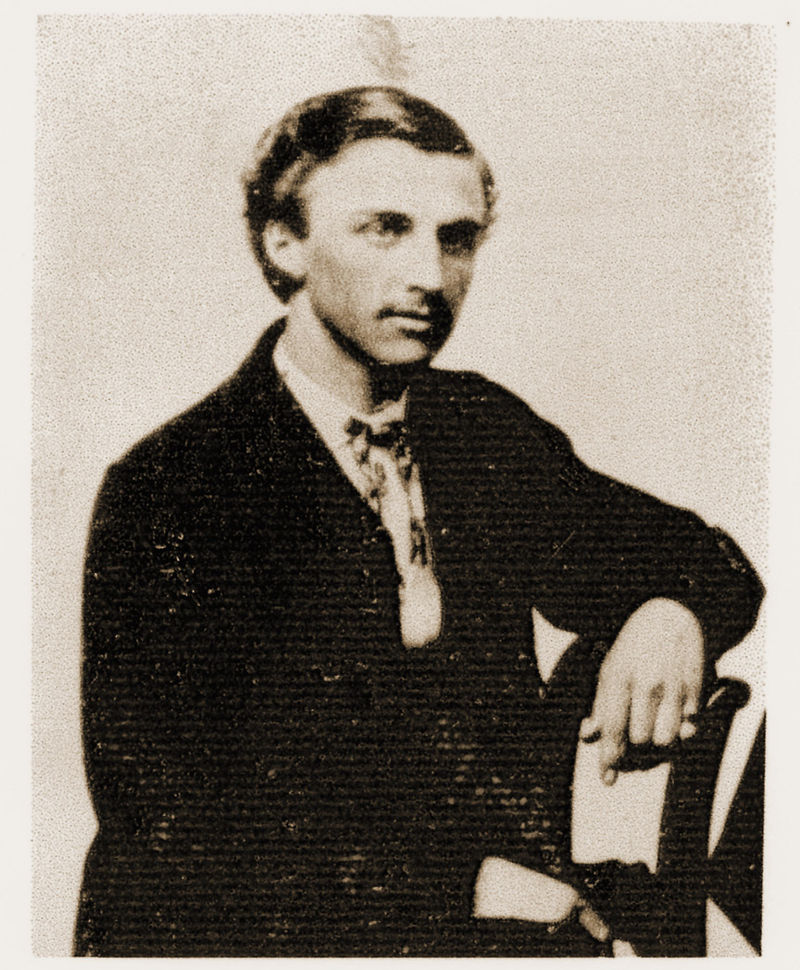
Photo: William “Billy” Claiborne. 1881. (Public Domain.)
On the night of November 14, 1882, Claiborne and Leslie argued when the gunfighter refused to refer to him as “Billy the Kid.” Later that night, Leslie was in the Oriental Saloon when a drunken Billy Claiborne entered and continued arguing with Leslie over the name. Fed up, Leslie showed him to the door and threw him out of the saloon. However, Claiborne was resolved and soon revisited the saloon with a Winchester. He began to boast to anyone who would listen that he intended to kill “Buckskin” Leslie on sight outside the tavern. When word of this reached Leslie, he immediately exited the saloon, and the expected gun battle began.
Claiborne’s shots missed the mark in the skirmish, but Leslie hit Billy numerous times. While Claiborne lay dying in the street, Leslie walked up to him, and the injured man said, “Don’t shoot me anymore; I’m killed.” He was taken to the doctor, where he died six hours later. His final words were: “Frank Leslie killed John Ringo. I saw him do it.”
Claiborne’s epitaph read: “Billy the Kid takes shot at Buckskin Frank. The latter promptly replied, and the former quickly turns up his toes to the daisies.”
When the Apache uprisings started in the mid-1880s, Leslie was again employed as an Indian Scout by the U.S. Army on at least two occasions.
Returning to Tombstone, things were not looking good on the home front, as, after seven years of marriage, he and Mary Killeen divorced in 1887. Mary maintained that one of the main reasons for the divorce was Leslie’s habit of always shooting her silhouette into the wall as she stood there, proving his excellent shooting skills. She also alleged that Frank had had sex with one Birdie Woods in July 1886. She maintained that he had choked and beat her on March 9, 1887. Judge William Barnes granted the divorce on June 3, 1887, ordering Frank to pay $650 in cash and Mary’s court costs.
At this time, Leslie was still working at the Oriental Saloon, but he spent most of his free time at the Bird Cage Theater. It was there he met a young singer and prostitute named Mollie Williams, and soon the two were living together. As with most prostitutes of that time, she went by the multiple names of Blonde Mollie and Mollie Bradshaw. Her pimp’s name was Bradshaw, though he was not her husband. However, he turned up deceased sometime later, and Leslie was inevitably suspected. Though he never admitted to murdering the man, he never denied it.
From the start, Frank and Mollie’s relationship was based solely on their mutual love of whiskey, which caused numerous vicious quarrels. The violence escalated on July 10, 1889, when he shot Mollie in the head in a drunken rage. The murder was observed by a ranch hand named James Neil. Leslie then shot him as well so that there be no witnesses. Though Mollie died, James survived and later testified against Leslie at trial. Frank was condemned to 25 years in the Yuma prison. The town of Tombstone was happy to be rid of the gunslinger who had admitted to murdering 14 people.
However, after serving just seven years, Leslie was released, and he quickly left Arizona, he headed to Los Angeles. Leslie later went to Stockton, California, and on December 1, 1896, after having met and courted Belle Stowell, went to the San Joachin County Clerk’s office and purchased a marriage license. Leslie self-identified as “Nashville Franklyn Leslie, native of Virginia, age 55,” and stated he was a “resident of San Carlos, Territory of Arizona.” His bride called herself “Mrs. Belle Stowell, a native of Warren County, Illinois, age 39, resident of Warren, Illinois.”
The Stockton Daily Independent reported that “their wedding trip was to be to China, the start to be made by the next steamer,” but they never went to China. Four months after, The San Francisco Call reported that “Mrs. Leslie is present in this state, but it is said that her husband cannot be located….It is not known whether they have separated or not, but it is believed that they have.” The marriage was legally ended on March 19, 1903, when Belle was granted a divorce from Leslie “for failure to provide.”
Frank would next chronicle that he had fought in the Spanish-American War of 1898 in Cuba, even at his advanced age. He would also maintain that he took part in the Alaskan Gold Rush, but it has been proven that he was on mining business in Mexico at the time.
Between 1898 and 1913, Leslie applied himself to various schemes to survive. He tried to con different businessmen out of their funds; he tried mining and working as a guide for a geological survey party searching for coal fields in Tombstone. He even accidentally shot himself in a saloon in San Francisco; he bent over, dropped the weapon to the floor, and it went off. The bullet hit him above the knee, passing through the fleshy part of the leg, tearing his right ear, and cutting a gash in his scalp.
Leslie married Elnora “Nora” Cast in Napa, California, on November 6, 1913. When they married, Leslie reported his occupation as a miner. On May 20, 1916, at 74, Leslie was living in Seattle, where he told a reporter about a trip he was planning to Mexico. Leslie lived in Sausalito, California, in January 1920. At this point, he was 77 years old and single. No public records of him have been found after this date, and it is unknown when he died. His last wife, Elnora, died in 1932 in Omak, Washington; Leslie was not listed as a survivor.
Subscribe to “History Daily with Francis Chappell Black” to receive regular updates regarding new content:
Help us with our endeavors to keep History alive. With our daily Blog posts and our publishing program we hope to inform people in a comfortable and easy-going manner. This is my full-time job so any support you can give would be greatly appreciated.
 History Daily With Francis Chappell Black
Leave a comment