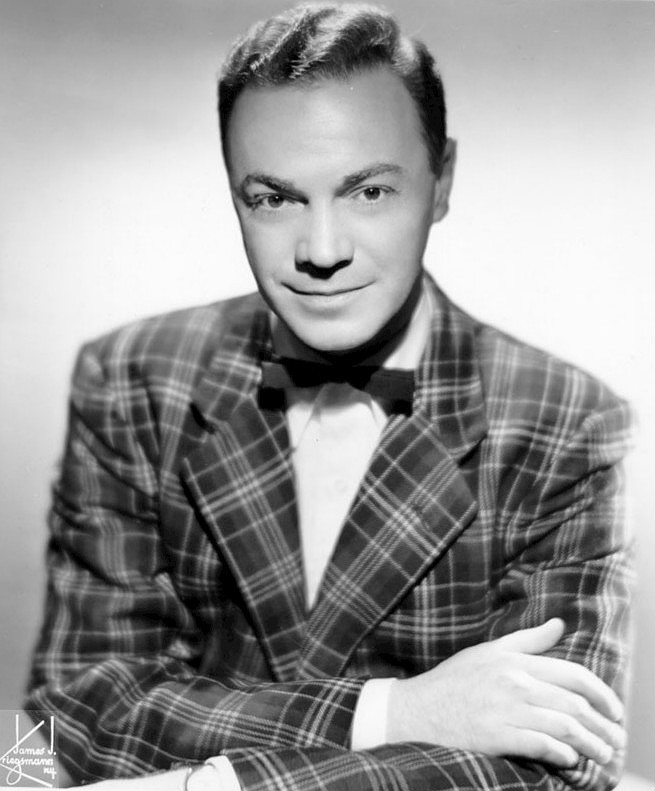
Image: Alan Freed, 1958. (Public Domain)
On this day in history, November 21, 1958, American disc jockey Alan Freed is fired from WABC radio station in New York City for his role in the payola scandal. Though payola – paying a DJ to play a song on the radio to promote it – was not illegal at the time, bribery was, and Freed was accused of accepting such bribes. He was fired after refusing to sign a statement for the Federal Communications Commission (FCC) saying that he never took bribes in exchange for playing songs.
In his brief life, Alan Freed was numerous things. A beloved disc jockey, a promoter of early assimilation, a television personality, a provocative person, and a songwriter. But the one thing he is most well known for is being the “father of rock ‘n’ roll.”
Born in Pennsylvania on December 15, 1921, his family moved to Ohio in 1933. After graduating from high school, Freed attended Ohio State University, where he became interested in radio. During World War II, he was in the army and worked for the Armed Forces Radio. After the war, Freed worked as a disc jockey at WAKR in Akron. He played a mixture of R&B, jazz, pop, blues, and country during his show. He became a local fan favorite for the new music he was introducing to listeners.
Freed eventually quit his job but found it difficult to find decent work because of the non-compete clause he had signed at WAKR. In 1951, he picked up an overnight shift at WJW in Cleveland. As it happened, WJW radio would be where Alan Freed would make history by playing rock and roll music and introducing the phrase “rock and roll” to mass audiences.
In the 1950s, the civil rights movement was beginning to take off. Alan Freed played music by Black artists instead of cover versions by white singers, which was uncommon then. He also promoted concerts with racially mixed audiences, which helped to bridge the segregation gap between white and Black teens at the time.
Freed planned the Moondog Coronation Ball in March of 1952 at the Cleveland Arena, the most prominent location in town. It was the first rock and roll concert featuring Paul Williams and his Hucklebuckers, Tiny Grimes, and the Rocking Highlanders – tickets sold out in a day.
An estimated 20,000-25,000 fans showed up for the event being held in the arena with a total capacity of only 10,000. Less than an hour into the concert, the overcrowding caused the gates outside to collapse. The police arrived and canceled the show immediately.
As ineffectual as the first rock concert was, it effectively showed the compelling desire for rock and roll music.
The Moondog Coronation Ball congealed Freed’s fame and standing as the father of rock ‘n’ roll. He got additional airtime added to his radio show as well as a new television show. On May 4, 1957, it premiered on ABC. The “Big Beat” was America’s first prime-time rock and roll TV show.
Despite the show’s sky-high ratings, a live episode highlighting an act by Frankie Lymon and the Teenagers presented Lymon dancing with a white girl. This angered the networks and caused them to cancel the show.
Freed was able to make an agreement that the show could resume on a local level. Nevertheless, the deal did not amount to much because of a scandal that would shortly shock the music business and Freed personally. Payola would bring it all crashing to the ground.
Payola was the payments record companies made to radio stations that required them to play particular records. Not only was Freed suspected of accepting payola, but he was involved in a conflict-of-interest hullabaloo. Because Freed had songwriting credits on certain records, it gave him part of the royalties from selling those records. He played those records on his radio shows to give them more publicity, and consequently, he would receive more royalty payments, making him look dishonest.
In 1959 he was dismissed from his TV show and radio program over the ensuing scandal.
Initially, Freed refused to acknowledge that he took payola but later admitted to his supporters that he had taken bribes. Freed declined to sign a statement for the FCC while working at WABC that stated that he never took payoffs. That caused his firing.
In 1960, payola was made unlawful. In December 1962, after being charged with several commercial bribery charges, Freed declared himself guilty of two counts of commercial bribery. He was given a three hundred dollar fine and given a suspended sentence.
There were also several conflict-of-interest accusations that he took songwriting co-credits that he did not earn. The most noteworthy instance was Chuck Berry’s “Maybellene.” Taking limited credit allowed him to receive a portion of the song’s royalties, which he could expand by significantly pushing the song on his radio show. (Berry ultimately reclaimed the writing credit to his song.) In another example, Harvey Fuqua of The Moonglows maintained that Freed had co-written the song “Sincerely” and that promoting it would still be a conflict of interest for Freed. Another group, The Flamingos, claimed that Freed had fraudulently taken writing credit for several of their tunes.
In 1964, Freed was indicted for tax evasion and directed to reimburse the federal government $37,920 in taxes on income he had not reported. Most of that income had come from payola sources.
The negative press circulating around Freed made him unwanted by any of the major radio stations. He finally got a job working for a small radio station on the West Coast.
In 1965, Alan Freed died from the effects of alcoholism. He was 43 years old.
Despite the problematic years he endured by the last years of his life, Alan Freed is still seen as a significant creator of rock and roll. He was one of the first people invested in the Rock and Roll Hall of Fame in Cleveland in 1986. He was also installed into the National Radio Hall of Fame in 1988; in 1991, he received a star on the Hollywood Walk of Fame.
Subscribe to “History Daily with Francis Chappell Black” to receive regular updates regarding new content:
Help us with our endeavors to keep History alive. With our daily Blog posts and our publishing program we hope to inform people in a comfortable and easy-going manner. This is my full-time job so any support you can give would be greatly appreciated.
 History Daily With Francis Chappell Black
Leave a comment