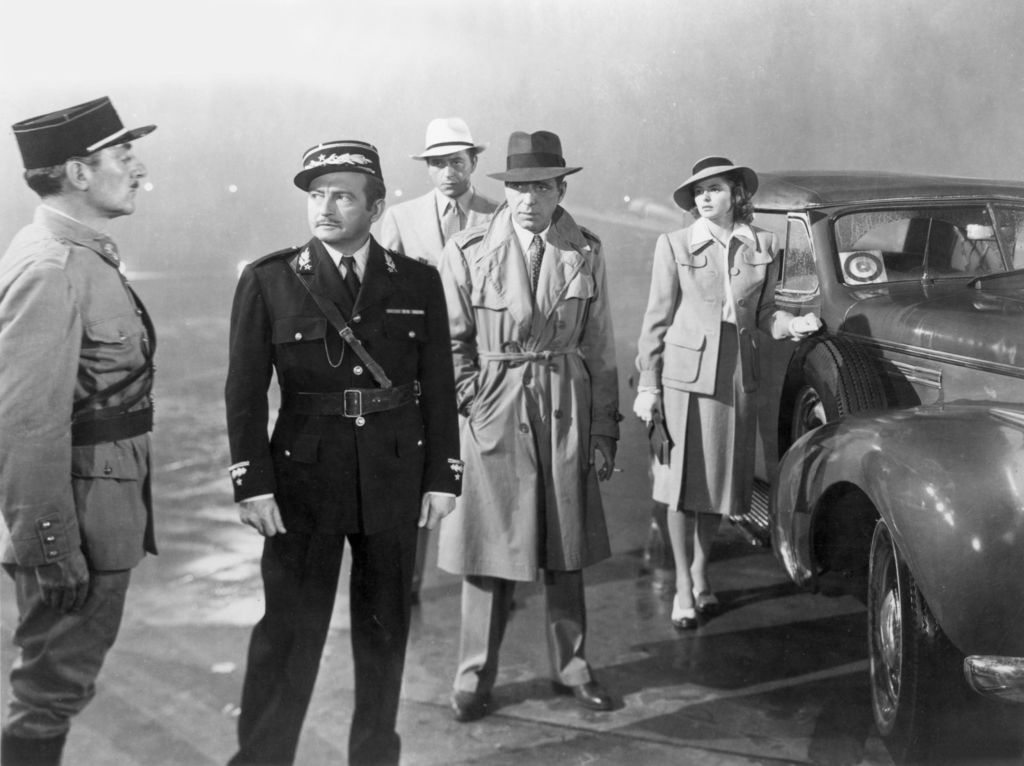
Image: Casablanca (film)
On this day in history, November 26, 1942, Casablanca, a World War II-era movie starring Humphrey Bogart and Ingrid Bergman, premieres at the Hollywood Theater in New York City; it went on to become one of the most favorite Hollywood films of all time.
In the movie, Bogart portrays Rick Blaine, the owner of an upscale North African night spot, who is brought back together with the stunning and mysterious Ilsa Lund (Bergman), the woman who had previously loved him before leaving him. Directed by Michael Curtiz, Casablanca premiered in theaters throughout the United States on January 23, 1943, and was ultimately nominated for eight Academy Awards, including Best Actor for Bogart. It won three Oscars for Best Picture, Best Director, and Best Adapted Screenplay. The film contained several now-iconic lines, including Rick’s utterance to Ilsa: “Here’s looking at you, kid,” as well as “Round up the usual suspects,” “Louis, I think this is the beginning of a beautiful friendship,” and “Of all the gin joints in all the towns in all the world, she walks into mine.”
Casablanca is a 1942 romantic drama film starring Humphrey Bogart and Ingrid Bergman. Produced and set during World War II, it spotlights an American ex-pat (Bogart) who must decide between his passion for a woman (Bergman) and aiding her husband (Henreid), a Czechoslovak resistance leader, to evade the Vichy-controlled officials in the city of Casablanca to resume his struggle against the Nazis. The screenplay is derived from the unproduced stage play Everybody Comes to Rick’s by Murray Burnett and Joan Alison. The supporting cast included Claude Rains, Peter Lorre, Sydney Greenstreet, Conrad Veidt, and Dooley Wilson.
Producer Hal B. Wallis was persuaded to purchase the film rights to the play in January 1942 by Warner Brothers story editor Irene Diamond. Siblings Julius and Philip Epstein were initially tasked to compose the screenplay. Nevertheless, regardless of studio opposition, they quit to produce Frank Capra’s Why We Fight series early in 1942. Howard Koch was appointed to write the script until the Epstein’s resumed working on the screenplay a month later. Principal photography commenced on May 25, 1942, with production ending on August 3; the movie was filmed entirely at Warner Brothers Studios in Burbank, California, except for one scene at the Van Nuys Airport in Los Angeles.
Even though Casablanca was an A-list production with proven stars and outstanding writers, no one in this production predicted that it would be notable amongst the hundreds of films produced by Hollywood each year. Casablanca was hurried into release to coincide with the Allied invasion of North Africa just a few weeks before its premiere. It opened in New York City on November 26, 1942, and was made available in wide release in America on January 23, 1943. The picture was a solid, understated success story in its opening run.
Surpassing all prospects, Casablanca managed to garner three Academy Awards. Its standing has progressively increased, and so have its characters, memorable lines, and ubiquitous theme song have all become widely recognized and well-established. It regularly rates near the top of listings of the greatest movies in film history. In 1989, the United States Library of Congress named the picture as one of the initial ones included for protection in the National Film Registry for being “culturally, historically, or aesthetically significant.”
Humphrey Bogart was born on December 25, 1899, in New York City, and throughout the 1930s, he established his movie career based on portraying tough guys. He became famous for playing Detective Sam Spade in The Maltese Falcon (1941), also John Huston’s directorial debut. Bogart and Huston later worked on films such as The Treasure of the Sierra Madre (1948) and The African Queen (1951), earning Bogart the Best Actor Oscar. In 1945, Bogart married his fourth wife, actress Lauren Bacall, with whom he co-starred in 1944’s To Have and Have Not. Bogey and Bacall became one of Hollywood’s power couples and went on to act together in The Big Sleep (1946), Dark Passage (1947), and Key Largo (1948). Other Bogart movie credits are The Barefoot Contessa (1954), Sabrina (1954), and The Caine Mutiny (1954). Bogart’s final film credit was The Harder They Fall (1956). He died on January 14, 1957.
Casablanca was also the film for which Swedish-born actress Ingrid Bergman is most recognized. Born August 29, 1915, Bergman received a Best Actress Academy Award nomination for For Whom the Bell Tolls (1943). She won in the same category for Gaslight (1944). She received a Best Actress nomination for The Bells of St. Mary’s (1945) and 1948’s Joan of Arc. Bergman appeared in Alfred Hitchcock-directed movies Spellbound (1945), Notorious (1946), and Under Capricorn (1949). In 1949, the then-married Bergman began an illicit affair with director Roberto Rossellini that caused outrage after she became pregnant with his child. (Bergman and Rossellini would later marry and have three children together, including the celebrated actress Isabella Rossellini.) Bergman won another Best Actress Academy Award for 1956’s Anastasia. She won her third Academy Award, for Best Supporting Actress, for Murder on the Orient Express (1974). Her final Oscar nomination for Best Actress was for 1978’s Autumn Sonata, directed by Ingmar Bergman (no relation). She died on August 29, 1982.
Subscribe to “History Daily with Francis Chappell Black” to receive regular updates regarding new content:
Help us with our endeavors to keep History alive. With our daily Blog posts and our publishing program we hope to inform people in a comfortable and easy-going manner. This is my full-time job so any support you can give would be greatly appreciated.
 History Daily With Francis Chappell Black
Leave a comment