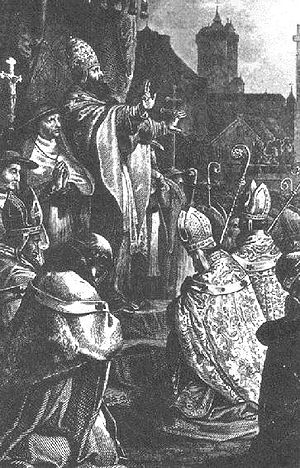
Image: Pope Urban II preaching the First Crusade at the Council of Clermont. (Public Domain)
On this day in history, November 27, 1095, Pope Urban II makes what is deemed the most significant address of the Middle Ages, causing the Crusades to escalate by summoning all Christians in Europe to go to war against Muslims to recover the Holy Land, with a shout of “Deus Vult!” or “God Wills It!”
Born Odo of Lagery in the year 1042, Urban was a disciple of the outstanding reformer Pope Gregory VII. Like Gregory, he made internal restructuring his primary focus, condemning simony (selling church offices) and other clerical abuses widespread during the Middle Ages. Urban proved himself to be a clever and forceful priest. When he was made Pope in 1088, he applied his diplomacy to the deterioration of support for his rivals, notably Clement III.
By the close of the 11th century, the Holy Land – now most generally known as the Middle East – had become a conflict location for European Christians. Since the 6th century, Christians frequently made journeys to the birthplace of Christianity, but when the Turks took control of Jerusalem, Christians were prevented from entering the city. When the Turks promised to invade the Byzantine Empire and seize Constantinople, Byzantine Emperor Alexius I appealed to Urban for assistance. This was not the first time an appeal was made, but it came at a crucial time for Urban. Wanting to strengthen the papacy’s power, Urban grasped the opportunity to combine Christian Europe under him as he battled to reacquire the Holy Land from the Turks.
At the Council of Clermont, in France, where several hundred clerics and noblemen congregated, Urban delivered an inspiring address beckoning rich and poor alike to cease their in-fighting and undertake a journey on a righteous war to assist their fellow Christians in the East and reclaim Jerusalem. Urban libeled the Muslims, amplifying stories of their anti-Christian actions, and vowed forgiveness and remission of sins for all who gave their lives in the service of Christ.
At the Council of Clermont, held on November 27, 1095, Pope Urban’s speech precisely transformed the direction of history. In it, he maintained that the Turks had invaded Christian lands and caused unbelievable crimes against Christians. This was a magnificent overstatement, but it was just the beginning.
Urban went on to chastise those convened for wicked sins against their brother Christians. He articulated how Christian knights fought other Christian knights, injuring, maiming, and murdering each other, thus endangering their immortal souls. If they were to maintain referring to themselves as knights, they should stop executing each other and travel to the Holy Land.
Urban vowed utter remission of sins for anyone who died in the Holy Land or even anyone who died on the way to the Holy Land in this righteous crusade.
One might argue that anyone who has studied the word of Jesus Christ would be disturbed by the suggestion of killing someone in Christ’s name. But one should remember that the only people who could study the scriptures were priests and members of religious orders. Few knights and peasants could read, and those who could rarely, if ever, had access to a Bible. A man’s priest was his link to God; the Pope was most assuredly able to know God’s wishes better than anyone. Who would dare argue with such a notable man of religion?
The theory of a “Just War” had also been under considerable thought ever since Christianity had become the preferred religion of the Roman Empire. St. Augustine of Hippo, the most influential Christian thinker of Late Antiquity, examined the issue in his City of God (Book XIX). Pacifism, a guiding value of Christianity, was predominant in the individual’s personal life. Still, when it came to sovereign nations and the defense of the weak, somebody had to fight.
In addition, Urban was right when he denounced the violence in Europe then. Knights killed each other almost daily, usually in practice tournaments but sometimes in deadly battles. The knight lived to fight. And now the Pope offered all knights a chance to fight for Christ.
Urban’s plea for war caught on quickly, marshaling clerics to muster backing throughout Europe for the crusade versus the Muslims. Between 60,000 and 100,000 people answered Urban’s call to advance on Jerusalem. Not everyone did so out of holiness: European nobles were enticed by the potential of enhanced land holdings and treasures from the invasion. These nobles were accountable for the death of many innocent people on the journey to and while in the Holy Land, grasping the valuables and lands of those they quickly considered enemies to their cause, causing the death toll to climb the amateurishness and lack of discipline of the Christian peasants who were brought to fight against the skilled, professional armies of the Muslims. Initially, the Christians were overcome, and only because of their vast numerical superiority were they ultimately able to be victorious.
Urban’s speech set in motion a lethal set of circumstances that continued for several centuries, the consequences of which are still being felt today. The First Crusade was also followed by seven other officially numbered crusades and many other expeditions, but the entire correlation between Europe and the Middle East was irredeemably changed. Crusaders did not restrict their carnage to Turks, nor did they easily differentiate among groups not Christian. During that period, Constantinople was still a Christian city and was assaulted by participants of the Fourth Crusade in 1204, thanks to determined Venetian traders.
Was Urban endeavoring to create a Christian empire in the East? If so, he could hardly have anticipated the end to which the Crusaders would go or the historical impact his aspirations would have. He did not even view the results of the First Crusade; by the time reports of the capture of Jerusalem reached the West, Pope Urban was deceased.
Subscribe to “History Daily with Francis Chappell Black” to receive regular updates regarding new content:
Help us with our endeavors to keep History alive. With our daily Blog posts and our publishing program we hope to inform people in a comfortable and easy-going manner. This is my full-time job so any support you can give would be greatly appreciated.

History Daily: 365 Fascinating Happenings Volume 1 and Volume 2 are for sale now from my publisher’s site:
https://yesterdaytodaybooks.etsy.com
Order your copy today to support our efforts.
Thank you.
Francis
 History Daily With Francis Chappell Black
Leave a comment