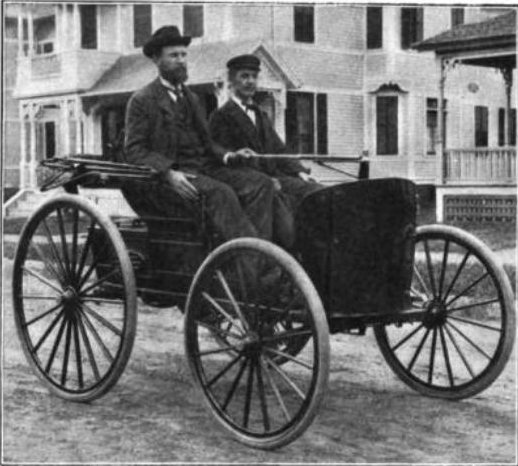
Photo of Charles (left) and Frank Duryea in the 1894 Duryea gasoline car. (Public Domain).
On this day in history, on Thanksgiving Day (November 28) in 1895, while navigating a gas-powered “horseless carriage” of his and his brother’s invention, the mechanic, creator, and now race car driver Frank Duryea triumphs in the first motor-car race in America. The Chicago Times-Herald promoted the race to create publicity for the emerging American car industry. It worked particularly well for the Duryeas: In the year after the race, the brothers sold 13 of their Motor Wagons, more than any other carmaker in America.
The Racecourse was initially meant to be driven from Chicago to Waukegan, Illinois, and back (a dreadful 92 miles). However, thanks to the abrupt appearance of an enormous snowstorm, race organizers decided to shorten the route. (“With eight inches of snow,” one journalist noted after, “Waukegan might as well have been Timbuktu.”) The contenders would travel just 50 miles from Chicago to Evanston, Illinois, and back again. The other rules would continue as before: Vehicles were required to have at least three wheels, all covered in twine to give traction in the snow, and they also had to be able to transport at least two people, the driver and a race-appointed umpire who would go along to prevent duplicitous behavior.
Because of the inclement weather, only six of 89 racers made it to the beginning line:
- The Duryea.
- Three Benz cars, one sponsored by Macy’s in New York.
- Two electrics whose batteries died directly after the race began.
The Chicago Times-Herald race was the first car race held in America. Backed by the newspaper, the race was born in Chicago in 1895 with six motorized vehicles competing: four motor cars and two “motocyles.” The winner was Frank Duryea’s Motorized Wagon. The race created significant publicity for the “motocycle,” invented in America only two years before.
On July 10, 1895, the Chicago Times-Herald publicized that a race would be held in the city, with prizes totaling $5,000 (approximately $162,900 today)—the event aimed to promote the fledgling auto industry’s growth in America and increase newspaper sales. The first automobiles in the country were manufactured only two years prior, and they were so novel at the time that the paper’s editors could not easily decide upon a name for them. After significant bickering, the editors pronounced that they would refer to it as a Moto Cycle race, and they first used the phrase in a July 15 news article.
The inaugural race was to run from Chicago north to Milwaukee, but the roads needed to be better for early cars to navigate easily. The route was altered to be only 54 miles from Chicago to Evanston and back. The finish line was near the current location of the Chicago Museum of Science and Industry. The race was proposed to be held on November 2, but only some cars had shown up, so the race was postponed. Eighty-three cars initially entered the race, but only six appeared for the competition. A number of the contestants did not have their cars ready on time, and many were incapable of making the journey. Elwood Haynes’ car, a heavy favorite to win the competition, was damaged en route and unable to participate.
Both Haynes and the Benz car were blocked from driving on city roads by police while attempting to get to the race. They were forced to hire horses to pull the vehicles because, as the police told them, they had no right to drive their cars on the city streets. The situation caused the race to be suspended again. At the same time, the Chicago Times-Herald editors spoke to city leaders to pass an ordinance to allow these vehicles to traverse on city roads. Once the law was passed, the race was held on November 28, Thanksgiving Day. The day was snowy, 38 °F (4 °C), and the roads were mud-filled, with snow drifts in places.
The first car to reach the starting line was a German-made car made by inventor Karl Benz. In total, three Benz cars took part in the race. Frank Duryea’s motorized wagon was the only other four-wheeled vehicle to run in the race. The two other vehicles taking part were two-wheeled automobiles. The “motocycles” did not have the power to climb one of the course’s grades. Another entrant was electric-powered, whose battery died from the cold weather close to the starting line. Just after the beginning, one Benz hit a horse and had to drop out of the race. On the return trip, the Duryea vehicle began to take the lead.
The Duryea car won the race, completing the course in 7 hours and 53 minutes of running time, 10 hours and 23 minutes total time, having covered an average of 7mph (11km/h). The Benz, entered by Oscar Mueller, finished the race ninety minutes later. Charles King drove Mueller’s car from point 31 of the course to the finish because Mueller was unconscious, suffering from exposure. King was originally an umpire in the race and of this motorcycle. No other vehicles finished.
The race was the first official automobile race in America. Newspapers across the country published stories about the race, and many foretold the coming end of horse-drawn transport, citing the cars’ capacity to travel even in inclement weather. The overall success of the race accelerated the rate of automobile development by a minimum of five years in America due to the positive press received from the event. The commercial production of American cars began only a year later.
Subscribe to “History Daily with Francis Chappell Black” to receive regular updates regarding new content:
Help us with our endeavors to keep History alive. With our daily Blog posts and our publishing program we hope to inform people in a comfortable and easy-going manner. This is my full-time job so any support you can give would be greatly appreciated.
 History Daily With Francis Chappell Black
Leave a comment