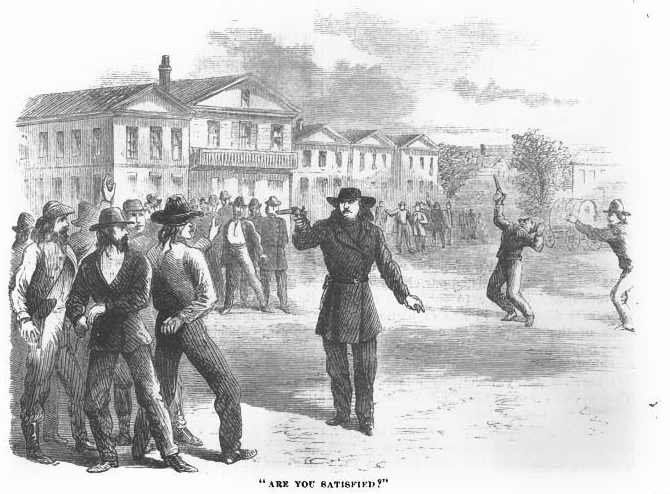
Image: Wild Bill Hickok threatens the friends of Davis Tutt after defeating Tutt in a duel. Harper’s New Monthly Magazine, February 1867. (Public Domain)
On July 21, 1865, Wild Bill Hickok and gambler Davis Tutt engaged in a gunfight in the town square of Springfield, Missouri. It is the first time in the recorded history of the Old West that a one-on-one pistol quick-draw duel took place in public, in the manner later made famous by countless dime novels, radio dramas, and Western films such as High Noon. The shootout story was first written about in an article in Harper’s Magazine in 1867, making Hickok a household name and folk hero.
Tutt and Hickok, both gamblers, had at one point been friends, even though Tutt was a Confederate Army veteran, and Hickok had been a scout for the Union Army. The eventual falling out between the two reportedly occurred over women. There were reports that Hickok had fathered an illegitimate child with Tutt’s sister. At the same time, Tutt had been seen paying great attention to Wild Bill’s paramour, Susanna Moore. When Hickok started to refuse to play any card game that included Tutt, the cowboy retaliated by openly supporting other local card players with advice and money in a dedicated attempt to bankrupt Hickok.
The conflict eventually came to a head during a poker game at the Lyon House Hotel. Hickok was playing against several other local gamblers while Tutt stood by, loaning money as needed and encouraging them to beat Hickok. Hickok was doing very well during the game, and Tutt was irritated that he was losing so much money. Then, Tutt reminded Kickok of a $40 debt from a past horse trade. Hickok shrugged and paid the sum, but Tutt was unappeased. He then claimed that Hickok owed him $35 from a past poker game. Hickok stated that the amount was $25, “I have a memorandum in my pocket.”
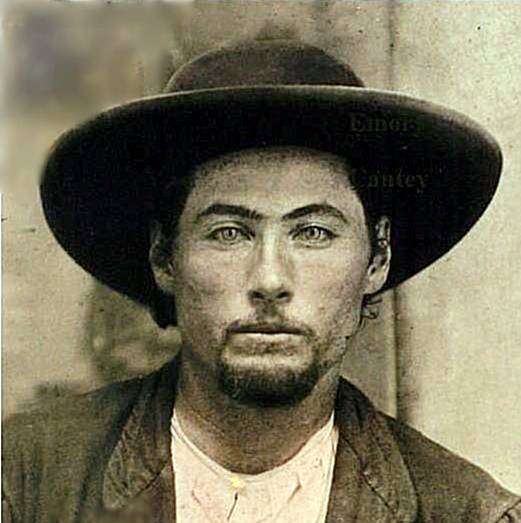
Image: Davis Tutt in the 1860s. (Public Domain.)
During this argument, Tutt grabbed Hickok’s Waltham repeater gold pocket watch off the playing table and said he would keep it until the $35 was duly paid. Hickok was shocked and livid but, being outnumbered and outgunned by Tutt’s friends, he was unwilling to resort to violence at that time. He quietly demanded that Tutt return the watch to the table. Tutt replied with an “ugly grin,” and left the premises with the watch.
After several days of goading by Tutt and his cohorts, Hickok was at his breaking point. When some of Tutt’s supporters stated that Tutt was preparing to sport the watch “in the middle of the town square” the following day, Hickok reportedly replied, “He shouldn’t come across that square unless dead men can walk.” Having made up his mind, Hickok returned to his room to clean, oil, and reload his pistols in anticipation of a confrontation with Tutt the following day.
Although Tutt humiliated his rival, Hickok’s ultimatum forced his hand. To go back on his very public boast would make everyone think he was afraid of Hickok, and so long as he intended to stay in Springfield, he could not afford to show cowardice. The next day, he showed up at the town square at 10 a.m. with Hickok’s prized watch hanging from his waist pocket. The word quickly spread that Tutt was making good on his pledge to humiliate Hickok, reaching Hickok’s ears within an hour.
According to the testimony of Eli Armstrong and two other witnesses, Hickok met Tutt at the square and discussed the terms of the watch’s return. Tutt now demanded $45. Armstrong tried to convince Tutt to accept the original $35 and negotiate for the rest later, but Hickok was still adamant that he only owed $25. Tutt held the watch before Hickok and said he would accept no less than $45. Both said they did not want to fight and went for a drink together. However, Tutt soon left, returning to the square, still wearing the watch.
At 6 p.m., Hickok was seen calmly approaching the square from the south, his Colt Navy in hand. He showed up armed, which caused the crowd to scatter to the safety of nearby buildings, leaving Tutt alone in the square. At about 75 yards, Hickok stopped, facing Tutt, and called out, “Dave, here I am.” He cocked his pistol, holstered it, and gave a final warning, “Don’t you come across here with that watch.” Tutt did not reply but stood with his hand on his pistol.
Both men faced off against each other sideways in the dueling position and hesitated momentarily. Then Tutt reached for his pistol. Hickok pulled his gun and steadied it on his other arm. According to the reports, each man fired a single shot at the same time Tutt’s attempt missed, but Hickok’s bullet hit Tutt between the fifth and seventh ribs on his left side. Tutt yelled, “Boys, I’m killed,” and ran onto the courthouse porch and back into the street, where he collapsed and died.
Hickok was arrested shortly after the gunfight and charged with manslaughter, but he was able to post bail with some friends’ help. At his trial in early August, Tutt’s allies testified that Wild Bill had already approached their friend with his gun and shot him in cold blood. Hickok’s supporters countered that Tutt drew first and that both men fired simultaneously. They presented Tutt’s gun as evidence, missing one bullet from its chamber. The gun was enough for frontier justice to win the day. Proving that the showdown was fair, the jury found Wild Bill innocent after only a few minutes of deliberation.
The killing of Davis Tutt would prove to be Hickok’s ticket to Old West stardom. A few weeks after the standoff, Colonel George Nichols arrived in Springfield and wrote a story about the shooting. One measure truth, another measure tall tale; when the story was printed in February 1867, it immediately became a bestseller. Gushing accounts of Wild Bill’s exploits appeared in several major newspapers, and dime novelists capitalized on the public interest. The Harper’s story made Hickok the most famous man in the West, and he spent the next several years adding to his legend while working variously as a wilderness scout, lawman, “Wild West” show performer, and gambler.
Subscribe to “History Daily with Francis Chappell Black” to receive regular updates regarding new content:
Help us with our endeavors to keep History alive. With our daily Blog posts and our publishing program we hope to inform people in a comfortable and easy-going manner. This is my full-time job so any support you can give would be greatly appreciated.
 History Daily With Francis Chappell Black
Leave a comment